The Principle
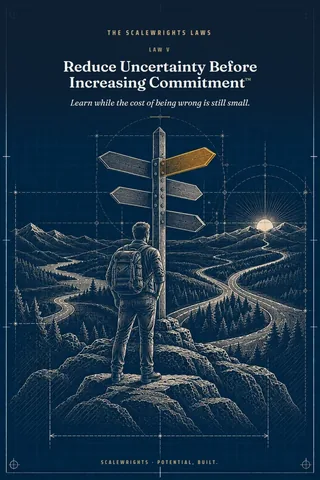
This is how I want you to operate under Law V — Buy Information Before You Buy Scale™: when uncertainty is high, keep the commitment small; when uncertainty falls, you can increase it.
Founders are paid to make decisions before every answer is available. You will not know exactly how the market responds, what the retailer does, what the consumer repeats, or what the next 24 months bring. If you wait until everything is certain, you will wait forever.
So I am not asking you to eliminate uncertainty. I am asking you to manage it intelligently. The mistake is not acting before you know everything. The mistake is committing too much before you know enough.
The question is not "Do we know?"
Ask instead: how much do we know relative to how much we are about to commit? Modest evidence may justify modest action. Strong evidence may justify a larger one.
The most expensive way to learn is at scale. A new functional beverage can be tested with concept work, prototypes, pricing tests, DTC, one geography, or 100 retail doors. Or you can produce 300,000 units and launch nationally. Both may answer the same question. One is far more expensive if wrong. Do not spend scale capital to answer an experimental question.
Small questions deserve small bets
Does the packaging work? Run a small batch. Will consumers pay $39.99? Test it. Does this retailer work? Pilot it. Does this distributor execute? Give limited territory. Does the country have potential? Prove one market. Match the size of the experiment to the size of the question.
Separate facts from beliefs
Build an Assumption Register™ with three columns: what we know, what we believe, what we need to prove. It clarifies strategy immediately.
Repeated assumptions start sounding like facts. “The consumer wants this.” “The retailer should perform.” “Cost will come down.” Ask what new evidence you have. Time passing is not evidence. Repetition is not evidence. Enthusiasm is not evidence.
Find the Kill Assumption™
The Kill Assumption is the assumption that, if wrong, makes the current strategy unattractive or unsafe: willingness to pay, shelf life, retailer economics, manufacturability, working capital, regulatory viability, repeat. Test the assumption that can hurt you most. For a national launch, demand, velocity, margin, working capital, replenishment, quality, and team capacity may all need to be true. Which are facts? Which are estimates? Which are hopes?
Not all uncertainty deserves more research. If we knew the answer, would it change the decision? If no, move on. If yes, investigate. That is the Value of Information™: a $15,000 test that prevents a $400,000 inventory mistake is valuable. The question is not how cheap the research is but how much decision risk it removes.
Reversible decisions can move faster
Small media tests are reversible. Ten-year leases are not. Fractional hires are more reversible than executive commitments. Pilot runs are more reversible than custom packaging orders. The less reversible the commitment, the stronger the evidence should be. Permanent decisions — equity, debt, facilities, manufacturing infrastructure, exclusivity, acquisitions — deserve a higher burden of proof.
Time is also capital. Six months pursuing the wrong channel can cost more than a $50,000 test. Measure not only what a test costs but how fast it produces usable evidence.
Build Learning Velocity™
Learning Velocity is how fast the company converts important unknowns into decision-grade evidence. High-velocity companies ask precise questions, run focused experiments, define thresholds, collect real behavior, stop weak ideas, and increase commitment behind strong ones. Move fast through learning. Increase commitment after learning. Test behavior, not compliments: “I love it” is weaker than purchase, and purchase is weaker than repeat.
Build the Cheapest Credible Test™
The Cheapest Credible Test is small enough to preserve capital, real enough to resemble the decision, and focused enough to answer one primary question. Do not change price, positioning, flavor, packaging, channel, and customer at once. The first batch should be designed the same way: decide what it has to teach — taste, repeat, shelf life, price, manufacturing consistency, velocity — so it produces product and decision-quality evidence.
Minimum Viable Evidence™ is the smallest amount of credible proof necessary to justify the next commitment. The threshold changes with the size and reversibility of the decision.
Stage the commitment
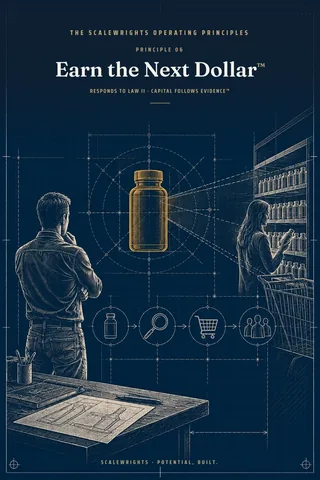
Spend $100,000. Measure. Spend another $200,000 if the threshold is met. Then release more. Each stage earns the next. Milestones should be earned, not calendared: expand when velocity reaches the threshold, hire when the constraint is proven, raise when the milestone and the use of proceeds are clear.
Every test needs a Stop Rule™. Define what would cause you to stop before the experiment begins. That protects you from sunk-cost logic and emotional attachment. Sunk cost does not own the next dollar.
Ego can increase commitment faster than evidence. You announced the launch, told investors, excited the team, and changing direction now feels embarrassing. A strong founder can say: we learned something, the evidence changed, we are adjusting. Be stubborn about the problem and flexible about the solution.
Learning should precede automation, headcount, geography, and dilution. Do not build the plant before proving the need. Do not surrender permanent ownership before asking what additional proof could improve your position.
Build the Learning Gate™
Map uncertainty against impact if wrong, and start with high uncertainty, high impact. Then ask ten questions. What decision are we making? What must be true? What do we know? What remains uncertain? Which uncertainty has the highest impact? What is the Cheapest Credible Test? What is Minimum Viable Evidence? How reversible is the next commitment? What is the Stop Rule? What does success earn?
Then decide: GO · GO SMALL · NOT YET · NOT THIS.
A scaling company runs the Learning Loop™ continuously: QUESTION → ASSUMPTION → TEST → EVIDENCE → DECISION → COMMITMENT → REVIEW → NEW QUESTION.
The Scalewrights view
When uncertainty is high, test. When evidence improves, commit. When the system proves repeatable, scale. When evidence weakens, adjust. When the thesis breaks, stop.
Take the single biggest decision you expect to make in the next 90 days and write nine lines: the decision, what must be true, what we know, what we are assuming, the Kill Assumption, the Cheapest Credible Test, Minimum Viable Evidence, the Stop Rule, what success earns. If you cannot fill those lines in clearly, don’t make the larger commitment yet. You need a better test, not more confidence.
Name your biggest Kill Assumption. Write down the one assumption that, if wrong, makes the current decision unsafe or unattractive — today, in one sentence.
Design the Cheapest Credible Test for it. Define the cost, the time to a usable answer, the owner, the success threshold, and the failure threshold, and cap the test at a figure you could lose without changing the plan.
Define what success earns, before the test runs. If it succeeds, we will commit _. If mixed, we will _. If it fails, we will stop ____. Fill in the three blanks and date the page.
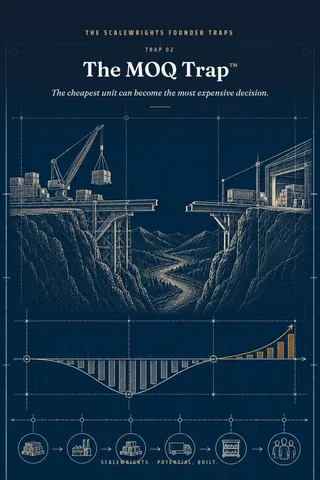
The Assumption Register and the Stop Rule begin in First Batch™ Template 1, 01_First_Batch_Plan.xlsx — the number you can lose and the first-batch arithmetic (MOQ, run-out, cash tied up, the three levers) — with Template 6, 06_First_Hundred_Customers.xlsx, as the cheapest credible test of purchase and Template 7, 07_Velocity_Tracker.xlsx, as the test of repeat, all in the First Batch workbook on Gumroad (scalewrights.gumroad.com/l/first-batch). When the evidence is what you are raising on, The Seed File™ (scalewrights.gumroad.com/l/seed-file) turns it into twelve artifacts an investor can verify.
START · RAISE — the First Batch Check at /first-batch.html before the first run; the Seed Readiness Check at /seed-file.html before the permanent decision.
Take the First Batch Check →