The Principle
This is how I want you to operate under Law II — Capital Follows Evidence™: the stronger the evidence, the larger the commitment you can intelligently make.
Every founder starts with belief. You believe the product should exist, the consumer has a real problem, the formulation is better, the retailer will care, the team can execute. Good. Without belief, nothing gets started.
But I want you to separate conviction from capital allocation. Conviction gives you the courage to begin. Evidence should determine how much you commit next. When evidence is weak, keep the bet small. When it gets stronger, increase the bet. When it becomes repeatable, scale.
You need conviction before proof. You should not treat conviction as proof.
Stop making binary decisions
Should we launch? Hire? Enter retail? Expand internationally? Order 200,000 units? Raise $5,000,000?
Add another question: how much commitment does the evidence justify right now? Maybe the right answer is 100 stores, a fractional leader, 25,000 units, or one country. The best founders make appropriately sized decisions.
Match the size of the bet to the quality of the evidence
The Evidence Hierarchy runs from Level 0 to Level 7: opinion, interest, behavior, purchase, repeat, velocity, economic proof, repeatability. A functional energy gummy begins at Level 0 as a hypothesis. Concept response, sampling, purchase, repeat, velocity, and channel economics move it up the ladder, and as the evidence rises, the size of the investment can rise with it.
Do not fund Level seven behavior with Level one evidence.
Early capital should buy learning
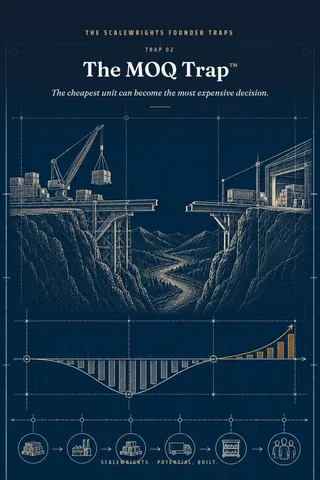
A 25,000-unit run at a higher unit cost may be economically superior to a 150,000-unit run if it answers whether people buy and repeat, whether the packaging works and the formula holds, whether the price is right and the claims land, and whether the retailer performs and the manufacturer executes. The cheapest unit is not always the cheapest decision. Measure learning per dollar committed.
So treat the first batch as an evidence machine. Before you produce it, write down what you need to learn: consumer understanding, taste, packaging, price, reorder rate, the SKU winner, channel performance, complaints, manufacturing issues. The batch should create product and evidence.
Inventory, distribution, hiring, and marketing each follow their own evidence
Inventory is capital with fewer options. Early: smaller runs, higher learning, lower exposure. Later: larger runs, better economics. The inventory curve should follow the evidence curve.
Distribution should follow velocity. A retailer agreeing to take the product is evidence of retailer interest, not proof of consumer demand. The stronger evidence is velocity, reorders, repeat, contribution, promotional efficiency, inventory turns, and retailer retention. Ask whether the existing evidence has earned more doors.
Hiring should follow the constraint. Every hire converts flexibility into fixed cost. Ask what constraint the person solves, whether it is persistent, whether the role is clear, and whether capacity rises more than complexity. Hire the constraint, not the company you admire.
Marketing should follow economics. Revenue rising with spend does not prove the engine works. Know CAC, contribution after acquisition, repeat, retention, payback, incremental lift, and spend saturation.
And channel expansion needs new evidence. DTC does not prove mass retail. Natural does not prove convenience. U.S. retail does not prove Mexico, Colombia, Spain, or Portugal. Each channel has its own consumer behavior, margins, terms, trade spend, logistics, and working-capital needs.
Capital is broader than money
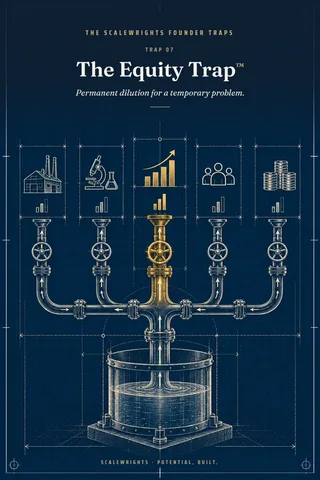
Evidence should govern all Five Capitals — FORHI. Financial Capital: cash, debt capacity, working capital, equity. Operating Capital: systems, capacity, manufacturing, processes. Relational Capital: retailers, suppliers, distributors, investors, partnerships. Human Capital: leadership, talent, time, management attention. Intellectual Capital: knowledge, data, consumer insight, formulation expertise, operating learning.
Debt should follow repayment evidence. It can be excellent against predictable receivables, repeatable inventory turns, and visible repayment. Debt against unproven demand is different: the repayment obligation is certain and the commercial outcome is not. Equity deserves even more discipline, because equity is permanent. Before raising, ask what evidence you could create that would improve valuation, terms, dilution, and control. Raise after proof, before panic.
Define what earns the next dollar
Before the pilot, define the threshold. Before marketing spend, define the economics. Before retail expansion, define velocity. Before the next production run, define sell-through. Before the next country, define proof in the first. Defining the evidence before you see it protects decision quality.
The Capital Ladder™ makes the sequence explicit: Idea → Prototype → Product Proof → Purchase Proof → Repeat Proof → Channel Proof → System Proof → Scale Capital. Each stage should earn the next.
Preserve optionality
Before cash becomes inventory, hires, or infrastructure, it can still become many things. Ask whether the commitment is valuable enough to justify surrendering those alternatives. A small ad test is highly reversible. A ten-year lease is not. The less reversible the commitment, the stronger the evidence should be.
Go Small is a strategy, not a retreat. It means controlling the size of the commitment while evidence is still developing: one region, one channel, one SKU, one retailer, one production run, one distributor, one country. That is staged conviction.
Build an Evidence Register™
For each bet, track the assumption, the evidence, the evidence quality, the capital at risk, the next test, the success threshold, the stop rule, and the next capital decision. This keeps repeated assumptions from turning into truths nobody has tested. When momentum builds, ask what has been proven, what remains assumed, and how much commitment the current evidence justifies.
The Scalewrights view
Great founders are not simply comfortable with risk. They learn how to structure it.
Take the largest capital commitment in front of your company and write four lines: what we believe, what we can prove, what we still need to learn, what we are about to commit. Then ask whether the quality of the evidence justifies the size and permanence of the commitment. If yes, GO. If almost, GO SMALL. If not, NOT YET — design the next test. Don’t abandon the vision. Earn the next bet.
Identify your three biggest current bets. Write down the three largest commitments expected in the next 12 months and the assumptions underneath each. Do it this week.
Grade the evidence. Score each assumption on the Evidence Hierarchy, 0 to 7, and circle every bet that is funding Level five behavior with Level two proof.
Define what earns the next commitment. For each bet, write the next test, the smallest credible version of it, the result that counts as success, the capital it justifies, and the result that means stop — one page, before the next dollar leaves.
The Evidence Register starts in First Batch™ Template 1, 01_First_Batch_Plan.xlsx — the number you can lose, the cost to the first shipment, and the first-batch arithmetic (MOQ, run-out, cash tied up) — with Template 7, 07_Velocity_Tracker.xlsx, supplying the Level five evidence a second run has to earn. Both are in the First Batch workbook on Gumroad (scalewrights.gumroad.com/l/first-batch). When the evidence is strong enough to raise on, The Seed File™ (scalewrights.gumroad.com/l/seed-file) is the twelve artifacts an investor can verify without taking your word for anything.
RAISE — score the file first with the Seed Readiness Check at /seed-file.html (Series A: /series-a.html). The rule itself holds at every door.
Take the Seed Readiness Check →