The Trap
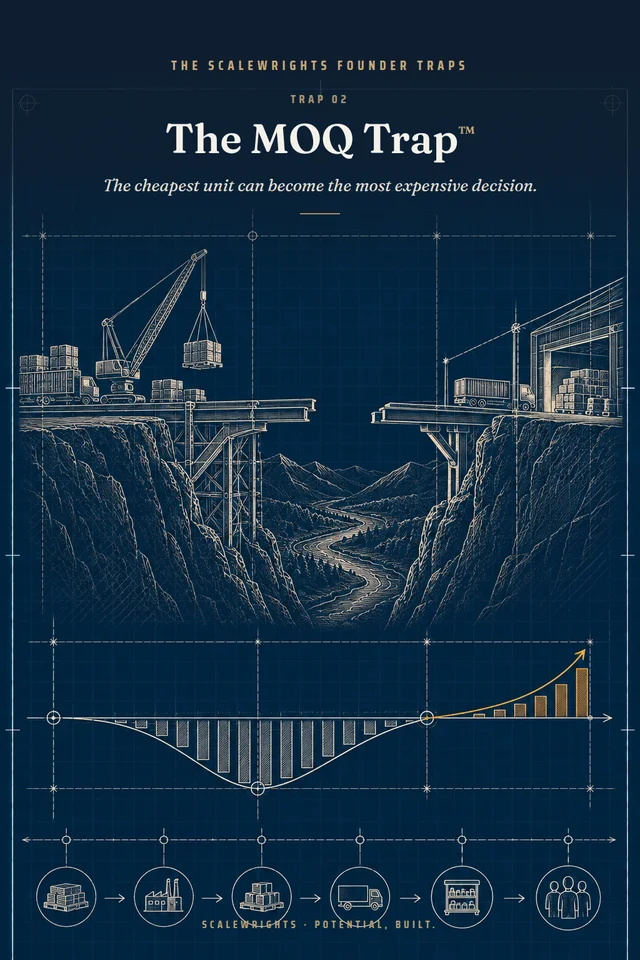
The co-packer’s quote arrives as a table with three rows, and the third row has the lowest number in it. You are a founder who has just spent months learning that margin is everything, and here is 62 cents of margin per unit, available today, for the price of ordering more. Ordering more is not even hard. It is one number on a purchase order. The MOQ Trap™ is the most rational-looking mistake in consumer products.
Law III — Growth Eats Cash First™ — names the mechanism: inventory is cash wearing a box. A larger run lowers the unit cost and raises the cash exposure, and the second effect is the one that decides whether you are still in business when the unit cost matters. Law V — Buy Information Before You Buy Scale™ — names the other half. A first run is a bet placed with the least information you will ever have. The MOQ tier turns a small bet into a large one, permanently.
The plant is not trying to trap you. The plant has a line to fill, and its economics improve with run length. Yours may not. The quote shows the price of a unit. It does not show the price of the units you will not sell.
The tell
- You can quote your unit cost from memory and cannot say how many weeks of stock the run represents.
- The run size was chosen from the price sheet, not from a velocity number you measured.
- Shelf life is a number on the label, not a number in the cash plan.
- The second run is a date on the plant’s calendar before the first run has a sell-through number.
- “We’ll grow into it” is the answer to how long the inventory lasts.
The arithmetic
A gummy founder has evidence of 1,200 units a month — a real number, from a real store list and a small direct site. The product carries 18 months of shelf life. The co-packer quotes three tiers.
| Run | Unit cost | Cash to the plant | Months of stock at 1,200 a month | Units past 18 months | Written off |
|---|---|---|---|---|---|
| 10,000 | $2.10 | $21,000 | 8.3 | 0 | $0 |
| 25,000 | $1.72 | $43,000 | 20.8 | 3,400 | $5,848 |
| 50,000 | $1.48 | $74,000 | 41.7 | 28,400 | $42,032 |
The third row “saves” 62 cents a unit — $31,000 across 50,000 units, if every unit sells. At the demand you can prove, 28,400 of them expire on the shelf. The cheap run costs $53,000 more in cash on the day of the deposit and $42,032 in write-offs at month 18, and it takes three and a half years to sell down, which means the next reformulation, the next label change, and the next price move all wait behind the inventory.
The small run costs 62 cents more a unit and is gone in eight months. By then you know the velocity, the repeat rate, and whether the flavor is right. The second run can be 25,000 units on evidence instead of 50,000 on a price sheet.
Hypo Energy’s first run was 150,000 units at $0.62 because 150,000 was the plant’s minimum, not because 150,000 was the demand. It tied up about $88,000 at the first shipment and set the date of the second run before the first had a sell-through number. The book is named for that arithmetic.
The fix
Law III’s rule is to finance the distance between spending the money and getting it back — and a larger MOQ lengthens that distance on both ends. Law V’s rule is that the less you know, the less you should permanently commit, and a production run fails the Reversibility Test™ the moment the filler starts.
Draw the Cash Conversion Map™ for each tier: deposit date, release date, first shipment, first collection, sell-out. Then run the Cash Gate™ with the tier as the variable. How much cash leaves? When? When is the next production commitment required? What happens at 50 percent of forecast?
Negotiate the MOQ, the tier, or the terms before the deposit, in that order. A plant that will not move the minimum will often move the deposit from 50/50 to 30/70, or hold the tier price across two runs in a quarter. The Gate answer this usually produces is GO SMALL — the smallest run that answers the question, at a unit cost you can carry until the answer arrives.
Divide every quoted run size by your measured monthly demand and write the months of stock next to the price, today.
Set a rule: no run longer than nine months of proven demand or half the shelf life, whichever is shorter.
Ask the plant for one of three things before the deposit — a lower minimum, a 30/70 deposit, or the tier price held across two runs — and get the answer in writing within two weeks.
The First Batch™ Workbook’s Template 1, 01_First_Batch_Plan.xlsx, holds the first-batch arithmetic: the MOQ, the run-out, the cash tied up, and the three levers. Template 3, 03_Co-Packer_Comparison_and_Run.xlsx, puts three quotes on one grid as landed cost and cash at risk, and Template 8, 08_Cash_Cycle_and_12_Month_Plan.xlsx, shows the month the run’s deposit and the second run’s deposit both land. The Honest Arithmetic card is the four numbers before any of it. Start with the check at /first-batch.html.
START — this trap belongs to First Batch. Take the check at /first-batch.html.
Take the First Batch Check →