The Principle
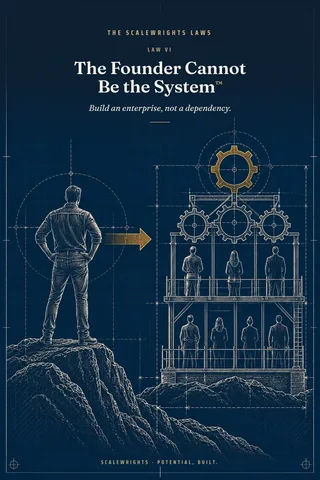
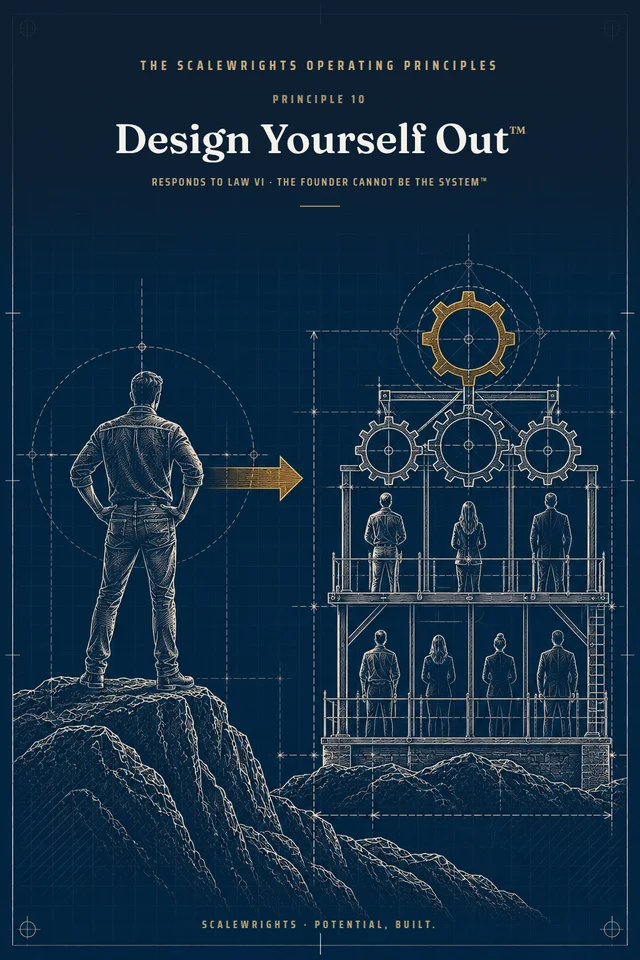
This is how I want you to operate under Law VI — The Founder Cannot Be the System™: I want the company to benefit enormously from your judgment, and I do not want the company to require your judgment for routine survival.
There is a point in almost every founder-led company where the founder becomes the most important operating system in the business. You know the customers, suppliers, numbers, formulas, people, and history, so people come to you for answers, approvals, exceptions, decisions, reassurance, and rescue. Early on, that is often necessary. Later, it becomes a constraint.
That is the difference between founder-led and founder-dependent.
This is different from "The Founder Is Not the Business"
The Founder Is Not the Business.™ was the belief. This Principle goes one level deeper, into operating architecture: where does the company still literally depend on you to function? Founder dependency is measurable. Anything measurable can be improved.
The org chart may show CEO, CFO, COO, Sales, Operations, Finance. But reality says Founder. When something is important, unusual, expensive, or risky, it comes back to you. That is hidden architecture.
Founder dependency is not the same as founder value. I want you highly valuable. A founder creating disproportionate strategic value is an asset. A company unable to make a routine pricing decision because the founder is on a plane is a weakness.
Start with the Founder Test™
If you were unavailable for 30 days, can payroll run, production run, inventory be ordered, quality issues be handled, pricing decisions be made, cash be managed, hiring continue, and investors be updated? Every “no” identifies unfinished infrastructure.
In The Build Line™, Hypo Energy’s founder is out of the building for two weeks at month 36. Nothing catches fire. Nothing moves either: 41 decisions wait for him, and the lead investor prices the company accordingly — a company plus the founder is worth less than a company.
Build the Founder Dependency Index™
Score each function from 0 to 4: 0, founder not required; 1, founder informed; 2, founder advises; 3, founder approves; 4, founder personally drives. Apply it to sales, customer relationships, pricing, product, operations, supply chain, quality, finance, cash, forecasting, hiring, strategy, capital raising, supplier relationships, culture, and major decisions. If you are a 3 or a 4 almost everywhere, that is a structural dependency problem.
One approval. One relationship. One spreadsheet. One exception. Individually, none seems serious. Collectively, they make the organization move only as fast as founder attention. That is the Founder Bottleneck™. Look for the decision queues.
Transfer decisions, not just work
If people prepare but you still decide, the team is doing more while you still own the operating system. Build explicit decision rights: for recurring important decisions, define who decides, who recommends, who must be consulted, and who must be informed. Unclear decisions climb upward. Authority should equal accountability: do not hold someone accountable for an outcome while withholding the authority required to produce it.
Use guardrails instead of permission. Give leaders clear economic limits, thresholds, and escalation conditions. Controlled autonomy is stronger than “ask the founder.”
Exceptions are where dependency hides
The easy work gets delegated first. The unusual work stays with you. Every significant exception should produce a principle, a threshold, or a process. The next person should know more because you handled the last one.
Principles scale better than endless rules. Protect quality before protecting the shipment. Protect liquidity before chasing marginal revenue. Do not scale weak economics. Raise bad news early. These let founder judgment travel through the company.
Teach your thinking — why a variable mattered, why you accepted a risk, why you said not yet. Keep a Decision Log™ — evidence, assumptions, alternatives, owner, rationale, result — so “the founder remembers” stops being the company’s knowledge system.
Relationships have to transfer too. Broaden retailer, manufacturer, investor, and supplier relationships; turn personal goodwill into Relational Capital. If the VP Sales becomes the only person who knows the customer, you moved the risk rather than eliminated it.
Build the Owner Map™
For revenue, margin, cash, inventory, forecast, quality, production, top customers, hiring, and technology, assign a primary owner, a backup owner, a core metric, decision authority, an escalation threshold, and the founder’s role. Every blank box is a structural question.
Documentation alone is not transferability. A process has transferred when someone else can run it without the founder, achieve the expected result, and handle normal exceptions. That is the Transferability Test™.
The founder should move up the value chain
Less routine approval, firefighting, and pricing exceptions. More strategy, capital allocation, leadership, culture, and enterprise design. Hire people who can take territory from you; that is a feature. Trust can follow evidence, in stages: execute, recommend, decide with review, decide independently, teach.
Run the Founder-Free Day™. Become intentionally unavailable for routine decisions for one day. Observe what stops, waits, escalates, or lacks information. Fix it. Later, test a week.
Transferability creates freedom and value
The Transferability Gap™ is the difference between what the founder carries and what the enterprise can carry without the founder. It should shrink as the company scales.
A transferable company gives you options: acquisitions, a chairman role, travel, family, sale, hold, or continued operation. Your involvement becomes chosen rather than required. And a buyer would rather own a company with strong management, shared relationships, clean decision rights, and documented systems than one dependent on the seller. The Market Pays for What It Can Verify™.
So write the Founder Transfer Plan™. For every significant responsibility you still own: what I own, why I still own it, who should eventually own it, what authority and guardrails they need, what evidence shows readiness, and the target transfer date. Then run the Founder Dependency Gate™: what still requires the founder, which of those items are truly strategic, which are unresolved dependency, and what proves transferability.
The Scalewrights view
The company should not need you to prove you matter. If the company makes a good decision without you because you hired the right person, taught the right principle, built the right process, and gave the right authority, you did that. That is leadership.
The founder should increasingly become architect, not infrastructure; allocator, not approval queue; teacher, not answer machine; leader, not permanent shock absorber. Your personal operating load should not have to rise at the same rate as revenue.
Build your Founder Dependency Index this week. Score all 16 functions from 0 to four and circle every three and 4.
Build the Owner Map for your five most important outcomes. Fill in primary owner, backup owner, decision authority, metric, escalation threshold, and founder role, and date every blank box.
Transfer one complete decision within 30 days. Not a task — a decision, with context, authority, guardrails, and accountability. Keep a seven-day list of everything that still comes to you, sorted into “only I should own this,” “someone else should eventually own this,” and “this should not require a person at all.”
The seven-day list is The Build Line Template 3, 03_Decision_Inventory_and_Rights.xlsx — the two-week log of every decision that waited on you, the decision-rights matrix with limits by role, and the six the founder keeps — with Template 4, 04_Role_Charters_and_Span.xlsx, for the Owner Map and Template 11, 11_Bench_and_Succession.xlsx, for the backup owner and the founder’s own cover, all in the Build Line workbook on Gumroad (scalewrights.gumroad.com/l/build-line). When a letter arrives, The Summit™ (scalewrights.gumroad.com/l/summit) shows how a buyer’s team prices the dependency you did not remove.
SCALE · SELL — the Scale Readiness Check at /build-line.html now; the Summit Check at /summit.html when the letter comes.
Take the Scale Readiness Check →