The Law
Every founder makes decisions with incomplete information. The goal is not certainty. The goal is to make sure the size and permanence of the commitment match how much you know.
When uncertainty is high, the commitment should stay small. When uncertainty falls, commitment can rise.
The mistake is not acting before certainty. Nobody who waits for certainty starts a company. The mistake is committing too much before learning enough.
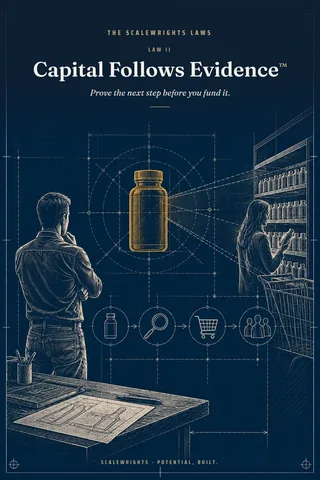
Readers of The Build Line™ will know this Law by its readiness corollary, printed there as Law II: you cannot control the weather, only your readiness for it. Same rule, said from the operator’s chair — the weather is the uncertainty, and readiness is the commitment sized to it.
I. Founders are paid to decide under uncertainty
Entrepreneurship is not a certainty business. At the start the founder does not know whether the product will work, whether customers will care, pay, or repeat, whether the manufacturer can execute, or whether the market is ready.
Conviction is useful. Certainty is usually fiction. A founder who claims to have it has usually stopped counting the assumptions, and this Law is written for that founder.
II. How much do we know relative to how much we are about to commit?
That is the question, and every instrument in this Law is a way of answering it.
Modest evidence can justify action, but the action should be small enough that being wrong is survivable. As evidence grows, the bet can grow. As knowledge strengthens, the decision can become less reversible. The founder manages the ratio between the two, not either one alone.
III. The Uncertainty–Commitment Curve™
The Uncertainty–Commitment Curve plots that relationship. At high uncertainty: low capital, a short time horizon, high reversibility, small scope, fast feedback. As uncertainty falls: more capital, longer commitments, broader scope, greater infrastructure, then scale.
If commitment rises faster than knowledge, the company is speculating. If knowledge rises but commitment never increases, the company becomes timid. The second failure is more common than it looks, because it feels like prudence.
IV. Uncertainty is not one thing
Map the kinds of uncertainty separately: market, product, pricing, channel, operating, financial, people, timing, and regulatory.
Different uncertainties require different tests. A taste panel says nothing about retailer economics. A pilot in one chain says nothing about the co-packer’s ability to run 10 times the volume. A founder who reports “we’ve tested it” has usually tested one of the 9.
V. The Value of Information™
Before paying for information, ask what decision it could change. If the answer is none, do not buy it. Research that confirms a decision already made is a receipt, not an input.
If a $20,000 test can prevent a $500,000 mistake, the information may be extraordinarily valuable. That is the Value of Information: the cost of the decision it protects, weighed against the cost of finding out.
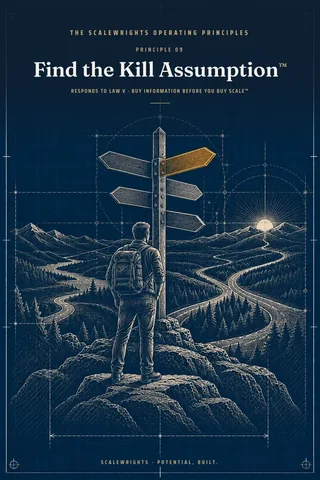
VI. Test the Kill Assumption™ first
The Kill Assumption is the assumption that, if false, makes the current strategy fundamentally unattractive or unsafe. Examples include willingness to pay, retailer economics, manufacturability, regulatory viability, working-capital requirements, shelf life, and repeat purchase.
Do not spend heavily solving secondary issues while a foundational assumption remains untested. Perfecting the label for a product whose price the shopper will not pay is work done in the wrong order.
VII. Ask "What must be true?"
List what must be true for the decision to work. Then separate the facts from the estimates and the hopes.
Keep three columns: what we know, what we believe, what we need to prove. Most plans, written out this way, have a short first column and a long third one. That is not a reason to stop. It is the list of tests.
VIII. The Assumption Register™
For each major initiative, the Assumption Register records the assumption, why it matters, the current evidence, the confidence level, the downside if wrong, the cheapest useful test, the owner, the decision date, and the next commitment if proven.
It is the third column from the previous section with a name and a date beside every row. Law II — Capital Follows Evidence™ keeps the Evidence Register™ for the same initiatives.
IX. Reversibility changes the burden of proof
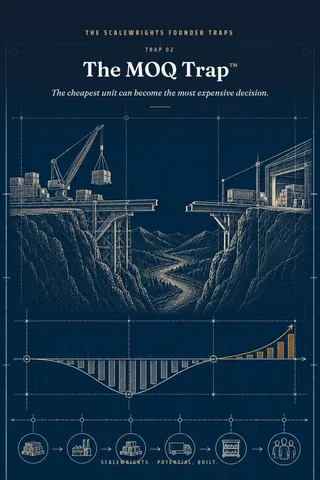
A small ad test can stop tomorrow. A 10-year lease cannot. A pilot run can be adjusted. A large equipment purchase is harder to unwind, and a co-packer minimum signed for the year is harder still.
The less reversible the decision, the stronger the evidence required. Reversible decisions can tolerate weaker evidence, which is the reason to prefer them while the evidence is weak.
X. Learning Velocity™
Learning Velocity measures how quickly the company converts uncertainty into decision-grade evidence.
High-velocity companies run focused tests, define thresholds in advance, get feedback quickly, make decisions, stop weak ideas, and scale strong ones. Low-velocity companies run the same tests and then discuss the results for a quarter. The company that learns faster reaches the right bet with more capital in hand.
XI. Minimum Viable Evidence™
Minimum Viable Evidence is the smallest amount of credible evidence required to justify the next decision. Not perfect proof. Enough proof.
The threshold depends on the size and reversibility of the next commitment. A $5,000 sampling program needs a good instinct and a spreadsheet. A $400,000 production run needs repeat-purchase data from real shoppers. Set the threshold before the test, in writing.
XII. Staged Commitment™
Break large bets into smaller gates wherever practical. Commit, evaluate, then release more capital only when the thresholds are met. That is Staged Commitment.
Staging creates option value. A $1,000,000 launch staged in four tranches gives the company three chances to stop, redirect, or accelerate with better information. The full launch gives it one decision, made at the moment of maximum ignorance.
XIII. The Stop Rule™
Every meaningful experiment should define the condition that tells the company when to stop allocating resources. That is the Stop Rule, written before the experiment begins, when nobody is attached to the answer.
Sunk cost is not evidence. Past commitment should not force future commitment. The $200,000 already spent on a channel is a reason to read the results carefully, not a reason to spend the next $200,000.
XIV. The Cheapest Credible Test™
The best test is not automatically the cheapest. It is the smallest test that resembles reality closely enough to inform the decision: the Cheapest Credible Test.
A survey is cheap and proves willingness to say yes. A paid sample in a real store proves willingness to pay. Minimum effort is not the goal. Minimum Viable Evidence is, and the cheapest test that reaches it is the right one.
XV. The Uncertainty Matrix™
Classify every assumption on two axes: how uncertain it is, and how much damage it does if wrong. The Uncertainty Matrix has four cells, and one of them matters most.
Highest priority is high uncertainty and high impact. That is where the next experiment belongs, and where the Kill Assumption nearly always sits. Low-uncertainty items do not need a test. Low-impact items do not deserve one yet.
XVI. The Learning Gate™
Before the next commitment, run the Learning Gate. What decision are we making? What must be true? What do we know? What remains uncertain? Which uncertainty has the highest impact? What is the Cheapest Credible Test? What is Minimum Viable Evidence? How reversible is the next commitment? What is the Stop Rule? What does the next stage earn?
Then choose: GO · GO SMALL · NOT YET · NOT THIS. Go Small is a learning strategy.
XVII. The Learning Loop™
Question → assumption → test → evidence → decision → commitment → review → new question.
A scaling company moves through the Learning Loop continuously. Each pass converts one assumption into evidence and earns the next, larger commitment. The loop never closes, because every commitment creates new uncertainty at the next scale. A passed test is not the end of learning. It is the next question.
The less you know, the less you should permanently commit.
We believe founders must act before certainty.
We believe they do not need to bet the company while doing it.
We believe uncertainty should be named.
We believe assumptions should be separated from facts.
We believe the highest-impact uncertainty should be tested first.
We believe small questions deserve small bets.
We believe pilots should be small enough to protect capital and real enough to teach.
We believe Minimum Viable Evidence is more useful than perfect certainty.
We believe reversible decisions can tolerate weaker evidence, and irreversible decisions require stronger evidence.
We believe every experiment needs a Stop Rule.
We believe sunk cost is not evidence.
We believe founders should remain stubborn about important problems and flexible about solutions.
We believe Go Small is a learning strategy.
Write the Kill Assumption for your current plan in one sentence today, and design the Cheapest Credible Test for it by the end of the week.
Build an Assumption Register with at least 10 rows, each with a confidence level, an owner, and a decision date within 90 days.
Before the next commitment above $50,000, write the Stop Rule and the Minimum Viable Evidence threshold on the same page, and date both.
The First Batch™ Workbook, Template one — the First Batch Plan, opens with the number you can lose and works through the first-batch arithmetic: MOQ, run-out, cash tied up, and the three levers: the size of a survivable bet. Template seven — the Velocity Tracker is the Cheapest Credible Test for demand: a row per door, four weeks of units, and the count below the line. Both are at scalewrights.gumroad.com/l/first-batch. The Seed File™ Workbook, Template 11 — the Lessons Register (scalewrights.gumroad.com/l/seed-file), gives every failed test its receipt.
Open the workbook →START · RAISE — this Law belongs to First Batch and The Seed File. Take the First Batch check at /first-batch.html or the Seed check at /seed-file.html.
Take the First Batch Check →