The Trap
The cash forecast shows a hole in month four. The second run’s deposit and the distributor’s net-60 have lined up the wrong way, and for about five months the company is $400,000 short. You know an investor who has said “call me when you’re raising.” So you raise. It is the fastest, cleanest, most respectable way to make the hole go away, and it comes with a press release.
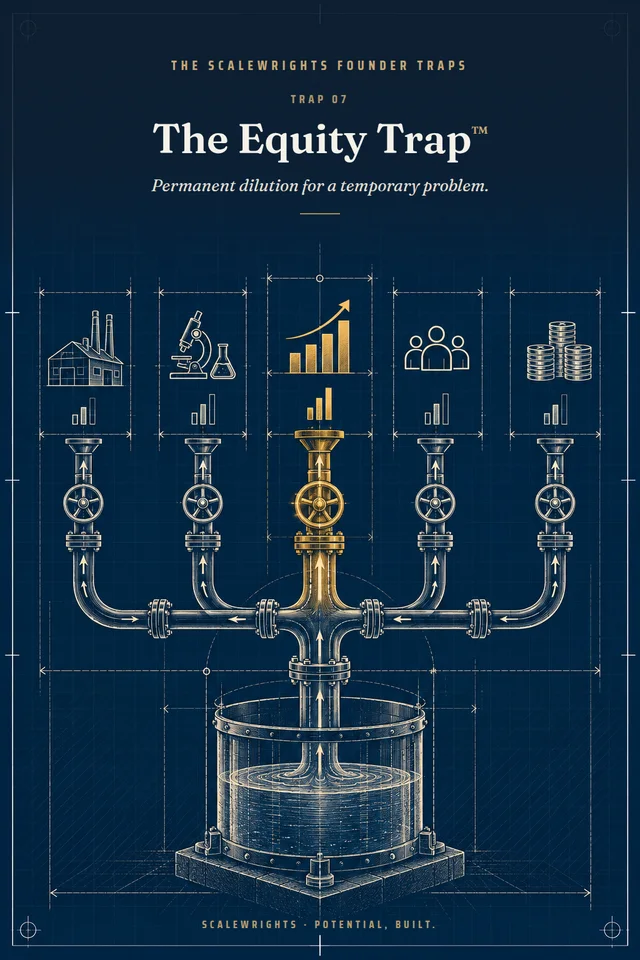
The Equity Trap™ is Law III — Growth Eats Cash First™ — solved with the wrong instrument. The working-capital gap is a timing problem. It has a start date and an end date, and when the receivable lands, it is over. Equity has no end date. Law II — Capital Follows Evidence™ — says a dollar of cash can be earned again, and ownership surrendered today may never return.
You are not being careless. You are being tired, which is different, and the raise is the option that requires the least explaining. The trap is that the problem is five months long and the solution is forever.
The tell
- The raise was sized to the hole in the cash forecast, not to a milestone the company needs to reach.
- The deck’s use of funds says “working capital” in the first line.
- You cannot say which rung of the Capital Ladder you are on — purchase proof, repeat proof, channel proof — because nobody asked.
- Nobody has called the plant about the deposit split or the distributor about early-payment terms.
- The valuation conversation is happening while the company is below its Working-Capital Waterline™, which is the worst place to have it.
The arithmetic
The gap is $400,000 for five months. Here is what closing it costs, four ways. None of this is advice on which to use; each one is a term to take to counsel and your accountant. It is arithmetic.
| Way to close the gap | What it costs |
|---|---|
| Sell 15% of the company: $600,000 at a $4,000,000 post-money | 15% of every future dollar. If the company is later worth $30,000,000, that is $4,500,000 |
| Finance the receivables at 2.5% a month on $400,000 for 5 months | $50,000, then it is over |
| Move the plant’s deposit from 50/50 to 30/70 on a $300,000 run | $60,000 less cash at scheduling, shifted to release |
| Offer the distributor 2% for net-15 on $1,200,000 of invoices | $24,000, and the cash arrives 45 days sooner |
The last two do not close the gap alone. Together they move $60,000 of cash out later and bring $1,200,000 of cash in six weeks earlier, and on the Cash Conversion Map™ that is most of the hole. The receivables line closes the rest, at a cost that is a rounding error next to the first row. The first row is only the right answer if the money is buying something that lasts as long as the dilution does.
Which is the point of the Capital Ladder™: Idea, Prototype, Product Proof, Purchase Proof, Repeat Proof, Channel Proof, System Proof, Scale Capital. Equity raised at the Purchase Proof rung, before repeat and channel economics are in evidence, is raised at the lowest valuation the company will ever have and with the least to show for it. Raise after proof, before panic. A working-capital hole in month four is panic, with a deck.
The fix
Law III’s rule is to finance the distance between growth and payment — with an instrument shaped like the distance. Law II’s rule is that capital follows evidence: the raise should be sized to a milestone, timed to the evidence that improves the terms, and made while the runway still lets you negotiate.
Draw the Working-Capital Waterline: the minimum cash below which the company stops making decisions from strength. Then solve the gap while it is still a forecast — at ninety days out you can move terms, stage the run, finance the receivable, or slow the plan; at Friday, you beg. Run the Capital Gate™ on the raise itself: What are we trying to prove with this money? What is the smallest amount that proves it? How reversible is it? Equity fails the last question by definition.
The Gate answer this usually produces is NOT YET on the equity and GO on the terms — the deposit, the discount, the receivables line — with the raise moved to the rung where the evidence is, six to nine months out, and sized to what that evidence earns. Principle 06 — Earn the Next Dollar™ — is the same sentence.
Set the Working-Capital Waterline in dollars this week and put it on the 13-week cash as a line, not a note.
Before any raise, make three calls in 10 days — the plant on the deposit split, the distributor on early-payment terms, a lender on a receivables line — and write down what each costs.
Size the next raise to a named milestone on the Capital Ladder and a date, and refuse to open the round more than 90 days before the evidence for that rung exists.
The Seed File is the check for this door: what a first check should buy, and what the company should be able to show before it asks. The First Batch™ Workbook’s Template 8, 08_Cash_Cycle_and_12_Month_Plan.xlsx, shows the five dates and the minimum-cash month, and Template 9, 09_Entity_and_Cap_Table_Day_One.xlsx, previews what a first check converts to. Template 10, 10_Distributor_Terms_Sheet.xlsx, is where the early-payment ask goes. If the company is past seed, the Build Line™ Workbook’s Template 17, 17_Capital_Readiness_Law_I.xlsx, has the “what it buys” page with the cheaper-instrument column beside every line. Start with the check at /seed-file.html.
RAISE — this trap belongs to The Seed File. Take the check at /seed-file.html.
Take the Seed Readiness Check →