The Trap
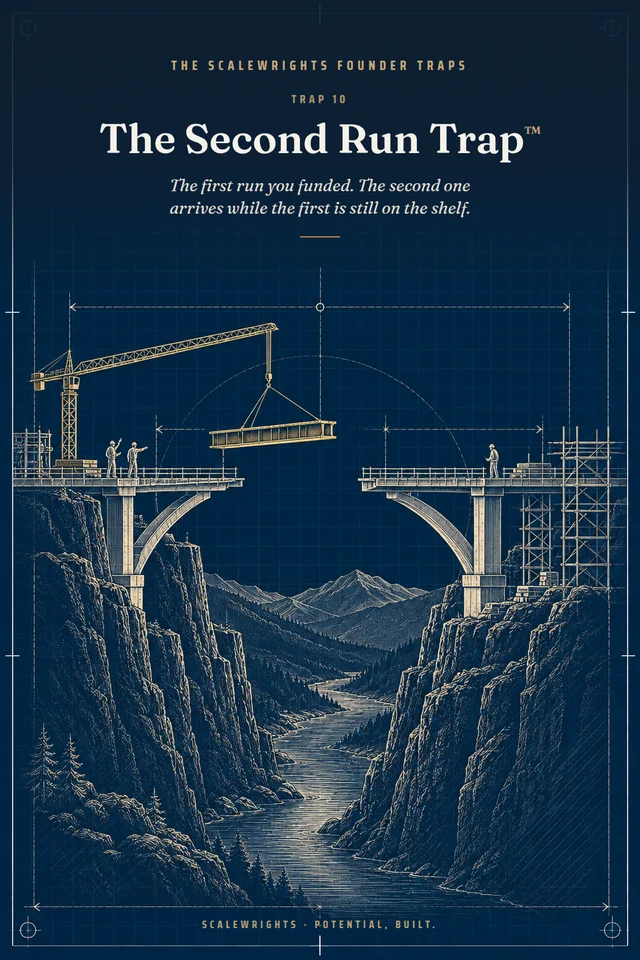
You planned the first run to the dollar. The deposit, the balance at release, the freight, the free fills — it was all in the plan, and the plan was funded. What the plan did not have was a second row. The product is selling. The distributor is reordering faster than the forecast. And the plant needs the next deposit ten weeks before the shelf empties, which is nine weeks before the distributor pays for what is on it now. The Second Run Trap™ is the working-capital gap, arriving on schedule, in the middle of good news.
Law III — Growth Eats Cash First™ — says the company is often funding the next production cycle before the previous one has converted to cash. That sentence is the entire trap. Law IV — Success Can Kill the Company™ — explains why it hits the companies that are working: the faster the product moves, the sooner the second run is due, and the further ahead of the first check it lands.
You are not surprised by the second run. You are surprised by its date. The first run was counted forward from the deposit. The second has to be counted backward from the empty shelf.
The tell
- The cash plan ends at the first shipment.
- You know the day the first receivable is due and not the day the second deposit is.
- The distributor’s reorders are ahead of forecast and that is the only way anyone has described it.
- The plant’s lead time is a number the plant knows and you do not.
- You are thinking about the second run as a purchasing decision, not a financing one.
The arithmetic
A first run of 100,000 units at $1.20, half at scheduling and half at release, eight weeks apart. The distributor takes the run in three POs at $2.20 a unit, pays net-60, and net-60 runs 75 days. The product moves at 10,000 units a week from the first shipment, so the shelf is empty at week 20 — which means the second run has to be scheduled at week 10, the same week the first shipment leaves. Opening cash is $200,000.
| Week | What happens | Out | In | Balance |
|---|---|---|---|---|
| 0 | Run 1 deposit (50%) | $60,000 | $140,000 | |
| 8 | Run 1 balance at release | $60,000 | $80,000 | |
| 10 | PO 1 ships, 40,000 units invoiced at $88,000 · Run 2 deposit · freight | $62,000 | $18,000 | |
| 14 | PO 2 ships, 30,000 units invoiced at $66,000 · freight | $2,000 | $16,000 | |
| 18 | PO 3 ships, 30,000 units invoiced at $66,000 · Run 2 balance · freight | $62,000 | −$46,000 | |
| 21 | PO 1 paid | $88,000 | $42,000 | |
| 25 | PO 2 paid | $66,000 | $108,000 | |
| 29 | PO 3 paid | $66,000 | $174,000 |
By week 18 the company has invoiced $220,000, sold through its entire first run, shown $100,000 of gross margin on paper, and is $46,000 overdrawn. Cash out before the first dollar in: $246,000, against a plan that funded $120,000. The hole lasts three weeks — long enough to miss a payroll, lose the plant’s slot, or take the check you should not take, which is the Equity Trap™, one door down.
Now the Upside Stress Test™. At 125 percent of velocity the shelf empties at week 18, the second run has to be scheduled at week eight — the same day as the first run’s balance — and the third run’s deposit is due at week 16, before the first PO is paid. The hole is $106,000 wide by week 16 and does not close until week 24. Success moved the deposits forward and the receivables barely moved at all.
The fix
Law III’s rule is to finance the distance between growth and payment, and to solve the cash problem while it is still a forecast. A rolling 13-week cash forecast built in week five shows the week-18 hole with thirteen weeks to work on it. At thirteen weeks out you can stage the run, move the deposit, change the terms, or arrange a line. At week 17, you beg.
Run the Cash Gate™ on the second run before the first ships. How much cash leaves, and when? When does the customer pay? When is the next production commitment required? What is peak cash need — here, $246,000, not $120,000 — and what happens at 125 percent?
Then Go Small on the run, not the ambition. Stage the second run at 60,000 units, take the tier hit, and ask the distributor for 2 percent for net-15 on the first PO. Rerun the table: the week-18 balance goes from −$46,000 to about +$83,000, and the third run gets sized on evidence from the second. The Gate answer this usually produces is GO SMALL. Principle 07 — Fund the Gap™ — says celebrate the order, then finance what the order requires. The second run is what the first order requires.
Count backward from the empty shelf today: sell-through per week, plant lead time, and the date of the second deposit — and write that date on the same page as the first receivable’s due date.
Build the 13-week cash forecast the week the first run is scheduled, and update it every Monday; the second run’s two payments go on it as known commitments, not as a note.
Before the first deposit, get three numbers from the plant in writing — lead time, deposit split, and the price if the second run is half the first — so the second run can be sized to cash, not to the tier.
The First Batch™ Workbook’s Template 8, 08_Cash_Cycle_and_12_Month_Plan.xlsx, is built for this trap: the five dates and the days between them, the run, the first collection, the second run’s deposit, and the minimum-cash month. Template 3, 03_Co-Packer_Comparison_and_Run.xlsx, holds the run schedule counted back from the ship date, and Template 10, 10_Distributor_Terms_Sheet.xlsx, is where the net-15 ask lives. Later, the Build Line™ Workbook’s Template 7, 07_Management_Report_Pack.xlsx, carries the 13-week cash forward. Start with the check at /first-batch.html.
START — this trap belongs to First Batch. Take the check at /first-batch.html.
Take the First Batch Check →