The Law
Every founder starts with belief. A product should exist. A customer has a problem. A channel is opening.
Belief is where entrepreneurship begins. It is not where capital allocation should end. Every meaningful step asks the founder to exchange something valuable for something uncertain: cash for inventory, equity for financing, payroll for capability, marketing dollars for demand.
The commitment is real. The outcome is not. Weak evidence deserves a small bet. Strong evidence can justify a larger one. No evidence should ever be treated like certainty.
I. Every company begins as a hypothesis
At the beginning, almost everything is an assumption. We think the customer cares. We think the price works. We think consumers will repeat. We think the retailer will reorder. We think the manufacturer can scale.
The founder’s job is not to eliminate uncertainty before acting. It is to replace assumptions with evidence before increasing the size of the bet. Question → test → evidence → decision → capital. Capital comes last because it cannot be taken back.
II. Do not spend scale capital to answer experimental questions
There are two ways to discover that an assumption is wrong. Test it cheaply, or discover it after scaling it. The second is far more expensive, and it is the one most companies use.
A founder who validates taste, price, conversion, repeat, and channel economics before a large run may look less aggressive than one who orders 200,000 units immediately. In reality, the first founder is structuring risk more intelligently.
III. Early capital should buy information
Early capital has a second job beyond buying things. It should buy answers.
A $30,000 pilot can be superior to a $300,000 production run if it answers whether customers will buy, repeat, and support the economics. The relevant metric is not only cost per unit. It is learning per dollar committed.
Early capital buys learning. Later capital buys scale. Reverse the order and you pay scale prices for pilot lessons.
IV. The Founder Commitment Gap™
The Founder Commitment Gap is the distance between the moment the company commits and the moment it knows whether the commitment was right. Sign the production agreement in March; learn whether the product sells in September. The gap is six months.
The wider the gap and the larger the commitment inside it, the greater the exposure. So keep commitments smaller while uncertainty is high. Shorten learning cycles. Stage capital. Increase commitment only when evidence earns it.
V. Capital is more than cash
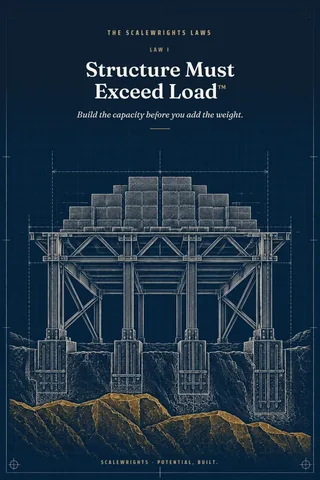
Scalewrights treats capital broadly: Financial, Operating, Relational, Human, and Intellectual (FORHI), the Five Capitals that Law I — Structure Must Exceed Load™ calls the structure.
A bad retail expansion can consume all five at once: it drains cash, occupies the production slot, strains the co-manufacturer, exhausts the sales team, and teaches the company nothing it can reuse. Evidence should govern the deployment of every capital, not just the one with a dollar sign.
VI. The Evidence Hierarchy
Evidence comes in levels that are not interchangeable.
Level 0 is opinion: “I think people will love it.” Level one is expressed interest: buyers say they like the idea. Level two is behavior: they click, sample, or sign up. Level three is purchase: someone exchanges real money. Level four is repeat: the customer comes back. Level five is velocity: the product consistently moves in a channel. Level six is economic proof: the product works after actual channel costs. Level seven is repeatability: the company can reproduce demand, operations, economics, replenishment, and execution.
Do not fund Level seven behavior with Level one evidence.
VII. Evidence before inventory
Inventory is capital with reduced optionality. Once cash becomes product, the company has fewer choices: sell it, discount it, or watch it expire.
Inventory should rise as evidence improves: smaller runs and faster feedback early, larger runs and optimized economics after demand is proven. The lowest unit cost on the co-packer’s quote is only a bargain if the units sell. Law III — Growth Eats Cash First™ follows inventory to the bank account.
VIII. Evidence before distribution
Distribution creates prestige. Velocity creates value.
A retailer logo is not enough. A purchase order is not enough. Sell-in is not enough. All three prove that a buyer said yes; none proves that a shopper did. Distribution should follow demonstrated sell-through, measured in units per store per week in the doors you already have, before it is extended to doors you do not.
IX. Evidence before hiring
Do not build the future org chart before the business has earned it. A senior hire made against an imagined company carries a real salary against imaginary revenue.
Hire against evidence of a real constraint: the thing that is late, wrong, or undone every week because nobody owns it. Hire the constraint, not the company you admire. A $50,000,000 org chart is not a plan for a $3,000,000 company.
X. Evidence before debt and equity
Debt should accelerate predictable economics, not postpone the discovery that the economics do not work. Borrowed money spent on an untested assumption is an assumption with interest.
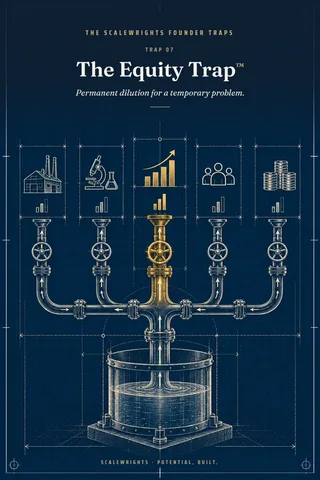
Equity deserves even greater discipline. A dollar of cash can be earned again. Ownership surrendered today may never return. Evidence improves valuation, reduces dilution, and improves terms. What each instrument is and what its terms mean is a question for counsel; whether the evidence justifies taking it is the question this Law asks.
XI. Raise after proof, before panic
The best financing moment usually arrives when meaningful new evidence exists, the next use of capital is clear, and the company still has enough runway to negotiate from strength. Those three conditions rarely line up by accident.
Evidence should improve terms. Runway should protect the negotiation. A founder raising with three weeks of cash and a great story has one of the 2, and the story does not set the price.
XII. The Capital Ladder™
The Capital Ladder has eight rungs: idea, prototype, product proof, purchase proof, repeat proof, channel proof, system proof, scale capital.
Each rung is a larger check written against a stronger claim. Evidence should become stronger as the checks become larger. A company that skips rungs is not moving faster. It is writing a scale-capital check against product-proof evidence, and the Ladder makes that visible.
XIII. Go Small is capital discipline
Go Small is not indecision. It is a method of buying evidence while preserving optionality.
A limited run, a regional test, a fractional executive, a single distributor, one geography: each lets the company participate in the upside without fully underwriting the uncertainty. If the small version works, the evidence funds the large one. If it does not, the company has lost a test, not a year.
XIV. The Capital Gate™
Before a meaningful deployment, run the Capital Gate. What are we trying to prove? What do we know? What are we assuming? What is the smallest test? What result justifies more capital? How reversible is the commitment? What is the next milestone?
Then choose: GO · GO SMALL · NOT YET · NOT THIS. Write the answer down with the evidence that produced it.
XV. The Evidence Register™
For each major initiative, the Evidence Register tracks the assumption, the current evidence, its level on the Ladder, the capital at risk, the next test, the success threshold, the decision date, and the next commitment.
The Register prevents assumptions from becoming facts merely because they have been repeated. An assumption said in 10 meetings is still an assumption. Law V — Buy Information Before You Buy Scale™ keeps its companion, the Assumption Register™.
A company should never commit more capital than its current evidence can intelligently support.
We believe entrepreneurship begins with belief.
We believe capital allocation should not end there.
We believe assumptions should be tested before they are scaled.
We believe early capital should buy information and later capital should buy scale.
We believe the size of the bet should match the quality of the evidence.
We believe opinion is weaker than behavior, behavior is weaker than purchase, and purchase is weaker than repeat.
We believe inventory should follow demonstrated demand.
We believe distribution should follow velocity.
We believe hiring should follow proven constraints.
We believe equity should be surrendered deliberately.
We believe capital should have a milestone.
We believe Go Small is a capital-allocation strategy.
We believe capital does not create truth. It amplifies whatever is already true.
We believe the company should become more certain as the bets become larger.
Open an Evidence Register this week: one row per major initiative, with the assumption, its Ladder level, the capital at risk, and a decision date.
Before the next production run, name the Level of evidence you hold and the Level the run size assumes; if they differ by more than one rung, cut the run.
Set the milestone for the next dollar of outside capital before the raise begins, with six months of runway to spare.
The Seed File™ Workbook, Template six — Velocity, shows store-by-store sell-through with quartiles and the count of doors below break-even: Levels four and five on the Ladder, on one page. Template 10 — Use of Funds writes the raise as five lines that sum to the round, each with an owner and a measure: capital with a milestone. Both are at scalewrights.gumroad.com/l/seed-file; The Series A Founder’s Playbook™ carries the same discipline a round later, at scalewrights.gumroad.com/l/series-a-playbook.
Open the workbook →RAISE — this Law belongs to The Seed File; every door checks it. Take the Seed check at /seed-file.html or the Series A check at /series-a.html.
Take the Seed Readiness Check →