The Trap
The purchase order you spent two years chasing arrives, and it is bigger than the company. That is not a figure of speech. A $1,800,000 PO from one account, at a company doing $4,000,000, is 45 percent of the year from one buyer’s signature. You say yes, because the alternative is to explain to your team why you said no to the thing you told them was the goal.
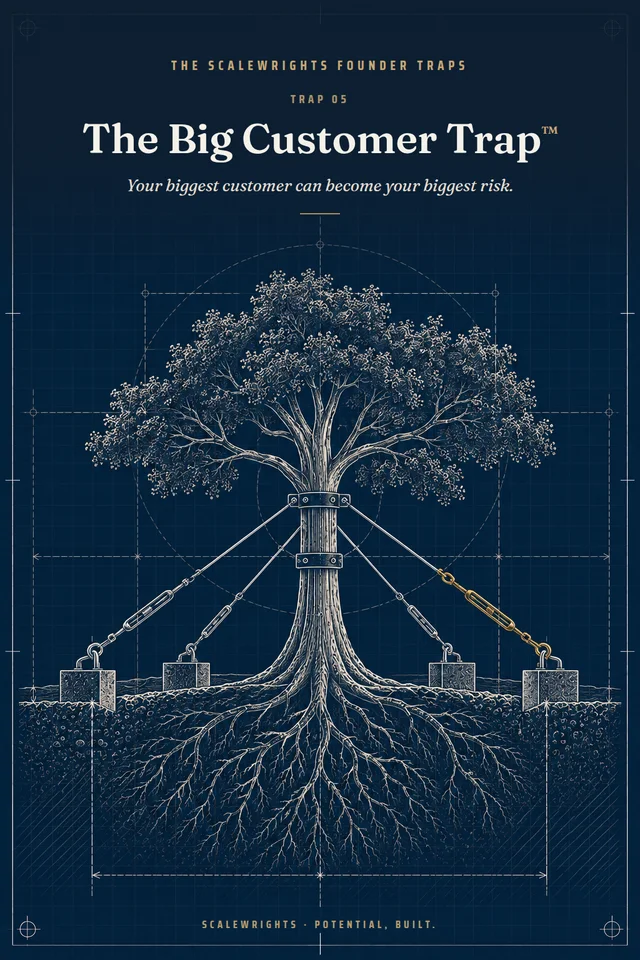
The Big Customer Trap™ is Law IV — Success Can Kill the Company™ — in its purest form. The PO you prayed for is the one you cannot afford: not because the margin is bad, but because the account now holds your cash, your production calendar, your forecast, and your negotiating position, all at once. Every yes creates a claim on the company. This yes creates a claim on most of it.
And there is a second trap behind the first. Law VII — The Market Pays for What It Can Verify™ — says the market prices what it can see. Concentration is one of the first things it looks for and one of the easiest to see. The account that made the year is the same line that discounts the company.
The tell
- One payer is above 30 percent of revenue and its share rose last year.
- The account’s terms — term, notice, exclusivity — were signed as sent, and nobody has reread them since.
- Your production calendar is built around that customer’s reset dates, and the other customers fit in the gaps.
- The account’s category manager is the relationship, and she has your number, not the company’s.
- When the account asks for a price concession, the question in the room is how much, not whether.
The arithmetic
The $1,800,000 PO, net-60. Follow the cash.
| Purchase order | $1,800,000 |
| Trade allowance (12%) deducted from payment | −$216,000 |
| Cash collected, about day 75 on net-60 | $1,584,000 |
| COGS (48%), paid half at scheduling and half at release | −$864,000 |
| Freight to the account’s warehouses | −$54,000 |
| Contribution | $666,000 |
Contribution is 37 percent of the PO. The economics are fine. The exposure is not. The plant’s first deposit, $432,000, leaves about ten weeks before the first truck. The second $432,000 leaves at release. Freight goes out with the shipment. That is $918,000 out the door before the first dollar arrives, and the first dollar arrives about 75 days after that. Peak cash need on this one order is $918,000 for roughly four and a half months, and the second run for the account has to be scheduled before the first is collected.
Now the concentration. If the account is reset off the shelf next spring — a category review, a new buyer, a private-label decision you were not in the room for — 45 percent of revenue goes with it, and the inventory built for the account’s next PO stays. If instead the account asks for 5 percent at renewal, that is $90,000 straight out of $666,000 of contribution, and the answer will be yes, because 45 percent is not a negotiating position.
The Success Load Map™ puts this on one page: what the order loads onto each of the Five Capitals. Financial — $918,000 for four and a half months. Operating — one plant, one slot, no second source. Relational — one buyer above 30 percent, no notice period. Human — the founder is the account manager. Intellectual — the forecast is the account’s forecast. The order is attractive in one dimension and heavy in five.
The fix
Law IV’s rule is to never accept growth the system cannot absorb — and absorption has a rate. Law VII’s rule is to close the Evidence Gap™ before the market opens it: a buyer’s team will build the concentration page whether you have or not, so build it first.
Run the Success Gate™ on the PO. What is the Success Tax™ — working capital, a second plant slot, a person to run the account? What becomes the new constraint? Does this create dependency? Can the commitment be staged? Then run the same question on the account’s contract: term, notice, exclusivity, and what each is worth in months.
The Gate answer this usually produces is GO SMALL — take the order in two shipments, get the second run’s deposit inside the first collection, and decline the exclusivity — paired with a plan to cut the share, not by shrinking the account but by growing the others. No payer above 30 percent is the line. Where a term is a legal matter — exclusivity, notice, a most-favored-customer clause — the page says what it is, and counsel says what to sign.
Build the concentration page this week: every payer by revenue and contribution, share against a 30 percent line, and the contract’s term, notice, and exclusivity beside each.
Stage the next large order into two shipments so the second run’s deposit lands after the first collection, and put both dates on the 13-week cash.
Set a cut plan by quarter that takes the top payer under 30 percent within 18 months by adding the second distributor, the chain, or subscription — and name the owner of each.
The Build Line™ Workbook’s Template 9, 09_Concentration_Map.xlsx, is the concentration page: payers and channels by revenue and contribution with share against a threshold, the contract terms, the cut plan by quarter, and the renewal log. Template 10, 10_Supplier_Resilience_Register.xlsx, does the same for the plant. Template 7, 07_Management_Report_Pack.xlsx, holds the 13-week cash the order’s dates go on. If a buyer is near, the Summit™ Workbook’s Template 4, 04_Quality_of_Earnings.xlsx, shows concentration against the threshold the way their team will read it. Start with the check at /build-line.html.
SCALE — this trap belongs to The Build Line. Take the check at /build-line.html.
Take the Scale Readiness Check →