The Law
You know what your company could become. The market does not pay for what only you can see.
Investors, lenders, partners, boards, and acquirers ask one question in many forms: can I verify this? The revenue, the margin, the growth, the concentration, the repeat purchase, the operating system, the IP, the transferability?
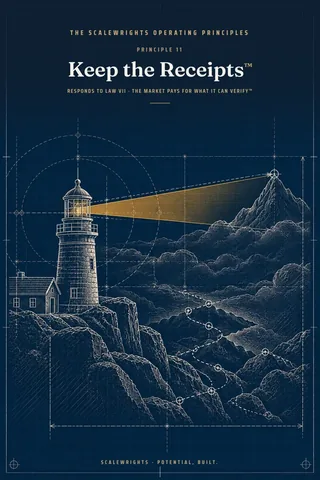
If yes, confidence rises. If no, risk rises and value falls. That is Law VII — The Market Pays for What It Can Verify™.
I. Value is not what the founder believes
The market values what is measurable, repeatable, transferable, defensible, durable, and verifiable. Your conviction is none of those, however well earned.
Founders can spend years building value without building the proof someone else needs to see it. The company is real. The evidence is not. An outsider is buying the second one, at a price set by what they can see.
II. Uncertainty becomes discount, and good businesses get undervalued
Every unsupported claim creates a question. Every unanswered question becomes a risk. Every risk becomes a discount: a lower price, a tougher term, a smaller check.
So a business can be stronger than the market believes. Good economics, strong relationships, a capable team — if the company cannot prove them, outsiders underwrite conservatively. Operating Principle 02 — Worth More Than It’s Getting™ starts here.
III. A claim is not an asset until it can be proven
“We have great customers.” “Our retention is strong.” “Our margins are improving.” “Our operations are scalable.” Each is a sentence, and a sentence is not an asset.
Claims become assets when they are supported by data, contracts, cohorts, dashboards, documents, third-party validation, and repeatable processes. Which of the four above could you hand over today? The claim gets the meeting. The receipt gets the check.
IV. Verify the economics
Can the company prove revenue quality, gross margin, contribution margin, cash conversion, customer and channel profitability, inventory turns, working-capital requirements, recurring versus nonrecurring revenue, and forecast accuracy?
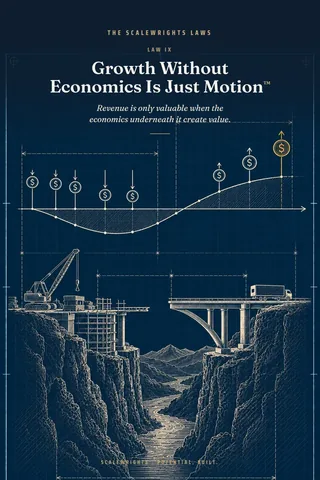
The market asks not how much you sold but how much value the sales created. Revenue without contribution beneath it is half an answer; Law IX — Motion Is Not Progress™ is the other half.
V. Verify demand
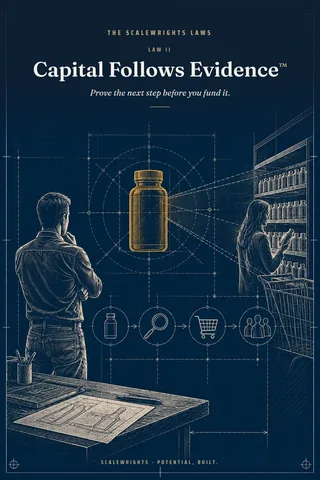
Distribution is not enough. Being on the shelf proves someone bought in; it does not prove anyone buys out.
Can the company prove velocity, repeat purchase, retention, reorders, cohort behavior, household penetration, acquisition economics, promotion dependence, and organic demand? Store-level sell-through beats a door count every time. Verified demand creates confidence; a door count creates a question, and a discount.
VI. Verify the operating system, the leaders, and the transfer
Can the company prove production reliability, quality, inventory accuracy, fill rate, forecasting discipline, supply-chain resilience, SOPs, and operating cadence? Repeatable systems are worth more than the same revenue produced through heroics.
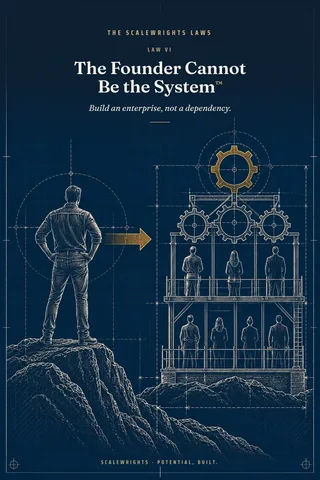
Titles do not verify leadership; behavior does. Can your leaders run the company without constant founder intervention? Can relationships, processes, contracts, IP, culture, and economics transfer to a new owner? Law VI — The Founder Cannot Be the System™ is about operating. Here it is about price.
VII. The Five Capitals must be verifiable
Run the Five Capitals through the same test. Financial: can the numbers be trusted? Operating: can the systems be observed and repeated? Relational: can the relationships be demonstrated and transferred? Human: can leadership depth be seen? Intellectual: can the know-how be documented and defended?
FORHI is how Scalewrights measures a company. Verification is how the market decides whether to believe the measurement.
VIII. The Evidence Gap™
The Evidence Gap is the difference between what the company believes is true and what an outside party can independently verify.
A large gap creates valuation friction: longer diligence, more questions, more conditions, a lower number. A small gap creates confidence, and confidence is what a premium is made of. The work of this Law is closing it, one claim at a time.
IX. Verify before the market asks
Do not wait until diligence begins to find the contracts, rebuild the margin, organize the IP assignments, and work out who owns each process. By then the clock is the buyer’s, and every day you spend building an answer, they spend discounting it. (An assignment moves ownership of work to the company; ask counsel whether yours are signed.)
A verifiable company is a better company, sold or not.
X. The Receipts File™
For each strategic claim, capture the supporting evidence and file the two together. “Retail velocity is improving” should point to a store-level velocity trend. “Founder dependency is down” should point to a Founder Dependency Index™ and decision-transfer evidence.
The Receipts File turns narrative into evidence. It is also the fastest way to learn which claims you cannot support, which is the point.
XI. The Proof Stack™
Every claim can be proven to a depth; the depth is the Proof Stack. Layer one is the claim. Layer 2, the metric. Layer 3, the source. Layer 4, the trend. Layer 5, transferability: the result survives a change of hands. Layer 6, third-party confirmation.
A claim that stops at Layer one is a hope. One that reaches Layer six is a price.
XII. Story and evidence
Story without evidence is promotion. Evidence without story can be undervalued, because nobody knows which number to look at first.
Story creates meaning. Evidence creates credibility. A sophisticated company needs both, in that order: the story tells the reader where to look, and the evidence is what they find there. Lead with the story. Close with the file. Send both.
XIII. Multiples are earned
A category multiple is not awarded for being in the category. The market applies multiples to perceived quality: durability, predictability, growth, margin quality, low risk, transferability, management depth, and defensibility.
Each is a thing you can build and prove. Operating Principle 03 — The Multiple Is Built™ says the first half. This Law says the second: the multiple is built, then shown.
XIV. The Verify–Value Loop™
Value creation and value recognition are different disciplines; most founders are good at only the first.
The Verify–Value Loop joins them: build → measure → document → verify → communicate → re-rate. Build the stronger company. Measure what changed. Document it where a stranger can find it. Verify it, with a third party where possible. Communicate it. Let the market re-rate. Repeat.
XV. The Re-Rate Gap™
The Re-Rate Gap is the difference between the quality of the company and the quality the market perceives. It is the Evidence Gap expressed as a price.
Closing it is specific work. Ask what evidence is missing, what part of the story is unclear, what risk is unverified, and what single artifact would close the gap. Then build it. The Re-Rate 180 is that work, dated.
XVI. The Verification Gate™
Before the claim goes into the deck or the file, ask: What are we claiming? What evidence supports it? How reliable is the source? Is it current? Is the result repeatable? Is it transferable? What remains unverified? What would a skeptical buyer ask next?
Then choose: GO · GO SMALL · NOT YET · NOT THIS. Here “we believe” becomes “we can show,” or gets sent back.
XVII. The Evidence Room™
Maintain a living Evidence Room: financials, customer data, contracts, channel economics, operating metrics, quality records, IP documentation, board materials, decision history, forecast accuracy, The Seed File, and the Receipts File. Every document with an owner and a last-verified date.
Verification is an operating discipline, not a transaction scramble. The room is open every Monday, not only the Monday the letter arrives.
If an outside party cannot independently see, measure, and trust the value, they will not fully pay for it.
We believe potential matters, and that potential alone is not enough.
We believe the market discounts what it cannot understand or verify.
We believe uncertainty becomes risk, and risk becomes discount.
We believe good companies can be undervalued when their evidence is weak.
We believe a claim becomes more valuable when it has a receipt.
We believe margin should survive diligence.
We believe distribution should be backed by verified demand.
We believe the Five Capitals should be provable.
We believe the deck gets the meeting and the file gets the check.
We believe multiples are earned.
We believe proof should travel faster than explanation.
We believe sophistication is clarity.
Write your five biggest claims on one page this week and, beside each, the document that proves it — or the word “none.”
Build the Receipts File for every “none” within 60 days, velocity and margin first.
Give the Evidence Room to an outside reader for one hour; log every question the pages cannot answer.
The Seed File™ Workbook is the Receipts File at the seed stage: the 12 artifacts of the file, Template one — Fact Sheet, Index, and Log to Template 12 — Investors and Promise Register, with Template five — Unit Economics and Template six — Velocity carrying the claims tested hardest (scalewrights.gumroad.com/l/seed-file; Seed check at /seed-file.html). At the far end, The Summit™ Workbook’s Template two — Buyer’s First Hour is the 20 pages a buyer’s team opens, in order, each with its owner and last-verified date (scalewrights.gumroad.com/l/summit; Summit check at /summit.html).
Open the workbook →RAISE · SELL — take the Seed check at /seed-file.html or the Series A check at /series-a.html; the same evidence sets the price at /summit.html.
Take the Seed Readiness Check →