The Law
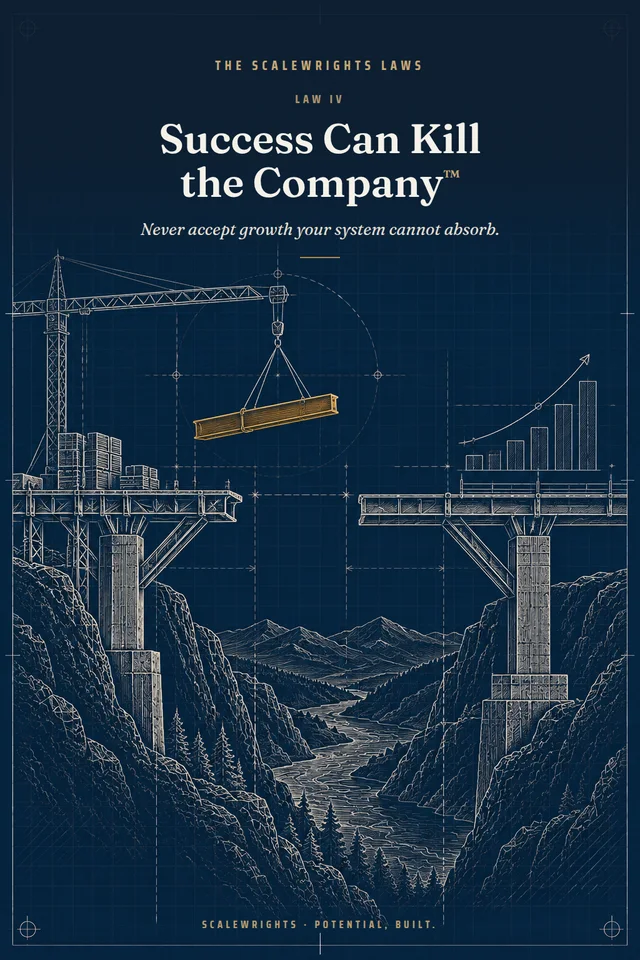
Failure is easy to recognize. Success is harder, because it can look healthy while it creates instability underneath.
A new retailer, a national launch, a major distributor, a large purchase order, a surge in demand, a financing round: each can look like proof that the company has arrived.
But every success creates obligations. More inventory, production, people, working capital, systems, complexity, promises, and places where execution can fail. Success can increase the load on the company faster than capability increases underneath it. The PO you prayed for may be the one you cannot afford.
I. The most dangerous moment can look like a win
A major purchase order is good news, but it is not free. Behind the revenue are inventory, ingredients, packaging, manufacturing, freight, retailer programs, technology, trade spend, sales support, customer service, quality, forecasting, and another production run.
Every major opportunity creates a hidden balance sheet of obligations. The purchase order shows the asset side. The company signs the liability side when it says yes, and it will be asked to pay that side first.
II. Distribution is not demand
Sell-in gets product into the channel. Sell-through gets product out.
The first creates revenue. The second creates a durable business. A pallet on a retailer’s dock is a sale to the retailer; it becomes a business only when the shopper takes a unit off the shelf and, later, comes back for another. Doors are not demand. Distribution is an opportunity to prove demand, and it expires if the proof does not arrive.
III. Velocity before distribution
A smaller brand with high units per store per week can be healthier than a broadly distributed brand with weak velocity. The second has more doors, more revenue, and a bigger problem.
Strong velocity creates reorders, retailer confidence, better shelf retention, cleaner forecasting, faster inventory turns, better working-capital efficiency, and enterprise value. Weak velocity across 2,000 doors creates 2,000 places to be discontinued. Earn velocity before chasing doors.
IV. The Scale Gap™
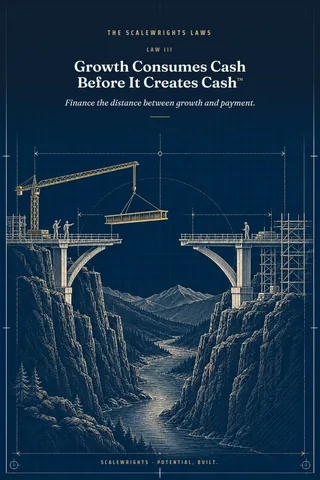
The Scale Gap is the distance between what the market is asking the company to deliver and what the company can reliably finance, produce, deliver, and support.
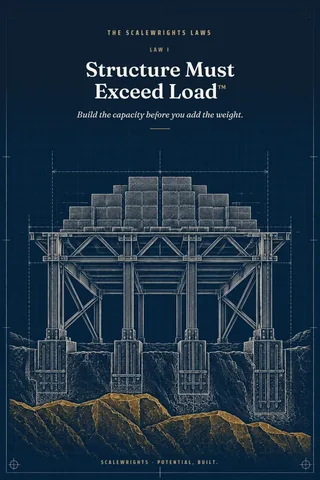
A large Scale Gap produces rush orders, founder intervention, overtime, expedited freight, emergency hiring, excess inventory, supplier favors, quality compromises, and cash stretching. None of those show up on the revenue line. All of them show up in the margin and the founder’s calendar. Opportunity has outrun infrastructure, which is Law I — Structure Must Exceed Load™ read from the other side.
V. Success can overload every capital
A major opportunity can consume all Five Capitals at once: Financial, Operating, Relational, Human, and Intellectual (FORHI).
The opportunity may be attractive in one dimension while overwhelming the company in the other 4. A national account that is good for revenue can drain cash, saturate the co-packer’s capacity, strain every supplier relationship, exhaust the team, and demand data the company has never collected. Judge the opportunity against all 5, not against the one that is easiest to count.
VI. The founder becomes the shock absorber
When success arrives faster than structure, the founder absorbs the difference. The retailer problem, the production slip, the warehouse miss, the cash issue, the senior-leader gap: each lands on the same desk.
This can preserve the business for a while. But the founder is now functioning as emergency stabilization rather than leading a scalable system, and the company has learned that the fix for every strain is the same person. Law VI — The Founder Cannot Be the System™ is what that turns into.
VII. Success is a stress test
Growth often reveals problems that were already there: weak forecasting, informal quality, founder-controlled pricing, fragile spreadsheets, unclear decisions. At $3,000,000 they were tolerable. At $10,000,000 they are the reason the fill rate dropped.
Success does not always create the weakness. It makes the weakness impossible to ignore, and it does so at the moment the company can least afford to stop and fix it.
VIII. Every yes creates a claim
A yes to a SKU, a retailer, a country, an employee, a distributor, a production run, or a partnership spends something: cash, time, attention, inventory, capacity, or strategic focus. The claim is filed at the moment of the yes and collected over the following year.
Before each one, ask: What are we saying no to by saying yes to this? If the answer is “nothing,” the question has not been taken seriously.
IX. Not all revenue is equally valuable
A large account may produce lower margin, higher trade spend, longer terms, more deductions, more inventory, more concentration, and more service burden. It may also become the account the plan depends on, which is a different kind of cost.
The best revenue is not simply the largest revenue. It is revenue that strengthens the company: better margin, faster cash, less concentration, and more options afterward than before.
X. The Success Tax™
The Success Tax is everything the company must add or absorb because the opportunity exists: working capital, people, technology, customer service, trade spend, deductions, inventory risk, compliance, freight, and management.
Calculate the Success Tax before celebrating gross revenue. A $2,000,000 account that carries $600,000 of Success Tax and 90-day terms is a $1,400,000 account that has to be financed for a quarter. That may still be a good account. It is not the account on the purchase order.
XI. The Scale-Quality Score™
Judge opportunities on the Scale-Quality Score, across seven dimensions: revenue quality, margin quality, cash quality, strategic quality, operating quality, concentration quality, and repeatability quality.
A smaller opportunity with high quality may be superior to a larger opportunity with poor quality. Scoring the seven forces the conversation the revenue number avoids, and it lets the team compare a regional chain and a national one without the national one winning on size alone.
XII. Go Small is a success strategy
Pilot the retailer. Limit the geography. Reduce the SKU count. Stage the rollout. Cap the first production run. Control the rate at which success arrives.
Go Small lets the company experience success without being overwhelmed by it. A 200-door pilot that reorders proves more than a 2,000-door launch that does not, and it costs one-tenth as much to be wrong. A retailer that wants the pilot to succeed will usually agree to one.
XIII. The Success Gate™
Before accepting the opportunity, run the Success Gate. What is the revenue opportunity? What is the Success Tax? What is the true contribution? What load hits each of the Five Capitals? What becomes the new constraint? What happens if demand is lower? Higher? Does this create dependency? Does it create more strategic options or fewer? Can we stage the commitment?
Then choose: GO · GO SMALL · NOT YET · NOT THIS. Not Yet, with a date and a list of what must be true by then, is a respectable answer to a good opportunity.
XIV. The Success Dashboard™
Track both growth and strain on the Success Dashboard. Growth is revenue, doors, and orders. Strain is cash conversion, margin, forecast accuracy, fill rate, quality incidents, inventory aging, turnover, founder dependency, concentration, complaints, decision cycle time, and expedited freight.
The dashboard should show whether the company is becoming healthier as it grows. If revenue is up and every strain measure is up with it, the company is not scaling. It is getting heavier.
A growth opportunity is only truly successful if the company becomes stronger after absorbing it.
We believe success creates obligations.
We believe distribution is not demand.
We believe sell-in is not sell-through.
We believe doors matter less than velocity.
We believe opportunity can outrun infrastructure.
We believe growth can consume all Five Capitals at once.
We believe founders should not become permanent shock absorbers.
We believe success exposes weak systems.
We believe every yes creates a claim on the company.
We believe not all revenue is equally valuable.
We believe concentration can turn success into dependency.
We believe every major opportunity carries a Success Tax.
We believe growth should create options rather than remove them.
We believe some good opportunities should be delayed.
We believe Go Small is a legitimate success strategy.
We believe the company should measure both growth and strain.
We believe the company should become more durable as it becomes more successful.
Calculate the Success Tax on the largest opportunity in front of you this week, line by line, and subtract it from the purchase order before anyone celebrates.
Score that opportunity one to five on each of the seven Scale-Quality dimensions and compare it with the second-largest opportunity on the same sheet.
Add five strain measures to next month’s dashboard beside the growth measures, and review both at the same meeting.
The Build Line™ Workbook, Template 13 — the Margin Stress Test, runs contribution by channel through three shocks, including the volume shock that is the upside case, and reports break-even velocity under load: the Scale Gap in figures. Template nine — the Concentration Map shows payers and channels by revenue and contribution against a threshold, with the cut plan by quarter: where a success that has become a dependency gets caught. Both are at scalewrights.gumroad.com/l/build-line.
Open the workbook →SCALE — this Law belongs to The Build Line. Take the Scale check at /build-line.html.
Take the Scale Readiness Check →