The Principle
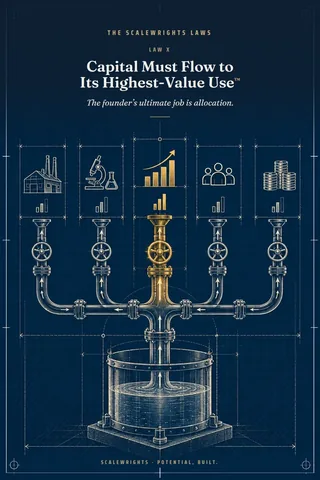
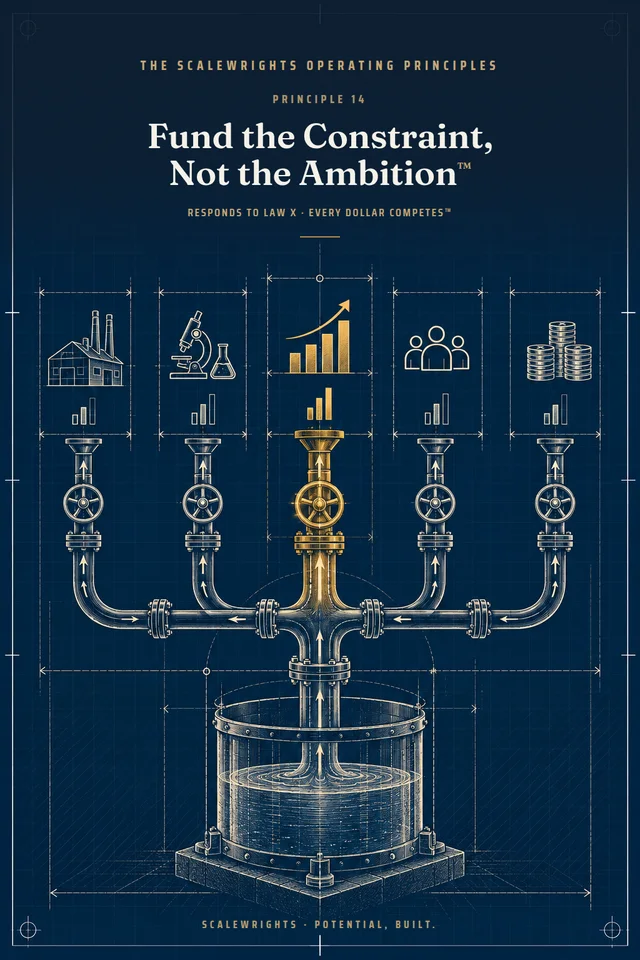
This is how I want you to operate under Law X — Every Dollar Competes™: find the constraint, fund it first, and make every other use of capital compete with that one on the same page.
Every company operates under scarcity. Not only of cash, though cash is the one everyone sees, but of production capacity, of leadership attention, of supplier goodwill, of the team’s hours, of the founder’s judgment. Each is a form of capital. Each is finite. And each one gets allocated every week, whether or not anyone calls it allocation. The budget allocates it. The calendar allocates it. Your attention allocates it.
I want the allocation to be a decision, made on purpose, and I want it to start with the thing that is holding everything else back.
Find the constraint
At any moment, one part of the system limits the whole. If demand is constrained, more production does not help. If production is constrained, more marketing makes it worse: orders you cannot fill, retailers you disappoint, a reputation for out-of-stocks you did not need. If cash is constrained, another SKU is the wrong answer to every question. If the founder is the constraint, hiring three salespeople adds three people waiting for the founder.
Name it in one sentence. The Load Test in Law I — Structure Must Exceed Load™ is one way to find it; the decision queue in Operating Principle 10 — Design Yourself Out™ is another. Most founders know the constraint the moment they are asked. Few have written it down, and fewer still have checked whether the budget funds it.
Ambition is not a return
The new product is exciting. The new retailer is prestigious. The new market sounds enormous. The acquisition feels bold. The executive has an impressive résumé. None of those sentences has a number in it.
Ambition is what gets a company started, and I would not trade it. But prestige is not return, novelty is not return, and activity is not return. The discipline is to run the exciting project through the same scorecard as the dull one, and to notice when the dull one wins. Very often the highest-return investment in the company is a second shift, a controller, a second source, or a forecasting process: the things that remove the constraint and release everything queued behind it.
Measure the Constraint Return™
Ask three things of any initiative. What constraint does it remove? What becomes possible once it is gone? How much value does that release?
That is the Constraint Return, and it is why the second shift can outscore the new market. Some investments create value directly. Others create value by opening the system, and their return is everything that follows. A controller who frees the founder from 41 waiting decisions does not return a salary. She returns the founder.
Price every initiative in all five capitals
For every major commitment, price what it requires in Financial, Operating, Relational, Human, and Intellectual capital, not only the first. Then ask what it returns in the same five currencies.
A new retailer that costs little cash but consumes half the operations team’s year and your best supplier’s patience is not cheap. The Five-Capital Allocation Model™ shows it. Run it on the three largest commitments in front of the company and the cheapest one will usually turn out to be more expensive than it looked.
Set a Hurdle Rate™ and write it down
Every company should carry a minimum risk-adjusted return required before it commits meaningful capital. It needs to exist, be written down, and be the same for the founder’s favorite project as for everyone else’s.
Higher uncertainty should require a higher expected return, or a smaller first commitment. The second is wiser: it is Operating Principle 06 — Earn the Next Dollar™ applied to allocation. When you are not sure the return clears the hurdle, do not lower the hurdle. Shrink the bet until the evidence catches up.
Put everything on one page
Every initiative competing for capital goes on one Capital Allocation Scorecard™, scored on the same 11 lines: expected economic return, strategic return, evidence strength, time to return, capital requirement, human-capital requirement, operating burden, risk, reversibility, option value, and opportunity cost.
The Scorecard does not make the decision. It makes the comparison unavoidable, which is most of the decision. “Strategic” stops excusing the absence of measurement when it is a column with a number beside the other ten.
Manage the Internal Portfolio™
The core business, the new products, the channels, the markets, the technology, the talent, the brand, the acquisition idea: each competes with the others for the same scarce resources, whether anyone says so or not. Treat them as a portfolio and treat yourself as its manager.
That means capital moves. Past allocation is not permanent entitlement. When an initiative stops earning its return, stop it and reallocate; sunk cost does not own the next dollar, and neither does the department that spent the last one. When evidence strengthens, increase the commitment. When it weakens, reduce it. Winners earn more capital. Weak initiatives lose it. That is venture logic, run inside the company, by you.
Remember that raising is allocation too
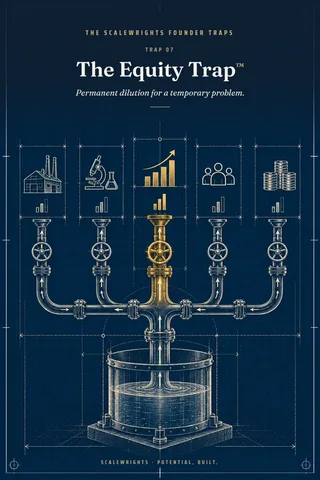
Equity is the most expensive capital the company will ever use, because it is priced today and paid for in every future year the company succeeds. Trap 07 — The Equity Trap™ is permanent dilution for a temporary problem. Before you raise, ask which constraint the money removes and whether a cheaper instrument, a deposit, a receivables line, a supplier term, removes it as well. Preserving cash, and preserving ownership, can be the highest-return allocation on the page.
Run the Allocation Gate™
Before the money moves, ask: What are we funding? Which constraint does it remove? What return do we expect? How strong is the evidence? When does the capital come back? What is the next-best use? Does this create more durable value than the alternative?
Then GO, GO SMALL, NOT YET, or NOT THIS. It is the last Gate, and the one the other nine feed.
The Scalewrights view
Budgets reveal strategy. Calendars reveal strategy. Leadership attention reveals strategy. If the plan says “velocity” and the budget says “new doors,” the plan is decoration and the budget is the strategy, and an outside reader can tell what the company believes from its spending long before they read the deck.
Fund the constraint, not the ambition. Then, when the constraint moves, find the next one and fund that. The ambition takes care of itself when the system underneath it is no longer waiting.
Name the company’s primary constraint in one sentence this week, and check whether the current budget funds it. If it does not, move something.
Put the next five initiatives competing for capital on one Capital Allocation Scorecard within 30 days, all 11 lines, and rank them.
Set a Hurdle Rate in writing and apply it to every commitment over $25,000 next quarter, the founder’s projects included.
The Build Line™ Workbook carries this Principle in Template 17, 17_Capital_Readiness_Law_I.xlsx: the test of structure against load, the five-line “what it buys” page with the cheaper-instrument column, and the offer evaluated and decided, with Template 15, 15_True_North_and_Hoshin.xlsx, where the priorities and the budget are made to agree (scalewrights.gumroad.com/l/build-line). The Summit™ Workbook’s Template 5, 05_Strike_Gauge_Hold_vs_Sell.xlsx, asks the same question of the whole company: the hold case from your own plan against the offer, producing the strike every letter is measured against (scalewrights.gumroad.com/l/summit).
SCALE · SELL — take the Scale Readiness Check at /build-line.html; the last allocation, hold or sell, is at /summit.html.
Take the Scale Readiness Check →