The Law
Eventually, almost every founder problem is an allocation problem. Where should the next dollar go? Whom should we hire? Which product should we fund? Preserve cash, pay down debt, acquire, expand, or raise?
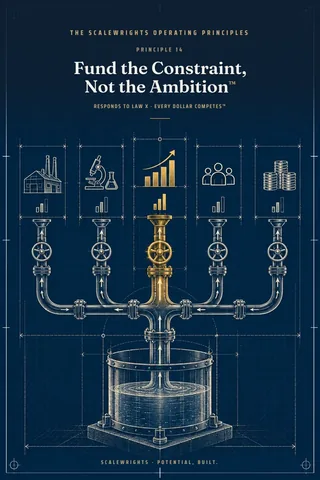
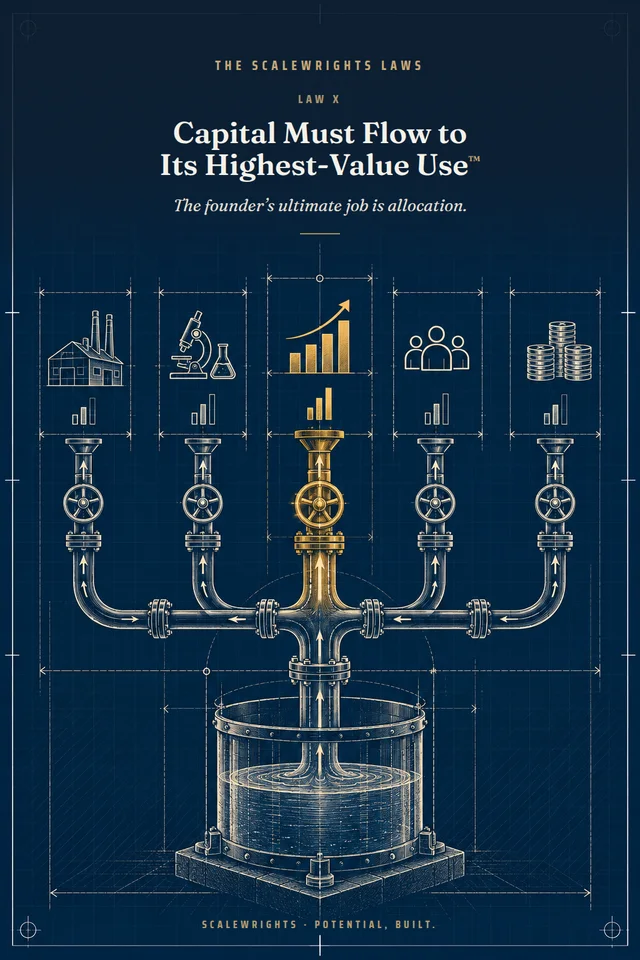
Every choice consumes something scarce. Your highest responsibility is to place scarce resources where they create the greatest durable value. That is Law X — Every Dollar Competes™, and the other nine Laws serve it.
I. A good investment can still be the wrong investment
An initiative that returns 15 percent looks attractive. If another open to you returns 40 percent at similar risk, the first is the wrong allocation.
The hurdle is never simply “will this work?” It is “is this better than the next-best use of the same scarce resources?” Most bad allocations were good ideas that never got asked the second question.
II. Capital is more than money
The scarce resource is sometimes money. Just as often it is time, talent, production capacity, trust, a relationship, or knowledge — and a company with cash in the bank can still be starved of the one it needs most.
Allocation begins by asking what is scarce right now. Fund the scarce thing. Adding more of what you have is spending, not allocating.
III. The Five-Capital Allocation Model™
For every major initiative, price what it requires in each of the Five Capitals — Financial, Operating, Relational, Human, and Intellectual — not only the first.
Then ask what it returns in the same five currencies. A new retailer that costs little cash but consumes half the operations team’s year and your best supplier relationship is not cheap. The model shows it.
IV. Founders often allocate by emotion
The new product is exciting. The new retailer is prestigious. The new market sounds large. The acquisition feels bold. The executive has an impressive résumé.
None of those sentences has a number. Prestige is not return. Novelty is not return. Activity is not return. The emotions are real and sometimes right; the discipline is to run them through the same scorecard as everything else.
V. Fund the constraint before the ambition
The highest-return investment usually removes the primary constraint, because everything behind it is waiting.
If demand is constrained, more production will not help. If production is constrained, more marketing may hurt. If cash is constrained, another SKU makes it worse. Find the constraint (the Load Test in Law I — Structure Must Exceed Load™ is one way) and fund it before the ambition.
VI. The Constraint Return™
Ask three things of any initiative. What constraint does it remove? What becomes possible once it is gone? How much value does that release?
That is the Constraint Return. Some investments create value directly. Others create value by opening the system — the second shift, the second source, the controller who frees the founder — and their return is everything that follows.
VII. Priorities are capital allocation
A strategic priority is meaningless unless resources follow it. If the plan says “velocity” and the budget says “new doors,” the plan is decoration and the budget is the strategy.
Budgets reveal strategy. Calendars reveal strategy. Leadership attention reveals strategy. Allocation reveals what the company actually believes, and an outside reader can tell what you believe from the spending long before they read the deck.
VIII. Preserving cash is an allocation decision
Sometimes the highest-value use of capital is doing nothing yet. Hold the cash. Keep the options. Wait for evidence. Protect the Working-Capital Waterline™ from Law III — Growth Eats Cash First™.
Liquidity is itself an investment: it buys the ability to act when the evidence arrives, and to survive when it does not. “Not yet” fails only when it is a default, not a choice.
IX. Invest in the core before chasing adjacencies
Before funding a new geography, SKU, channel, or acquisition, ask whether the same capital would return more by strengthening the engine you have: velocity, margin, retention, inventory turns, pricing, operations.
The core often carries the highest risk-adjusted return for one reason: you already have evidence. Law II — Capital Follows Evidence™ points the same way. The adjacency is a guess with better branding.
X. Everything the company buys is allocation
Every hire commits salary, time, equity, and complexity. Every production run is an investment. Marketing should compete for capital rather than inherit a budget. Innovation projects need a hypothesis, a budget, an evidence gate, a Stop Rule™, and an expected value.
Acquisitions consume cash, debt capacity, and leadership bandwidth. Paying down debt earns a return: the interest and risk removed. Equity becomes extraordinarily expensive when the company succeeds, so raise permanent capital for permanent value creation, not a temporary inefficiency. Which instrument fits which purpose is a question for counsel.
XI. The Hurdle Rate™
Every company should carry a Hurdle Rate: the minimum risk-adjusted return required before committing meaningful capital. It needs to exist, be written down, and be the same for the exciting project and the dull one.
Higher uncertainty should require a higher expected return or a smaller first commitment. The second is wiser; Law V — Buy Information Before You Buy Scale™ says why.
XII. The Capital Allocation Stack™
The biggest upside is not automatically the best investment. A 30 percent return in six months is not 30 percent over five years, and probability matters as much.
Evaluate each initiative on seven lines: economic return, strategic return, option value, risk, time, reversibility, and opportunity cost. That is the Capital Allocation Stack. It stops “strategic” from excusing the absence of measurement.
XIII. Capital should move
Past allocation is not permanent entitlement. If an initiative stops earning its return, stop it and reallocate. Capital belongs to the enterprise, not to departments.
Sunk cost does not own the next dollar; evidence does. When evidence strengthens, increase the commitment. When it weakens, reduce it. Winners earn more capital; weak initiatives lose it. That is venture logic, applied inside the company.
XIV. The Internal Portfolio™
See your major initiatives as an Internal Portfolio: the core business, new products, channels, markets, technology, talent, brand, acquisitions. Each competes with the others for the same scarce resources, whether anyone says so or not.
The CEO is the portfolio manager. That is not a metaphor; it is the job, and why Law VI — The Founder Cannot Be the System™ moves the founder from doing to designing.
XV. The Capital Allocation Scorecard™
Put every initiative on one page and score it on the same 11 lines: expected economic return, strategic return, evidence strength, time to return, capital requirement, human-capital requirement, operating burden, risk, reversibility, option value, and opportunity cost.
Then compare them side by side. The Scorecard does not make the decision; it makes the comparison unavoidable, which is most of it.
XVI. The Allocation Gate™
Before the money moves, ask: What are we funding? Which constraint does it remove? What return do we expect? How strong is the evidence? When does the capital return? What is the next-best use? Does this create more durable value than the alternative?
Then choose: GO · GO SMALL · NOT YET · NOT THIS. It is the last Gate, and the one the other nine feed.
XVII. Allocation shapes the company; the Flywheel compounds it
Every budget creates tomorrow’s company. Fund innovation and you build Intellectual Capital. Fund leadership and you build Human Capital. Allocation is strategy expressed through resources.
As a loop, it is the Scalewrights Capital Flywheel™: build structure → generate evidence → deploy capital → create growth → protect cash → control complexity → transfer capability → verify value → harvest → reallocate → compound. Then it begins again.
Continuously move scarce financial, operating, relational, human, and intellectual capital toward the opportunities that create the greatest durable risk-adjusted enterprise value.
We believe every company operates under scarcity.
We believe capital means more than money.
We believe a good investment can still be the wrong one.
We believe allocation should begin with the constraint.
We believe resources should follow evidence.
We believe priorities are revealed by allocation.
We believe preserving cash can be an investment.
We believe headcount, inventory, and marketing are capital allocation.
We believe equity is expensive when the company succeeds.
We believe sunk cost does not own the next dollar.
We believe the CEO is a portfolio manager of scarce resources.
We believe operations create value and allocation compounds it.
Name the company’s primary constraint in one sentence this week, and check whether the budget funds it.
Put the next five initiatives competing for capital on one Capital Allocation Scorecard within 30 days; rank them.
Set a Hurdle Rate in writing and apply it to every commitment over $25,000 next quarter.
The Build Line™ Workbook carries this Law in Template 17 — Capital Readiness: the Law I test of structure against load, the 5-line “what it buys” page with the cheaper-instrument column, and the offer evaluated and decided (scalewrights.gumroad.com/l/build-line; Scale check at /build-line.html). The Summit™ Workbook’s Template five — Strike Gauge (Hold vs. Sell) asks the same question of the company: the hold case from your own plan, the discount run three ways, producing the strike every offer is measured against (scalewrights.gumroad.com/l/summit; Summit check at /summit.html).
Open the workbook →SCALE · SELL — take the Scale check at /build-line.html; the last allocation, hold or sell, is at /summit.html.
Take the Scale Readiness Check →