The Principle
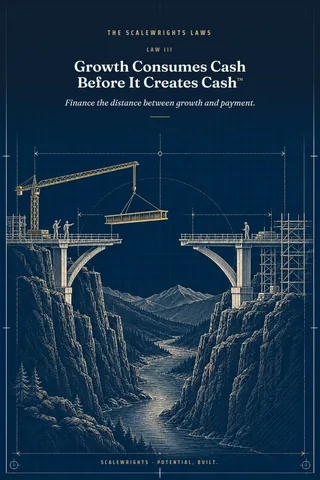
This is how I want you to operate under Law III — Growth Eats Cash First™: the order is only the beginning, and now you have to fund the distance between making the product and getting paid.
Growth feels good. More customers, more retailers, more production, more revenue. But in VMS, beverage, supplements, and consumer products, growth usually consumes cash before it creates cash.
You can be growing and getting financially weaker at the same time. You can land the biggest customer in company history and open the largest working-capital gap in company history. You can be profitable on paper and still run out of money.
Revenue is not cash
A $500,000 purchase order is not $500,000 in the bank. You may need to pay for ingredients, packaging, manufacturing deposits, testing, freight, warehousing, trade spend, and payroll before payment arrives 30, 60, or 90 days later. How much cash do we have to spend before that revenue comes home?
Profit is not cash either. You can have a profitable P&L while inventory, receivables, trade spend, and next-run deposits consume liquidity. Is the company profitable? Is the company generating cash? Know both.
Follow one dollar through the company
CASH → INGREDIENTS → PACKAGING → PRODUCTION → INVENTORY → WAREHOUSE → CUSTOMER → RECEIVABLE → CASH.
Every step takes time. Every step can cost money. That is your cash conversion cycle, and drawn out with dates on it, it is your Cash Conversion Map™. The working-capital gap begins when cash leaves to fulfill demand and ends when the resulting cash is collected. The longer the gap and the faster the growth, the more money the company needs.
The second production run is often the real test
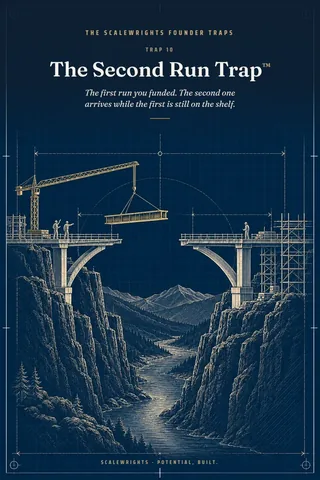
The second run may be required before the first receivable is collected. Do not ask only how you fund the launch. Ask how you fund replenishment if the launch works.
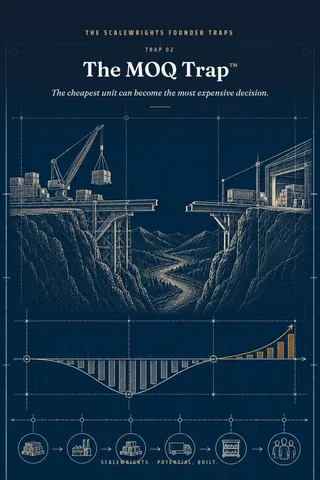
Inventory is cash wearing a box. Every pallet is cash converted into something less flexible. Too little creates stockouts; too much creates trapped capital. And MOQs can seduce you: a larger run may improve unit economics while radically increasing cash exposure. The cheapest unit can become the most expensive decision.
Shelf price is not your economics
Shelf price minus retailer margin minus distributor margin minus trade spend minus broker and sales expense minus freight minus landed COGS equals contribution. Then ask how much cash was committed before the contribution arrived, and for how long.
Payment terms are financing terms. If your supplier wants 15 days and your customer pays in 60, you finance the difference. Who gets paid first? Who gets paid last? Who is financing whom?
Trade spend hides in plain sight. Billbacks, free fills, slotting, markdowns, returns, distributor fees, and deductions all reduce realized economics. Build the next production run off realized economics, not gross optimism.
Forecasting is cash allocation
A forecast becomes a production instruction, then inventory, then a cash commitment. Separate committed, high-confidence, probable, and speculative demand, and do not finance all four the same way. Shelf life is a financial variable, too: aging inventory is trapped capital plus markdown and write-off risk. Treat inventory aging as a liquidity metric.
Build your Working-Capital Waterline™
The Working-Capital Waterline is your minimum liquidity threshold. Above it, you operate from strength. Below it, you delay payments, pause hiring, cut marketing, stretch suppliers, raise capital under pressure, and accept bad terms. Define the waterline before you are underwater.
Cash creates strategic freedom. Liquidity lets you walk away, change suppliers, respond to recalls, invest in downturns, raise later, and negotiate from strength.
Use the 13-Week Cash Forecast
Track beginning cash, expected collections, payroll, production, ingredients, packaging, freight, marketing, trade spend, debt, taxes, operating expenses, and ending cash, week by week. The purpose is visibility, not perfect prediction.
Solve cash problems while they are still forecasts. A projected shortage is a planning problem; a current shortage is a crisis. If the gap is 90 days away, you can negotiate, reduce the run, stage the launch, improve collections, secure a line, sell slow inventory, or delay a SKU.
Cash Velocity™
Cash Velocity measures how quickly a working-capital dollar returns ready to be used again. Margin tells you how much you make. Cash Velocity tells you how often you can make it.
Growth rate is a financing decision. If each new dollar of revenue requires significant working capital, growth requires financing — from internally generated cash, supplier terms, debt, receivables or PO financing, equity, or slower growth. Ask how fast you can safely finance the cash cycle.
Debt can be the right tool against predictable receivables, repeatable inventory turns, and visible repayment; Capital Follows Evidence™. Equity can be very expensive working capital: selling permanent ownership to fund temporary inventory costs a great deal if the company succeeds. Match the instrument to the need. What each instrument is, legally, is a question for counsel; what it costs you is arithmetic you can do first.
Build a Cash Gate™
Run downside and upside scenarios. What if sales are 50 percent below plan? What if they are 50 percent above? Success can accelerate the working-capital need — Success Can Kill the Company™.
Then ask eight questions. How much cash leaves? When? When does product become sellable? When does the customer pay? What deductions or delays are realistic? When is the next production commitment? What is peak cash need? What happens at 50, 75, 100, and 150 percent of forecast?
Then choose: GO · GO SMALL · NOT YET · NOT THIS.
Don’t let sales own the cash decision alone. A large retailer win is a working-capital decision, a risk decision, and a capital-allocation decision at once.
The Scalewrights view
The order is not the cash. Healthy growing companies know what growth costs, when money leaves, when it comes back, what their waterline is, and how fast cash moves.
Take your single largest growth opportunity or production commitment over the next 90 days and write six lines: cash out, how much and when; cash in, how much and when; peak working-capital gap; second production requirement; waterline; financing source. If you cannot fill those six lines with confidence, do not approve the full commitment yet. Build the cash map first. Then grow.
Map your cash conversion cycle. Take your highest-volume product and put dates on the timeline from ingredient payment to final collection — one page, this week.
Set your Working-Capital Waterline. Decide the minimum cash balance the company should not casually cross, and put the number on the first line of every weekly cash review.
Run the next growth opportunity through the Cash Gate. Calculate peak cash requirement, inventory and receivable requirements, timing of the second run, the 50-percent downside, the 50-percent upside, and the financing source, and decide GO, GO SMALL, NOT YET, or NOT THIS before you sign.
The Cash Conversion Map and the waterline are First Batch™ Template 8, 08_Cash_Cycle_and_12_Month_Plan.xlsx — the five dates and the days between them, the twelve-month plan with the run, the first collection, the second run’s deposit, and the minimum-cash month — in the First Batch workbook on Gumroad (scalewrights.gumroad.com/l/first-batch). The 13-Week Cash Forecast itself is The Build Line™ Template 7, 07_Management_Report_Pack.xlsx (scalewrights.gumroad.com/l/build-line).
START · SCALE — the First Batch Check at /first-batch.html before the first run; the Scale Readiness Check at /build-line.html once the second run is the question.
Take the First Batch Check →