The Law
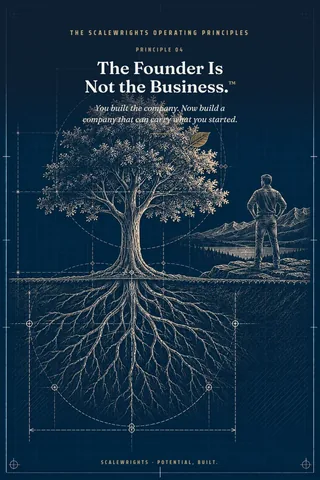
Every founder begins as the system. You sell, decide, hire, fix, and approve. You know the customer, the supplier, and why the pricing works.
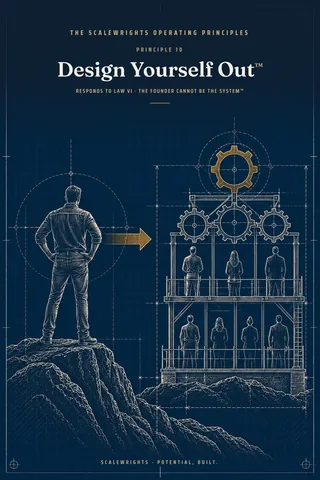
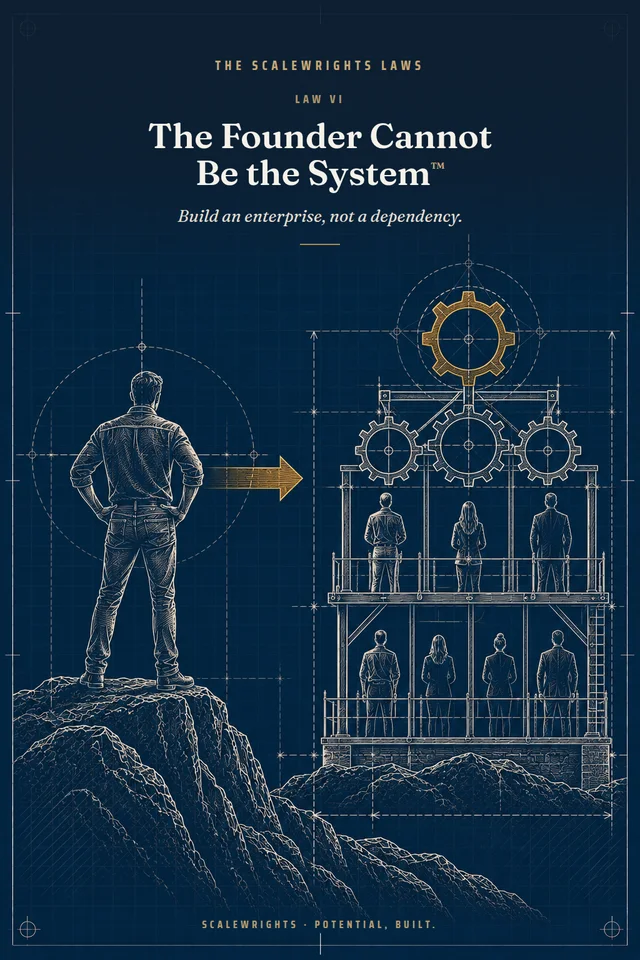
At first this is not a flaw; it is how the company survives. But what helps a company start can later stop it from scaling. If every important decision, relationship, exception, and piece of knowledge runs through one person, the company is not yet transferable. That is Law VI — The Founder Cannot Be the System™.
I. The founder advantage becomes the Founder Bottleneck™
As the company grows, every major quote, difficult customer, hire, pricing exception, supplier issue, and strategic decision finds its way back to you. Decision velocity slows. People stop owning outcomes. Managers become messengers. Employees wait.
The advantage that built the company — one person who could do everything — becomes the constraint on it. The company grows around the founder instead of beyond the founder.
II. Founder dependency often looks like control
“I just need to make sure it is right.” Sometimes that is quality control. Just as often it means the standards live in your head, decision rights are unclear, the team lacks authority, or your judgment was never converted into a system.
Strong companies make that conversion on purpose: judgment into standards, principles, processes, metrics, decision rights, and training, so that “is it right?” no longer needs you in the room.
III. Founder dependency is a business risk
A company that depends heavily on one person carries operational, leadership, relationship, knowledge, financing, and exit risk at once. Lenders price it. Investors discount it. Buyers walk.
Ask what happens if you are unavailable for 30 days. Who signs? Who decides? Who manages the retailer? Who knows the manufacturer? Who understands cash? Who owns the forecast? If most answers are your name, the risk is not theoretical.
IV. The Founder Dependency Index™
Score 12 domains: sales, customer relationships, pricing, product, operations, finance, hiring, strategy, capital raising, supplier relationships, culture, and decision-making.
For each, ask three questions. Can it operate well for 30 days without you? For 90? Can someone else explain how it works? The pattern of answers is the Index: where the company still borrows your capacity instead of owning its own.
V. Knowledge in the founder's head is not company knowledge
Knowledge becomes enterprise value only when the organization can use it without the person who first held it. Until then it is a personal asset on loan.
Important knowledge belongs in playbooks, systems, dashboards, decision logs, contracts, the CRM, operating procedures, training, financial models, and diligence files — places a new hire or an outside reader can reach without you.
VI. Relationships must become company relationships
Founder-owned relationships with customers, suppliers, investors, and distributors are valuable. They are also a dependency, and the market reads them that way.
Transfer them deliberately: shared context, more than one relationship holder per account, clear account ownership, CRM discipline, exposure for your leaders, documented history, and trust built wider than one handshake. The retailer should know three people at your company, and call you last.
VII. Decision rights must be explicit
For every recurring decision, define who decides, who recommends, who must be consulted, and who must be informed. Write it down, and set the limits — the dollar amount, the discount, the hire — that move a decision up a level.
Unclear decision rights cause escalation, and escalation has a destination. Eventually every road leads back to the founder, and the founder becomes the queue.
VIII. Delegation is not task transfer
Handing someone a task creates an assistant. Handing someone an outcome creates an owner.
True delegation includes the outcome, the authority to reach it, the resources, the boundaries, the metrics, and the consequences. Leave any one out and the work comes back with a question attached. Task transfer creates assistance. Ownership transfer creates scale. Most founders who say they delegate do the first.
IX. The Founder Test™
If you disappeared for a week, what would stop? For two weeks? For 30 days? For 90?
Each horizon reveals a different dependency. A week reveals task dependency — what only you know how to do. A month reveals decision dependency — what only you may decide. A quarter reveals leadership and relationship dependency — the people and accounts that stay because you are there.
X. From doing to deciding to designing
Your role should move through three stages. First you do the important work. Then you decide the key priorities and tradeoffs. Then you design the people, systems, incentives, and structure that let good decisions happen without you.
The end state is not a founder who stepped back but one who stepped up — no longer the best operator in the system, but its architect.
XI. The Owner Map™
For every major business outcome, name the primary owner, the backup owner, the decision rights, the core metric, the escalation threshold, and the founder’s involvement. Put it on one page.
Then read the page. Where the founder is still the primary owner, dependency remains, whatever the org chart says. The Owner Map shows who actually carries the company, not who is supposed to.
XII. The Transferability Test™
A process is not transferable because it is documented. Plenty of companies own a binder nobody can run.
The test asks three things of any process. Can someone else run it without the founder? Do they get the same result? When something goes wrong, can they recover? A documented process that fails the third question is a description, not a system.
XIII. Principles scale judgment
Rules handle routine situations. Principles handle new ones, which is where the founder’s phone usually rings.
A short set does most of the work: protect cash, protect quality, do not trade permanent equity for a temporary problem, do not scale weak economics, escalate customer risk early. Teach those and people will make your decision without you. Principles create distributed judgment.
XIV. The Founder-Free Day™
Run one day where you are deliberately unavailable for routine decisions. Watch what stops, what escalates, what waits, what lacks information, and what fails. Write it down.
Then run a week. Eventually, longer. This is a diagnostic, not a vacation exercise. The output is the list of what broke, with an owner and a date against each line, and the next run scheduled.
XV. The Transferability Gap™
The Transferability Gap is the distance between what you currently carry and what the enterprise can carry without you.
It should fall as revenue, complexity, and enterprise value rise. When it rises with them instead — a bigger company that needs its founder more, not less — dependency is growing as fast as sales, and a buyer will price the dependency.
XVI. The Founder Dependency Gate™
Before the raise, the chain, or the sale, ask: What still requires the founder? Which items are critical? Who should own them next? What knowledge and authority must transfer? Which relationships must become company relationships? What proves transferability? What backup exists?
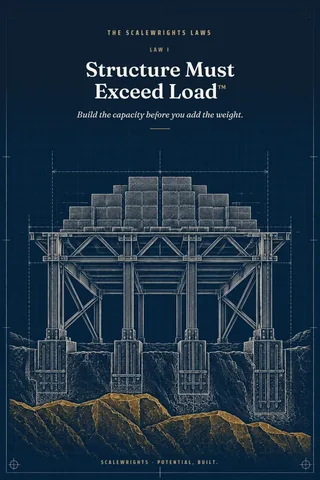
Then choose: GO · GO SMALL · NOT YET · NOT THIS. It is the Gate from Law I — Structure Must Exceed Load™, aimed at one load-bearing member: you.
XVII. The Founder Transfer Plan™
List everything you still own and, for each item, why, who should own it next, what they need to learn, what authority they need, what process must be documented, what metric proves readiness, and the target transfer date.
The plan is never finished. Its objective is to keep removing you from the critical paths where you add the least, one dated line at a time.
If the company needs the founder for routine survival, it has not yet converted founder capability into enterprise capability.
We believe founder intensity is necessary at the beginning, not forever.
We believe founder dependency is concentration risk.
We believe knowledge in one person’s head is not institutional knowledge.
We believe relationships should become company relationships.
We believe decision rights should be explicit.
We believe delegation means ownership, not task transfer.
We believe documented processes must also be transferable.
We believe principles scale judgment.
We believe founders should teach how they think, not only what they decide.
We believe founders must eventually fire themselves from jobs they once did well.
We believe the Transferability Gap should shrink as the company grows.
We believe the best evidence of founder leadership is a company that runs without the founder.
Log every decision that waits on you for two weeks, and hand back everything that is not one of the six you keep.
Score the Founder Dependency Index across the 12 domains this month; write a dated transfer line for the three lowest.
Run a Founder-Free Day within 30 days, and a founder-free week within 90.
The Build Line™ Workbook carries this Law in three templates. Template three — Decision Inventory and Rights is the two-week log of every decision that waited on you, the decision-rights matrix, and the six the founder keeps. Template four — Role Charters and Span is one charter per seat. Template 19 — Founder Life Quotient holds the week-away log, which is the gate: the two weeks you were gone, and what waited. All three at scalewrights.gumroad.com/l/build-line; Scale check at /build-line.html.
Open the workbook →SCALE · SELL — take the Scale check at /build-line.html; a buyer runs the same test at /summit.html.
Take the Scale Readiness Check →