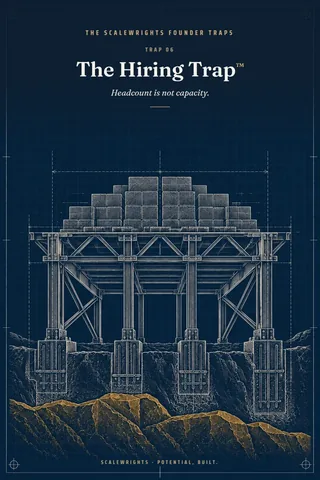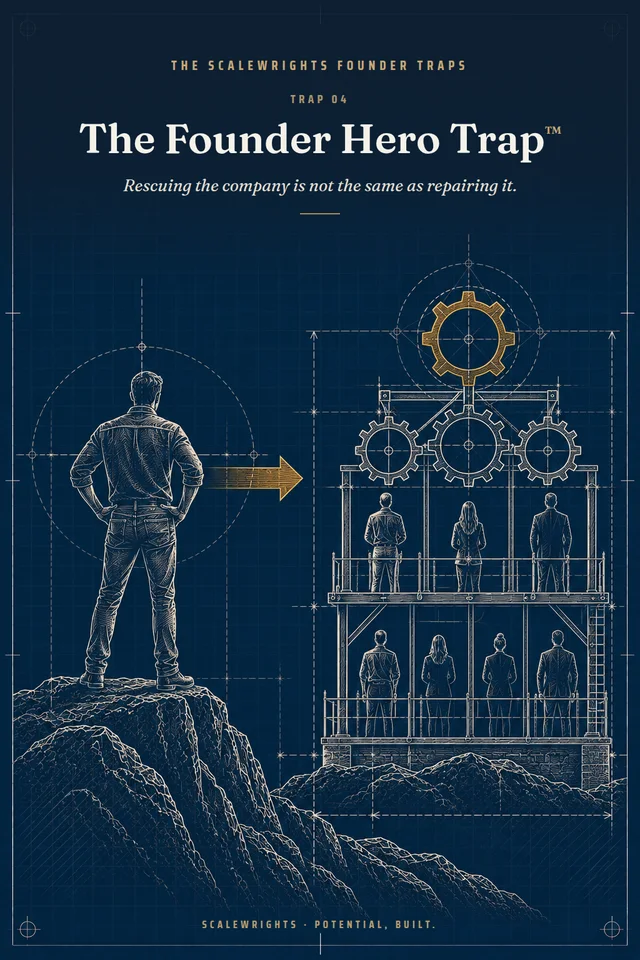
The Trap
The co-packer slips a week and you call the owner yourself, because you have his cell and your operations lead does not. The chain’s deduction is wrong and you argue it down, because you know the contract and nobody else has read it. The forecast is off and you rebuild the spreadsheet at midnight, because it is faster than explaining it. Each of these is the right call on the day. Each one works. That is the problem.
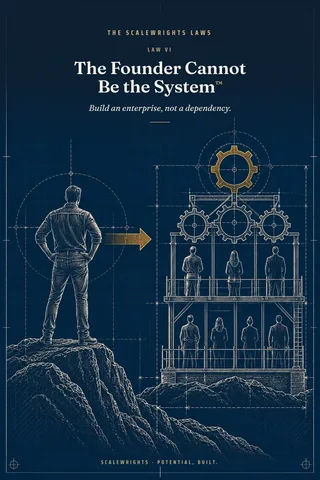
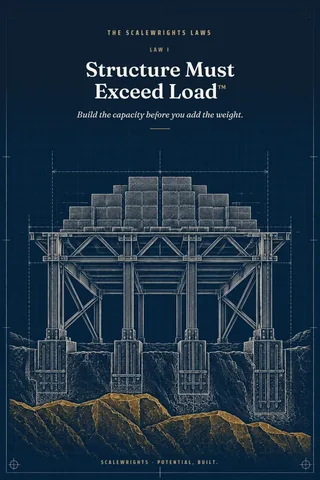
The Founder Hero Trap™ is what Law VI — The Founder Cannot Be the System™ — looks like from the inside. Rescue feels like leadership, and at small scale it is. But every rescue that works teaches the company that the system is fine, when the truth is that a person is compensating for the system. Law I — Structure Must Exceed Load™ — has a name for the work you did not do because the rescue was available: Structural Debt™.
You are not doing this out of ego. You are doing it because it is Tuesday and the truck has to leave. The trap is that the company learns to route every Tuesday through you, and you learn to read that routing as being needed, which is not the same as being a good CEO.
The tell
- Your calendar has no recurring meetings that would run without you and several that would not exist.
- The last three problems that were “solved” were solved by you and are on nobody’s process list.
- People come to you with questions they could answer, because the last time they decided, you re-decided.
- You cannot take ten working days away without the phone, and have not tried.
- The company’s best relationships — the co-packer, the distributor’s category manager, the lender — have your number and nobody else’s.
The arithmetic
Keep a log for two weeks of every decision that waited on you. One founder’s log, at $4,200,000 of revenue and fourteen people, had 214 entries. At twenty minutes each, that is 71 hours in two weeks — 35 hours a week of deciding things for other people, on top of the job. Of the 214, 161 were below $5,000 and 148 had a precedent in the previous quarter. Those are the ones a decision-rights page and a price band would have handled without you.
Now score the rescues for the same quarter.
| Rescue | Founder hours | What it saved |
|---|---|---|
| 4 expedited freight runs after production slips | 26 | $13,600 of chargebacks avoided |
| 2 deductions disputed personally | 18 | $8,200 recovered |
| 1 production slot renegotiated with the plant owner | 9 | The month’s shipments |
| 11 pricing exceptions approved one by one | 7 | Nothing measurable |
| Quarter | 60 | $21,800 in cash |
Sixty hours a quarter, about $87,000 a year of rescued cash, and the same four problems back next quarter. Compare the repair: a demand planner at $85,000, loaded to about $102,000, and a written forecast-to-production process. Three of the four freight expedites do not happen. The deductions are disputed from a log by the controller, who is better at it. The pricing exceptions become a band that the sales lead can approve inside. The founder gets 240 hours a year back — and more than that, the company gets a system where it had a person.
Then run the Founder Dependency Index™: twelve domains, and for each, can it run 30 days without you? The company in the log scored nine of twelve as no. That number is the one a buyer’s team will find in a week of diligence, and Law VI says what they will do with it.
The fix
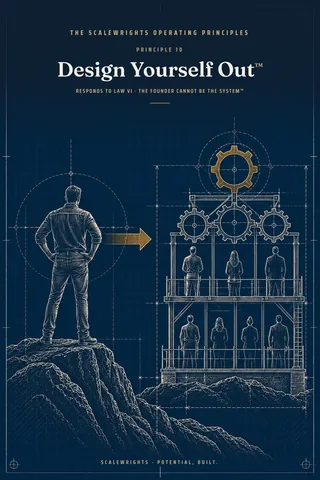
Law VI’s rule is to build an enterprise, not a dependency, and the move is from doing to deciding to designing. Law I’s rule is that the rescue is a symptom: the structure was already below the load, and the founder is the margin of safety. Repair means paying down the Structural Debt the rescue has been hiding.
Build the Owner Map™. For every outcome the rescues touched — production schedule, deductions, pricing, the forecast — name the primary owner, the backup, the decision rights, the metric, and the escalation threshold. Where your name is still primary, that is the dependency, on paper. Then run the Founder Test™: one day unavailable for routine decisions, then a week, and write down what stops.
Run the Founder Dependency Gate™ before the next growth step. What still requires you? Which of those are critical? Who owns them next, and what authority do they need? The Gate answer this usually produces is NOT YET — not the next retailer, not the next raise, until the nine become five and the next rescue has a name on it that is not yours.
Log every decision that waits on you for two weeks, and sort it into the ones with a precedent — those become rules by the end of the month.
Score the Founder Dependency Index across 12 domains and pick the three lowest to transfer this quarter, each with a named owner and a date.
Take five working days away from routine decisions within 90 days, and treat what breaks as the repair list, not a reason to come back early.
The Build Line™ Workbook’s Template 3, 03_Decision_Inventory_and_Rights.xlsx, is the two-week log sorted into the four kinds, the decision-rights matrix with limits by role, and the six decisions the founder keeps. Template 4, 04_Role_Charters_and_Span.xlsx, gives every seat a charter — decides, delivers, measured by — and Template 11, 11_Bench_and_Succession.xlsx, puts a named second and a dated cover on every seat, the founder’s included. Template 6, 06_Process_Register.xlsx, tests each process with a stranger. Start with the check at /build-line.html.
SCALE — this trap belongs to The Build Line. Take the check at /build-line.html.
Take the Scale Readiness Check →