The Principle
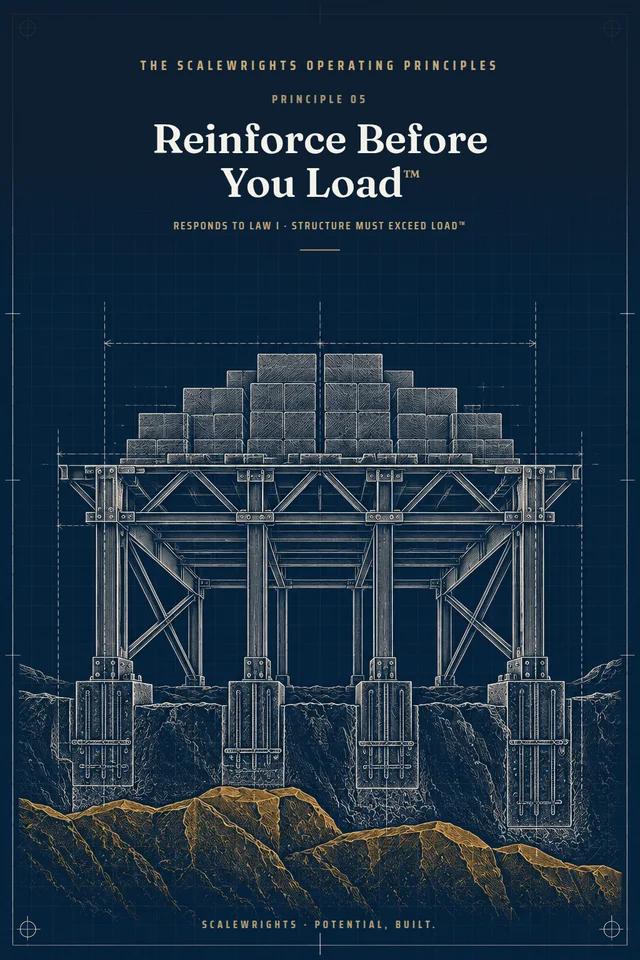
This is the operating response to Law I — Structure Must Exceed Load™. The Law says what is true about every company. This is what I want you to do about it.
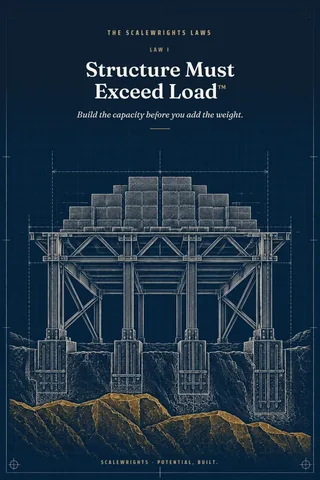
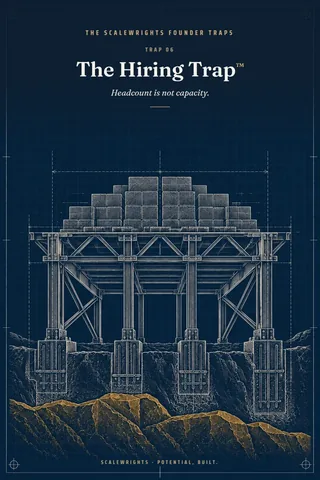
I want you to imagine your company as a bridge. When the bridge is carrying 10 tons, you can get away with a certain amount of structure. Then the load becomes 20 tons. Then 50. Then 100. At some point you have only two choices: strengthen the bridge or reduce the load. What you cannot safely do is keep adding weight and hope the structure somehow figures it out.
Businesses work the same way. Every new customer creates load. Every retailer, every SKU, every employee, every production run, every distributor, every geography, every dollar of growth. Revenue can grow much faster than structure. That is why a company can look more successful from the outside while becoming more fragile underneath.
If you want to build a bigger company, first build a company capable of being bigger.
Growth adds weight before it adds strength
A national retailer, a distributor, a new SKU, a major customer, or an international market may be excellent. But every opportunity comes with a load profile: inventory, payment terms, trade spend, forecasting complexity, deductions, production, working capital, service requirements, and leadership burden. Ask: what load does this opportunity place on the system?
Success changes the engineering requirements. A $2 million company does not need the same finance function as a $30 million company. DTC does not require the same forecasting capability as national retail. One product does not create the supply-chain complexity of twelve. What was appropriate at one stage can become dangerous at the next.
Your company gives you warning signs
Inventory is wrong. Forecasts are missed. Production gets expedited. Service deteriorates. Cash tightens. Meetings multiply. Decisions slow. People work later. Margins get harder to explain. The founder gets pulled back into operations. The load has reached the structure.
Heroics are Structural Debt™
Great people can hide weak structure. But repeated heroics mean the system required human overperformance to compensate for structural underdevelopment. That is Structural Debt™, and the interest is paid in burnout, mistakes, turnover, margin erosion, lost customers, and cash.
When structure is weak, the founder becomes the shock absorber — coordinating departments, covering leaders, calling customers, finding money, intervening in production. The Founder Is Not the Business.™ Stop being the permanent shock absorber between load and structure.
Measure load before accepting it
A PO is both validation and commitment. Before celebrating a national retail launch, understand the units, MOQs, lead time, shelf life, inventory buffer, payment terms, trade spend, deductions, fill rate, downside, upside, working capital, and manufacturing capacity. Evaluate the load, not merely the opportunity.
That is the Load Test, and it belongs before the commitment, not after the problem. What load are we actually adding? Where will it land? Which capital becomes the constraint? What happens if the load is greater than expected? What happens if the return is lower?
There are five kinds of load
Financial load: cash, inventory, receivables, trade spend, payroll, deposits, freight, capital expenditure. Operating load: production, quality, forecasting, warehousing, replenishment, compliance, systems. Human load: people, capability, bandwidth, ownership, leadership. Relational load: retailers, distributors, suppliers, co-manufacturers, brokers, investors, partners. Intellectual load: more SKUs, forecasts, pricing, requirements, contracts, formulations, decisions, and institutional knowledge.
The Five Capitals — FORHI — must stay ahead of each:
FINANCIAL CAPITAL > FINANCIAL LOAD OPERATING CAPITAL > OPERATING LOAD RELATIONAL CAPITAL > RELATIONAL LOAD HUMAN CAPITAL > HUMAN LOAD INTELLECTUAL CAPITAL > INTELLECTUAL LOAD
If load consistently exceeds capital in one critical area, that area becomes the constraint.
The weakest beam governs the structure
You can have demand and no working capital. Cash and no manufacturing. Manufacturing and poor forecasting. Great operations and weak leadership. A brilliant team and one critical ingredient with a 20-week lead time.
So ask: if the plan works exactly as intended, what breaks first? Can you fund it, make it, ship it, replenish it, support it, maintain quality, manage cash, and carry the success? Success Can Kill the Company™. Find the constraint before it finds you.
Capacity is not capability
Another warehouse, production line, employee, software platform, or capital raise creates capacity. Capability means the system can reliably convert resources into outcomes. Do not add infrastructure for its own sake. Build the capability required to carry the load.
And do not hire around a broken system. Everyone is overwhelmed, so you hire. But the issue may be structure: unclear priorities, weak ownership, too many SKUs, bad meetings, weak forecasting, too many approvals, founder dependency. Ask: are we understaffed, or structurally inefficient?
Complexity is load you chose. The seventh flavor, the custom pack size, the low-margin customer, the legacy SKU, the manual workaround — each seemed reasonable. Together they are complexity load. Every addition should have to earn the complexity it creates.
Build ahead of the load — but not too far ahead
Do not build a $100 million infrastructure for a $5 million company. Structure should exceed load, not dwarf it. I want you just ahead of the load.
Think in load-bearing stages: founder-led to team-led, DTC to omnichannel, regional to national, single product to portfolio, single manufacturer to resilient supply network, founder relationships to enterprise relationships. Before crossing each line, ask: what must be stronger first?
Use the Gate
Score the Five Capitals before major commitments. If a critical capital is weak, strengthen it, reduce the commitment, stage it, delay it, test first, or do not proceed.
GO · GO SMALL · NOT YET · NOT THIS
Stage commitment whenever you can. Test 100 doors before 3,000. One geography before five. Two SKUs instead of eight. Contract capacity before owning it. Validate demand before building inventory. Hire the constraint before building the department. Buy Information Before You Buy Scale™.
“Not yet” can be an excellent decision. Not yet until working capital is secured, until manufacturing is validated, until contribution works, until the leader is hired, until the forecast is credible, until the product has evidence. That is earning the right to move fast.
Maintain a Structural Reserve™
Structural Reserve™ is the difference between what the system can safely carry and what it is carrying now. Maintain reserve in cash, manufacturing, leadership, supplier capacity, systems, people, and time. A company operating permanently at 100 percent of capacity is brittle.
The Scalewrights view
The goal is not to see how much weight your company can survive. The goal is to build a company that gets stronger as it grows.
Ask what breaks first — tonight. Imagine your current growth plan works 100 percent. What breaks first?
Map the load across the Five Capitals for your single biggest opportunity in the next 12 months. Write five lines: financial load, operating load, human load, relational load, intellectual load. Answer: what will this require from us if it succeeds, and where are we least prepared to carry it? Circle the weakest area.
Reinforce one beam before the opportunity places its full weight on the company. Name the single constraint most likely to limit the next stage of growth. Define current capacity, expected load, required reserve, the gap, the owner, the plan, and the evidence of readiness.
The Load Test and the Gate, run before the commitment. The Build Line™ is where they live on a calendar — the five capitals a buyer prices in the first hour, the margin stress test, the Gate card that puts Law I on one page, and twenty live templates — $399 on Gumroad (scalewrights.gumroad.com/l/build-line).
Open the workbook →SCALE — score your five capitals free with the Scale Readiness Check at /build-line.html.
Take the Scale Readiness Check →