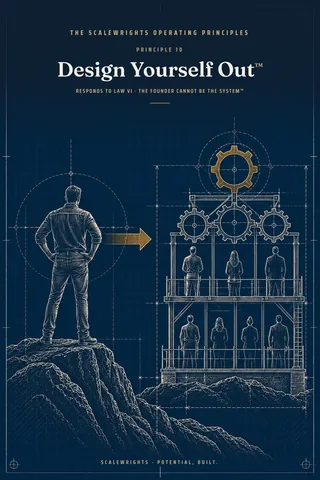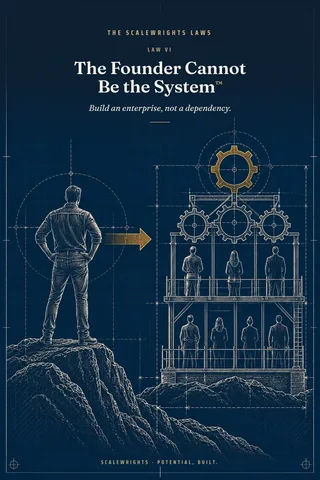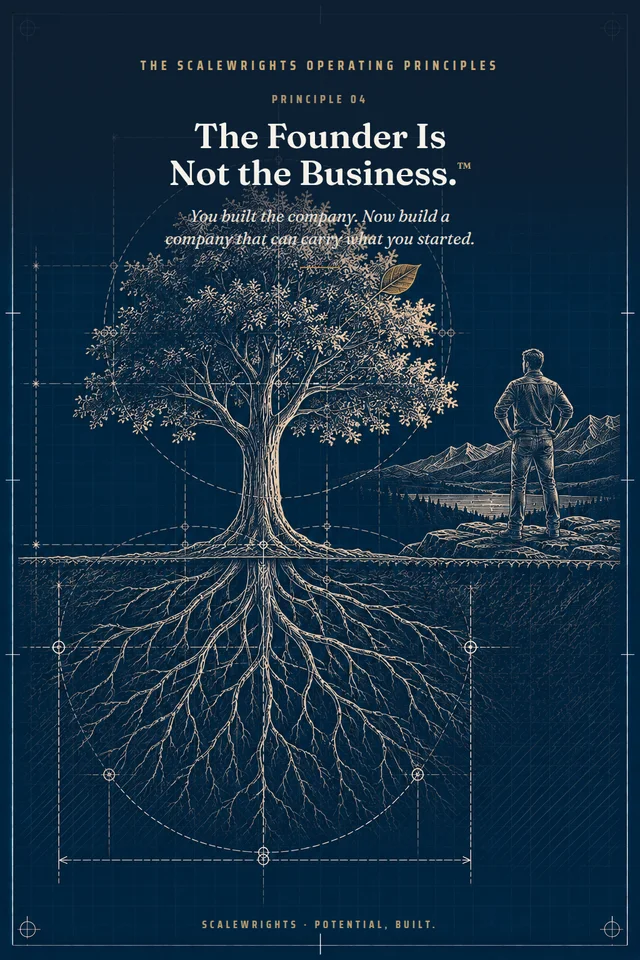
The Principle
I want you to stay important to your company. I just do not want the company to require you for everything. Those are very different things.
In the beginning, the founder is the business. You develop the product, find the manufacturer, make the first sale, approve packaging, solve quality problems, manage cash, recruit the team, call the retailer, calm the investor, and make the decision. Early on, that is often exactly what is required.
But something dangerous happens as the company grows. Revenue gets bigger, the team gets bigger, the stakes get bigger, and the operating model does not change. Everything still runs through you. At that point, the behavior that helped create the company begins limiting it.
The Founder Is Not the Business.™ You created it. You may own it. You may lead it. But if the company cannot function without your constant intervention, you have not finished building it yet.
Founder dependency usually starts as a strength
You are fast, contextual, committed, and close to the problem. People bring you issues because you can often solve them in five minutes. But every time the organization learns that the fastest way to solve a hard problem is to bring it to you, it stops learning how to solve hard problems without you. That is the trap.
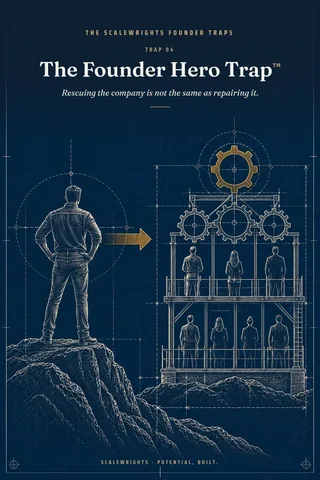
Heroics do not scale. A founder saving a production run is impressive. Afterward, I want you asking: what did we build so that this does not require me next time? If the answer is nothing, you solved the incident. You did not solve the system. The founder’s instinct is to fix the problem. The builder’s instinct is to fix the capability that allowed the problem to require the founder.
You can grow revenue faster than you grow the company
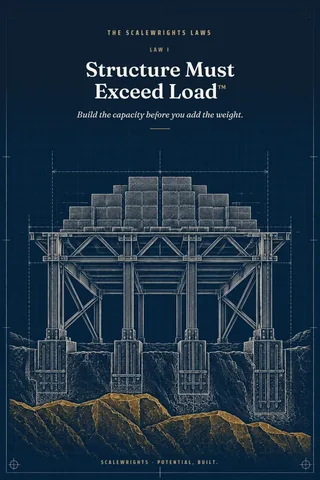
At $2 million, the founder can know everything. At $10 million, most things. At $25 million, cracks appear. At $50 million, a founder-centered operating system becomes dangerous. More customers, SKUs, retailers, people, inventory, suppliers, production runs, forecasts, contracts, decisions, and consequences. Structure Must Exceed Load™. As load increases, structure must get stronger.
The company needs an operating system
Imagine removing yourself for 30 days. Can people decide? Manage pricing? Handle inventory? Manage production? Update forecasts? Protect cash? Hire? If the company becomes confused without you, too much of the operating system still lives inside your head. Move it into the company.
Hypo Energy’s founder found out by accident. Thirty-six months in, a birth announcement took him out for two weeks. Nothing caught fire. Nothing moved either: 41 decisions waited for him. Nine could have been made by someone else if that person had been told they could. Seventeen needed information only he had. Fifteen needed an approval only he could give in a system. Zero were hard.
Transfer context, not just tasks
Task delegation without decision authority is distributed execution with centralized judgment. Transfer context, standards, decision criteria, authority, accountability, information, and economic understanding. That is how capability moves into the organization.
Decision rights matter. Some decisions should remain yours. Some should require consultation. Some should be fully delegated. Some should be governed by clear rules. Put each decision at the correct level of the organization.
And do not delegate chaos. Before transferring something important, ask: is the outcome clear? The standard? The ownership? Does the person have the information, understand the economics, and hold authority equal to responsibility? Is escalation defined? Do not transfer confusion.
Build guardrails instead of approval chains
Instead of “ask me before discounting,” use contribution thresholds. Instead of “ask me before placing inventory,” use approved demand ranges and working-capital limits. Instead of “ask me who to hire,” use scorecards, compensation bands, and final approval conditions. Guardrails create controlled autonomy.
Your job should change as the company changes
DO → MANAGE → LEAD → DESIGN → ALLOCATE → STEWARD.
At the beginning, you create output. Later, you create the system that creates output. You trade personal control for organizational capacity.
Founder dependency has an economic cost
Founder-dependent companies grow more slowly, repel strong executives, burn people out, make succession and financing harder, and eventually affect valuation. The Multiple Is Built.™ A sophisticated buyer asks: what happens if the founder is not here? If the answer is “most of this stops,” they have found risk, and they price it as a founder discount.
So relationships must become company assets. The retailer may trust you. So may the manufacturer and the investor. Broaden the relationship. Create multiple points of connection. And knowledge must become company property: formulation history, supplier history, promotion economics, and pricing architecture should not live only in your head. Turn experience into Intellectual Capital.
Build leaders, not assistants
An assistant helps you do your job. A leader removes an entire class of decisions from your job. The test is not “did I hire someone?” It is “did organizational capacity increase?”
And do not become the answer machine. When someone asks what they should do, ask what they think, why, what evidence supports it, what could make them wrong, and what they would decide if you were not there. You are developing judgment.
Your calendar will tell you the truth
Look at where your time went last month. If most of it is recurring operating issues, ask why the organization still requires the founder for these things. Your calendar is a diagnostic instrument.
Then run the Founder Dependency Index™. List the ten most important recurring responsibilities and score your involvement in each: 0, not involved; 1, informed; 2, advise; 3, approve; 4, personally drive. If you are a 3 or 4 across most of the company, that is a scaling constraint.
Transfer one layer at a time: DOCUMENT → TEACH → DELEGATE → OBSERVE → CORRECT → TRANSFER. Build capability deliberately.
The goal is not absence
How much of the company can operate without you? Can it still sell, produce, collect, forecast, hire, protect cash, and hit the plan? If not, you have found unfinished construction. Your freedom is a business metric.
I want your contribution concentrated where your judgment, relationships, vision, creativity, and leadership create disproportionate value. The company should get more of your highest-value contribution and less of your routine intervention.
The Scalewrights view
I want you to build a company that benefits enormously from your presence but is not endangered by your absence. Early productivity means doing more yourself. Later, productivity means building more capability in others.
Find where you are still the system — score your ten most important recurring decisions 0–4 this week. Take your calendar from the last 30 days and circle every recurring activity, approval, decision, or problem that came to you but should not require the founder.
Choose one decision and transfer it in the next 30 days. Define the outcome, the owner, the information, the guardrails, the limits, the escalation, and the metric. Document it, teach it, assign the owner, and let the decision go.
Recover the hours and reinvest them upward. Strategy, capital allocation, leadership, product, culture, and enterprise design. Every meaningful decision the company learns to make well without you is capacity you just added to the enterprise.
The Founder Dependency Index™ is the score; the Owner Map™ — primary owner, backup owner, decision rights, metric, and escalation threshold for every major outcome — is where the transfers are written down. The Build Line™ is the build on a calendar: its Workbook carries the decision inventory and the decision-rights matrix, then the cadence, the process register, and the bench — twenty live templates, $399 on Gumroad (scalewrights.gumroad.com/l/build-line).
Open the workbook →SCALE — score your five capitals free with the Scale Readiness Check at /build-line.html.
Take the Scale Readiness Check →