The Principle
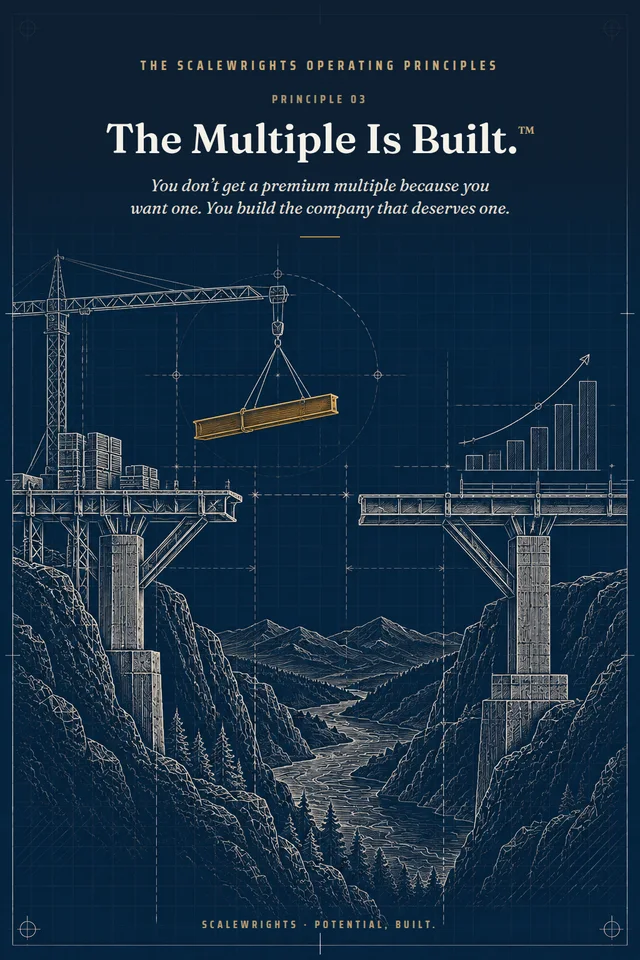
I want you to stop thinking about your multiple as something that gets decided when you sell your company. It does not. The number may get negotiated then. The multiple itself has been under construction for years.
Every time you improve gross margin, contribution, repeat, concentration, supply-chain resilience, forecasting, leadership depth, IP protection, or founder independence, you are building it. Every time you add complexity without economics, chase low-quality revenue, let one customer become too important, tolerate sloppy reporting, or make the company more dependent on you, you may be doing the opposite.
The multiple is not an exit event. It is the accumulated result of how you build the company. If you want a better multiple someday, build a better business today.
First, understand what a multiple actually is
Founders sometimes talk about valuation multiples as though they are market prices. A multiple is not a reward for being in the right category. It is the market’s shorthand for a much larger judgment: how much confidence do I have in the future cash flows of this company? The more durable, predictable, transferable, and scalable those economics appear, the more someone may pay for them. A multiple is a price placed on confidence in future economic performance.
Same revenue. Different value.
Two VMS companies can both have $30 million of revenue and 25 percent growth. Company A has strong margins, repeat, velocity, diversified customers, efficient inventory turns, disciplined working capital, a redundant supply chain, accurate forecasting, documented quality, protected IP, strong management, and low founder dependency. Company B has growth driven by more doors and heavy promotion, unclear contribution, unmeasured repeat, 42 percent customer concentration, inventory growing faster than revenue, frequent expediting, inconsistent forecasting, founder-owned supplier relationships, undocumented processes, and constant founder approvals.
Same revenue. Very different asset. The market is pricing the quality underneath the revenue.
Multiples compress uncertainty
Worth More Than It’s Getting.™ introduced the idea that unsupported value creates an Evidence Gap™. UNCERTAINTY → RISK → DISCOUNT. The inverse matters too: EVIDENCE → CONFIDENCE → OPTIONALITY → VALUE.
Do not ask how you get a 5× multiple. Ask what would have to be true about this company for a sophisticated buyer to believe it deserves one. Then build those inputs.
Revenue quality matters more than revenue quantity
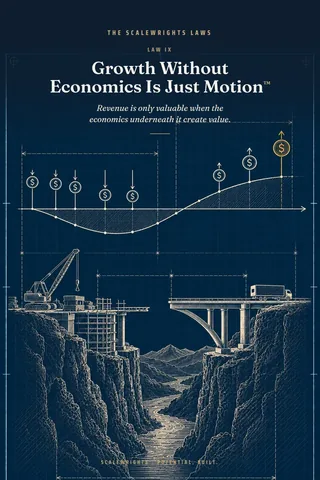
A national retailer may offer $8 million of incremental revenue and require $2 million of inventory, longer terms, heavier trade spend, custom packaging, larger runs, lower pricing, more freight, another employee, higher returns and deductions, and 35 percent customer concentration. Is that $8 million valuable? Maybe. Maybe not. Ask what the revenue does to the quality of the enterprise. Motion Is Not Progress™.
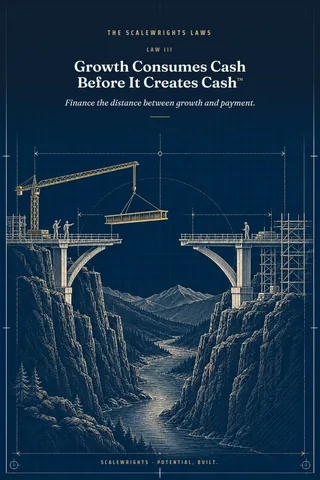
Cash quality matters too. A fast-growing VMS or beverage company pays for ingredients, packaging, manufacturing, freight, slotting, trade spend, people, and inventory before the cash returns. Growth Eats Cash First™. A business that needs enormous incremental capital to generate each new dollar of revenue is a different asset from one that can grow on modest capital. Know your cash conversion cycle.
Predictability earns confidence
One of the most valuable characteristics a company can develop is predictability. Track forecast accuracy across revenue, margins, inventory, production, cash, velocity, acquisition, repeat, and promotional performance. A company that can predict itself is usually becoming a company that understands itself.
Concentration and complexity
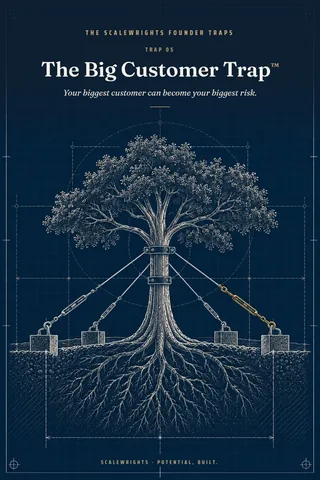
If one retailer is 50 percent of revenue, one co-manufacturer produces every unit, one supplier controls a critical input, or one founder owns every relationship, the buyer sees dependency. Concentration creates risk, and risk creates discount. Identify concentration before someone conducting diligence identifies it for you.
Complexity has a cost as well. Another SKU, flavor, channel, retailer, distributor, country, pack format, or promotion may create revenue. It also creates forecasting, inventory, MOQs, working capital, production complexity, quality exposure, and coordination. Structure Must Exceed Load™. There are times when saying no to revenue increases enterprise value.
The founder discount matters
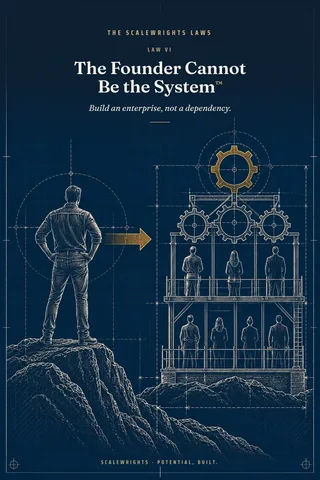
If you are the primary salesperson, the relationship owner, the price approver, the manufacturing contact, the formulation expert, the recruiter, the capital raiser, and the strategic integrator, you may have built a successful company but not yet a transferable enterprise. The Founder Cannot Be the System™.
Transfer capability without surrendering leadership. Your role should move upward: from doing to managing to leading to allocating to designing to deciding to stewarding.
Build the Five Capitals
Together, the Five Capitals — FORHI — increase the quality of the asset.
Financial Capital: better margins, cash conversion, liquidity, reporting, predictability. Operating Capital: manufacturing resilience, quality, forecasting, supply-chain depth, inventory discipline, documented processes. Relational Capital: durable customer, supplier, retail, distributor, and strategic relationships owned by the enterprise. Human Capital: leaders, decision rights, accountability, depth, succession. Intellectual Capital: formulations, IP, data, processes, institutional knowledge.
Build the re-rate
Think of your company as carrying a Re-Rate Gap™ — the distance between the quality you have built and the quality the market perceives. Maybe concentration is 35 percent and you want it under 20. Maybe contribution is 12 percent and you want 20. Maybe inventory turns are three and you want five. Maybe the founder owns every major relationship and you want a commercial leader to own most. Those are operating projects.
Then track a small set of quality metrics: growth, economics, repeat, cash, inventory, concentration, operations, people, founder dependency, and evidence. Do not build a fifty-metric dashboard. Build one with the ten that matter, and ask it every month: did we merely become bigger, or did we become better?
Protect optionality. Don't build for the buyer.
A better company gives you choices: raise or not, borrow or not, recapitalize, acquire, sell, hold, step back, stay involved, pass ownership. A strong enterprise preserves options. A fragile one removes them.
Think like a buyer, but build the company for yourself. Strong economics, leadership, cash conversion, low concentration, predictable systems, protected IP, and clear reporting make the company better to own even if you never sell.
The Scalewrights view
Enterprise value is something you manufacture. Capital, people, products, relationships, knowledge, and time become capability. Capability produces performance. Performance produces evidence. Evidence reduces uncertainty. Reduced uncertainty increases confidence.
POTENTIAL → EVIDENCE → CAPABILITY → REPEATABILITY → ECONOMICS → TRANSFERABILITY → ENTERPRISE VALUE.
The multiple sits at the end of a long chain of things you control.
Divide one page into three columns tonight: builds our multiple, kills our multiple, our 180-day re-rate. Put three items in the first column — what a sophisticated investor would value most — and three in the second — what someone would use to argue for a lower valuation.
Choose one 180-day re-rate. One item in the third column, with a baseline, a target, an owner, a deadline, and the evidence threshold that proves it.
Write the first 30 days. What happens in the next 30 days, and who does it. The best time to improve the quality of your company is not when someone is standing in your data room. It is while you still have time to build it.
The Build Line™ — the five capitals a buyer prices in the first hour, five camps, four gates a stranger can check, and twenty months walked once, with the Workbook’s twenty live templates — $399 on Gumroad (scalewrights.gumroad.com/l/build-line). The Scalability Quotient is the score underneath it: all five capitals measured, one number for what is ready to scale and what will crack under pressure. When the re-rate needs more than a founder’s evenings, The Re-Rate 180 runs it alongside you.
Open the workbook →SCALE — score your five capitals free with the Scale Readiness Check at /build-line.html.
Take the Scale Readiness Check →