The Principle
I want you to think about your company differently. Not simply as something that produces revenue, or a brand you are trying to grow, or something you may sell someday. I want you to think of it as an asset whose value you are building every day.
Two questions every founder should be asking: how good is this company becoming? And will the market recognize how good it has become? They sound similar. They are not.
You can build a good business and still receive a disappointing valuation. You can grow revenue and still receive a weak multiple. That is one of the most frustrating positions a founder can be in: the company is worth more than it’s getting.
Sometimes the market is wrong. More often, the company has not yet done enough to make its value undeniable. You cannot control what someone will pay. You can control what you build, what you prove, and how much uncertainty you remove.
Value creation and value recognition are different jobs
Value creation is the work of making the company better: products, economics, margins, customers, velocity, systems, leadership, cash generation, repeatability. Value recognition is the work of making those improvements visible, credible, and transferable to someone outside the company.
You need both. A weak company with a great story gets exposed. A strong company with poor evidence gets discounted. Build the value. Build the proof.
The market does not know what you know
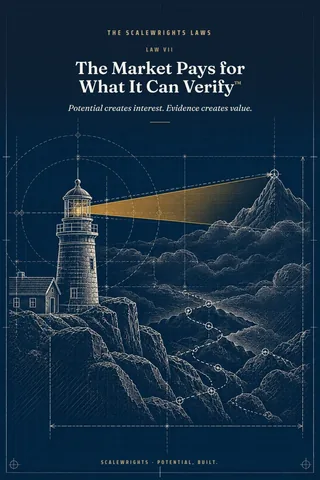
You have an informational advantage. You know why the product works, why last quarter’s margin was unusual, and what is coming next. An investor, lender, or buyer does not. They underwrite what they can observe. That is why The Market Pays for What It Can Verify™.
The distance between what you know to be true and what an outsider can independently verify is your Evidence Gap™. Evidence Gaps become valuation gaps.
Uncertainty gets priced
Imagine two beverage companies with the same revenue and growth rate. Company A has clean financials, contribution margin by SKU and channel, documented repeat, manageable concentration, measured forecast accuracy, clean IP, a capable management team, and low founder dependency. Company B has financials that require explanation, unclear contribution, unmeasured repeat, high concentration, spreadsheet forecasting, founder-owned supplier relationships, messy IP documentation, and constant founder approvals.
Same revenue. Same growth. Very different companies — because Company B requires the buyer to underwrite more uncertainty.
UNCERTAINTY → RISK → DISCOUNT.
When a buyer cannot verify something important, they lower the multiple, change the structure, and add earn-outs, holdbacks, or escrow. Verification removes reasons to discount the company.
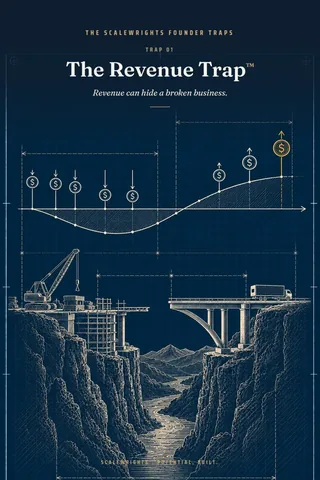
Revenue is not enterprise value
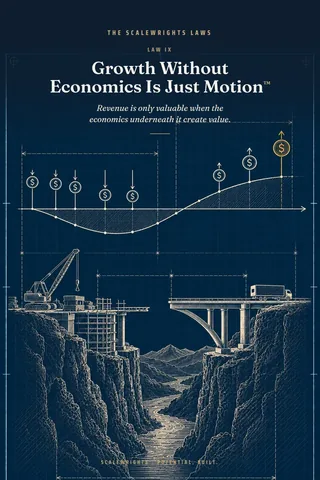
In VMS and beverage, sophisticated capital looks underneath revenue. At what margin? At what contribution? How much inventory and working capital? How fast does cash return? How concentrated? How much repeat? What happens if the founder leaves? The headline is revenue. The value lives underneath it. Motion Is Not Progress™.
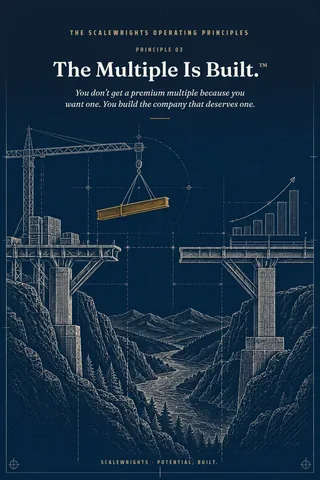
And your multiple is being built right now. Founders think valuation happens when capital is raised or the company is sold. The negotiation happens then. The value was built years earlier — in decisions about concentration, pricing, SKUs, senior hires, contracts, financings, and founder dependence. Those decisions accumulate. The Multiple Is Built.™
Build the Five Capitals
The Five Capitals — FORHI — explain why two companies with similar revenue command radically different values.
Financial Capital: cash, margin, working capital, cash conversion, clean reporting. Operating Capital: manufacturing, quality, supply chain, forecasting, inventory discipline. Relational Capital: customers, retailers, suppliers, co-manufacturers, distributors, investors. Human Capital: leadership, accountability, decision rights, management depth, succession. Intellectual Capital: formulations, data, consumer insight, trademarks, patents, trade secrets.
Reduce the founder discount
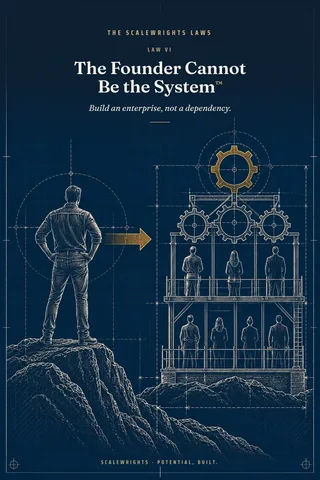
I want you valuable. I just do not want the company to be valuable only because of you. If you personally own the customer relationships, make the pricing decisions, know the formulas, approve the hires, raise the money, and solve every serious problem, you represent key-person risk — and a buyer prices it as a founder discount. The Founder Cannot Be the System™. Convert your knowledge into institutional knowledge, your relationships into company relationships, your judgment into principles, your decisions into decision rights.
Build Quality of Revenue™
High-quality revenue has strong contribution, strong repeat, healthy velocity, good cash conversion, low dependence on discounting, low concentration, and durability. Do not just ask how much revenue you can get. Ask what kind of revenue you are building.
Make the business easier to understand
Sophistication is clarity. Clean metrics, clear ownership, clear economics, clear reporting, clear evidence. A sophisticated investor should be able to look at the business and think: I understand how this company creates value. And document what the company has learned — ingredients, claims, co-manufacturers, MOQs, promotions, cohorts, pricing. What the company knows should belong to the company.
Build the Receipts File™
Every important claim should have evidence. “Velocity is improving” — show the trend. “Customers repeat” — show the cohort. “Manufacturing is reliable” — show fill rates and quality metrics. “Leadership can run the company” — show decision ownership. “Founder dependency is down” — show what has transferred.
CLAIM → METRIC → SOURCE → TREND → PROOF.
Now imagine you are a skeptical buyer. For every major value claim, ask: can I prove this? If not, you have found an Evidence Gap. The claim may be true. The market may still have difficulty paying you for it.
Don't wait for diligence
Do not wait until someone wants to invest or acquire to find contracts, organize IP assignments, or reconcile margins. I want you building a company that is always capable of surviving diligence.
The Re-Rate Gap™ is the distance between the quality of the company you have actually built and the quality the market currently perceives. Ask what would cause a sophisticated investor to assign a higher-quality multiple — margins, concentration, repeat, cash conversion, leadership depth, founder independence, better evidence. Then work backward. I am not asking you to dress up the company. I am asking you to improve it, and to make that value easy to verify.
The Scalewrights view
I want you to build a company worth owning, then worth investing in, then worth acquiring. You do not have to raise or sell. The disciplines that make a company attractive to sophisticated capital are the same disciplines that make it better for you to own. Value creates optionality.
Write down the five claims that justify your value. Not twenty. Five. Under them, one page with three headings: what we say we’re worth, what the evidence proves, what is creating the discount.
Put evidence behind each claim within 30 days. Ask what would convince a skeptical investor each one is true, and file the metric, the source, and the trend.
Name your biggest valuation discount and fix it in 180 days. If someone were trying to lower the value of your company today, what would they point to first? That is your largest Re-Rate Gap. Do not defend it. Choose the one issue that, materially improved over the next 180 days, would most raise the quality or perceived value of the enterprise, and start there.
The Summit™ — the fourteen pages a buyer’s team prices in the first hour, with the Workbook’s fourteen live templates, from the buyer’s first hour to the valuation bridge — $499 on Gumroad (scalewrights.gumroad.com/l/summit). When the discount is bigger than a founder’s evenings, The Re-Rate 180 is the engagement behind it: 180 days run alongside you, with the buyer’s inspection run on your own file first.
Open the workbook →SELL — score your file free with the Summit Check at /summit.html (raising instead: the Seed Readiness Check at /seed-file.html).
Take the Summit Check →