The Principle
I want you to believe in the potential of your business. You should. You saw something before other people saw it — a consumer need, a better formulation, an underserved market, a new channel. Seeing what could be is part of what makes you a founder.
But I want you to understand something equally important: the market does not reward potential forever.
Eventually, potential has to become something. A product people buy, then buy again. Margin. Cash. Reliable manufacturing. Distribution that produces velocity. People who can make good decisions without waiting for you. Systems that work on an ordinary Tuesday when nobody is performing heroics. And, in the end, an enterprise that creates value without depending on the founder who imagined it.
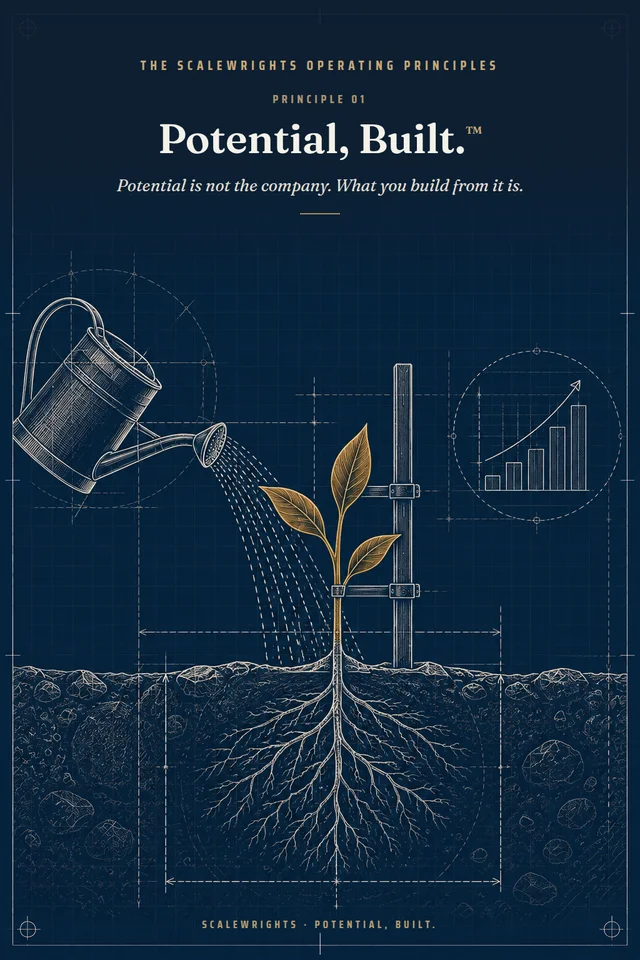
That is what we mean by Potential, Built.™ Your job is not merely to see the future. Your job is to build the company capable of reaching it.
Potential is where every founder begins
Every meaningful company begins with something that does not exist yet. You can see the energy product before there is a formula, the national retailer before your first case ships, $100 million of revenue when the company is doing $1 million.
I do not want to take that away from you. I want you to protect it. But I also want you to separate vision from evidence. Vision tells you where you might go. Evidence tells you whether you are getting there. The most important transition you will make as a founder is the move from “I believe this can work” to “Here is the evidence that it works.” That is when potential starts becoming enterprise value.
Potential has to be converted
Think of potential as raw material. It has value only because of what can be made from it. A great formulation is potential. So are a beautiful brand, a meeting with a major retailer, a purchase order, a new executive, a large addressable market.
Keep asking: what has this potential actually been converted into? Instead of celebrating distribution, examine velocity. Instead of the first purchase, repeat. Instead of revenue, contribution. Instead of the production run, sell-through and cash conversion. Instead of the hire, whether capacity increased. Instead of the raise, what the capital built.
Believe aggressively. Build deliberately.
The Scalewrights conversion chain
I want you to think about your company as a series of conversions:
POTENTIAL → EVIDENCE → CAPABILITY → REPEATABILITY → ECONOMICS → TRANSFERABILITY → ENTERPRISE VALUE
Each stage earns the next.
Potential → Evidence. First, prove that something is true. Will people buy, at that price, and buy again? Can you manufacture it? Can the channel support the economics? You do not need certainty. You need enough evidence to justify the next commitment. That is why one of our Laws is Capital Follows Evidence™.
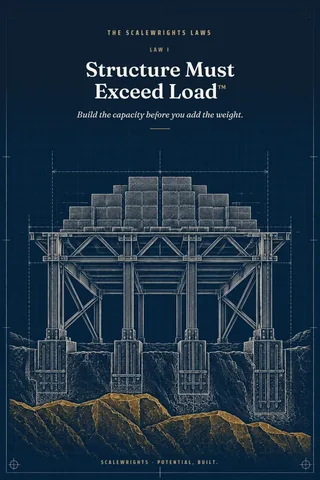
Evidence → Capability. Knowing something works is not enough. Now you have to deliver it. Your energy gummy gets traction: can you manufacture consistently, finance inventory, survive 60-day terms, and fund the next run before you have collected on the last one? That is why another Law is Structure Must Exceed Load™. Opportunity creates load. Capability carries it.
Capability → Repeatability. Doing something once proves you can do it. Doing it repeatedly proves you have a business. One production run is not a manufacturing system. One retailer launch is not a channel strategy. Ask: can we do it again? Then: can someone other than me do it again? That second question is where companies begin becoming enterprises.
Your company has five kinds of capital
I do not want you thinking about capital as just money. The Five Capitals — FORHI — are how potential gets built.
Financial Capital: cash, working capital, margin, runway, access to financing. Operating Capital: manufacturing, supply chain, quality, systems, forecasting. Relational Capital: customers, retailers, suppliers, co-manufacturers, distributors, investors. Human Capital: leadership, talent, accountability, decision rights, depth. Intellectual Capital: formulations, consumer insight, data, processes, IP.
Revenue is not one of them. Revenue is an output. These five are what let you produce revenue repeatedly, economically, and at increasing scale.
Growth can fool you
In VMS, beverage, supplements, and consumer products, you can grow very quickly and still weaken the company. More doors, more SKUs, more inventory, more people, more revenue. Everything looks bigger. Underneath, cash may be disappearing, inventory aging, contribution falling, and the founder making more decisions than ever. You are moving. But are you building? That is why Motion Is Not Progress™.
And do not confuse distribution with demand. Distribution gives you the opportunity to prove demand. It does not prove it. I would rather see 500 doors producing exceptional velocity, strong repeat, and healthy contribution than 2,000 doors accumulating inventory. One creates evidence. The other creates exposure.
So build the economics underneath the growth. Know exactly what happens to a dollar from the moment a consumer buys your product — shelf price minus retailer margin, distributor margin, trade spend, broker expense, freight, and landed cost — and then how much working capital that revenue required and how long the cash was tied up. I do not want you building revenue that impresses people. I want you building economics that compound.
Then build yourself out of it
You know the product, the customer, the supplier, the pricing, and the history. That makes you valuable. It can also make you dangerous: if the business works primarily because you work, you have not finished building it. Your knowledge must become company knowledge, your relationships company relationships, your judgment decision rights, your standards systems. That is why The Founder Cannot Be the System™. I want you increasingly important to the company’s future and increasingly unnecessary to its routine operation.
Potential becomes valuable when someone else can verify it
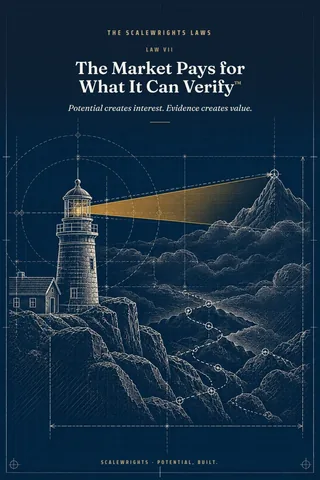
Eventually an investor, lender, board, or acquirer will ask for proof. Show me the margin, the velocity, the repeat rate, the concentration, the cash conversion, the IP. Show me the company works without you. That is why The Market Pays for What It Can Verify™. Potential may get you the meeting. Evidence gets you the value.
So build backward from value. Imagine a sophisticated buyer walked into your company three years from today. What would you want them to find? Do not wait three years to create it. Start building it now.
The Scalewrights view
Founders deserve to be optimistic. Optimism becomes powerful when you give it structure. Build the evidence, the economics, the cash engine, the team, the proof. The objective is not simply a bigger company. It is a company increasingly capable of carrying its own success.
Write down the potential — one page, today. What you believe this company can become. Not the investor version. The truth.
Write down what must be true, under eight headings. Demand, economics, cash, operations, people, relationships, intellectual capital, transferability. Separate what you know from what you believe.
Name the next proof, and design the smallest credible action that produces it this month. What is the single most important thing to prove next? Do not fund the entire dream yet. Build the next piece of evidence that earns the right to keep going.
If you cannot answer the third question clearly, start with The Page — seven components on one sheet, the founder-sized version of Hoshin Kanri, $39 on Gumroad (scalewrights.gumroad.com/l/the-page). If you know the next proof but are not sure the business has earned the investment it requires, read Operating Principle 06, Prove the next step before you fund it — the response to Law II, Capital Follows Evidence™.
Open the workbook →START — score the plan free with the First Batch Check at /first-batch.html.
Take the First Batch Check →