The Law
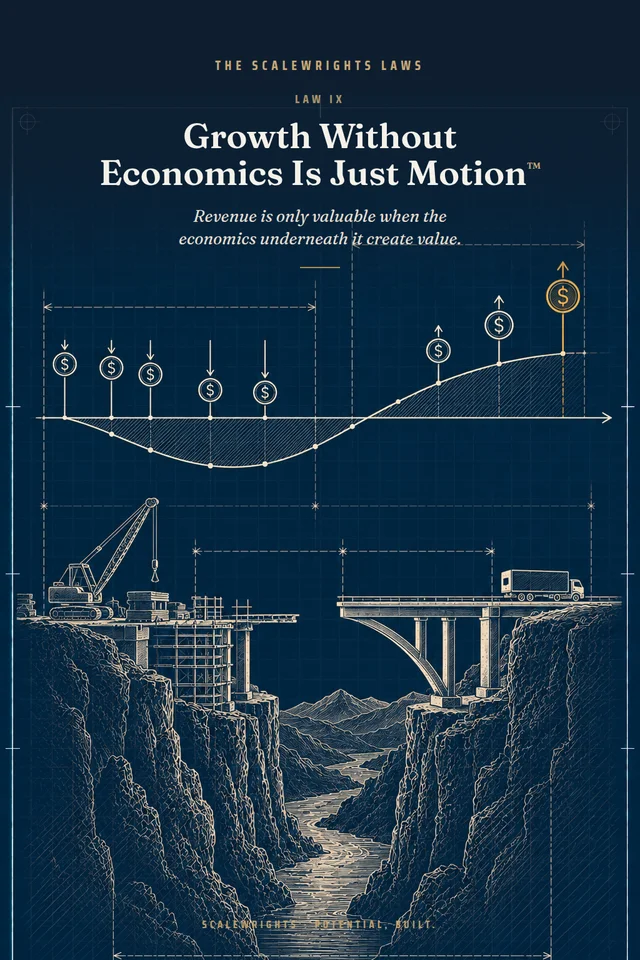
Revenue is intoxicating. The number gets larger: more retailers, more employees, more production, more recognition.
But revenue does not tell you whether the company is creating value. A company can grow revenue while margin declines, working capital expands, cash disappears, complexity increases, concentration rises, and risk climbs. The company becomes bigger, but not better.
Revenue is movement. Economic value is progress. Law IX — Motion Is Not Progress™ is the difference between the two.
I. Revenue is the beginning of the question
When someone says “we did $20,000,000,” the number is where the conversation starts. At what gross margin? At what contribution margin? With what trade spend? With what working capital? With what inventory turns? With what concentration? With what cash generation? With what return on invested capital?
Revenue alone tells you how much product moved. It does not tell you what the movement was worth.
II. The Economic Truth Stack™
Start at the shelf and walk down. Shelf price, minus retailer margin, minus distributor margin, minus trade spend, minus broker and selling expense, minus freight and logistics, minus landed COGS, equals contribution. That is the Economic Truth Stack; the number at the bottom is the first one that is yours.
Then keep asking. How much working capital did it require? How long was it tied up? What overhead did the channel need? How fast does cash come back?
III. Gross margin can lie by omission
Two channels can report the same gross margin while one requires heavy promotion, long payment terms, deductions, freight, and dedicated people to produce it.
Same reported gross margin. Different economics. Gross margin is not lying; it is answering a narrower question than the one you asked. The costs it omits are real, and they usually decide whether the channel is worth having.
IV. Contribution is closer to truth
Contribution asks what remains after every variable cost required to generate the revenue is paid: the trade, the freight, the broker, the deductions, not only the COGS.
What remains has a long list of jobs: pay the overhead, fund the growth, service the debt, produce the profit, generate the cash. If contribution is thin, none of those jobs gets done, however large the revenue above it.
V. Negative contribution does not become good through volume
“It will work at scale” is a claim, and Law VII — The Market Pays for What It Can Verify™ applies. Before accepting negative economics, know exactly what improves with volume — COGS, freight, trade, CAC, plant capacity — by how much, and when.
If the economics improve only because a spreadsheet assumes they will, the company is financing hope. Volume does not repair a losing unit; it multiplies it.
VI. Customer, SKU, and channel economics matter
Calculate true contribution by customer, by product, and by route to market, running the Economic Truth Stack for each. Averages hide the answer.
The largest customer may not be the best customer. The highest-revenue SKU may not be the best SKU. There is no universally best channel, only the ones whose contribution, capital, and cash timing fit this company now. Trap 01 — The Revenue Trap™ is the average, trusted.
VII. Cash Velocity™ changes the answer
A product with lower margin and faster capital turns can produce more annual economic output from the same dollar of working capital than a higher-margin product that sits on the shelf.
Margin matters. Velocity matters too. Cash Velocity — how fast a dollar goes out and comes back — belongs to Law III — Growth Eats Cash First™, and to this calculation as much as that one.
VIII. Return on Working Capital™
Return on Working Capital asks how much contribution the business generates relative to the working capital required to support it. Two businesses with the same contribution are not the same business if one needs twice the inventory and receivables.
Do not ask only how profitable the sale is. Ask how productive the capital behind it is. A buyer’s model will compute that number whether or not you do.
IX. Promotions and trade spend must have a return
Promotions increase volume. They do not automatically create value, and some destroy it, moving next month’s units into this month at a lower price.
Trade spend is an investment. Every dollar should say what behavior it is buying — trial, velocity, placement, awareness, or retention — and whether it worked. If nobody can answer the second question, the first was never asked.
X. CAC must connect to contribution
Return on ad spend alone can mislead. It measures revenue against media, and revenue is the number this Law refuses to take at face value.
Understand CAC, gross margin, contribution, repeat rate, retention, lifetime value, payback period, and cash requirement as one chain. A customer acquired at a loss who never returns is a cost with a receipt. Revenue without profitable customer economics is activity, not value.
XI. Repeat changes everything
First purchase proves interest. Repeat purchase begins to prove a business. A company that sells once has a customer list; a company that sells twice has a business.
Strong repeat improves lifetime value, forecasting, retailer velocity, inventory turns, and enterprise value. It is also the cheapest revenue there is; the acquisition cost was paid last time. Watch the cohort curve before the top line.
XII. Price must support the business model
Price must cover channel margin, trade, COGS, operations, innovation, marketing, working capital, and profit — every layer of the Economic Truth Stack, with room to spare.
Underpricing can be as dangerous as overpricing. An overpriced product sells slowly and tells you so. An underpriced product sells well and tells you nothing, while every unit moves the company further from covering its costs.
XIII. The Margin of Safety™
Forecasts are wrong. Ingredients rise. Freight rises. Promotions change. Retailers negotiate.
A business model that works only when every assumption is perfect is not a model; it is a hope with a spreadsheet. The Margin of Safety is economic room for ordinary variation — margin that survives a 10 percent input-cost increase, a lost promotion, a slow quarter — built in before it is needed.
XIV. The Economic Waterfall™
Revenue → gross profit → contribution → operating profit → free cash flow. The Economic Waterfall is five levels, each answering a different question. Are we selling? Does the product carry margin? Does the sale create economic room? Does the enterprise make money? Does the business produce deployable cash?
Most founders can answer the first. Few can answer the last without a pause. The pause is the diagnosis: EBITDA is not cash, and only the last level pays anyone.
XV. Quality of Revenue™
High-quality revenue looks the same wherever you find it: strong contribution, repeatability, good cash conversion, low concentration, low service burden, low promotion dependence, high strategic fit.
Low-quality revenue can be the same size. Quality of Revenue is the discipline of telling the two apart, and a buyer will do it whether or not you have. Revenue quality can matter more than revenue quantity.
XVI. The Economics Gate™
Before the next channel, customer, promotion, or run, ask: What is true net revenue? What is true contribution? What working capital is required? How quickly does it return? What fixed capacity must be added? What happens at scale? What if volume is lower? What is the alternative use?
Then choose: GO · GO SMALL · NOT YET · NOT THIS. It is the Gate with a calculator on it.
Growth is only valuable when the incremental economics justify the incremental capital, complexity, and risk required to produce it.
We believe revenue matters, and that revenue alone is insufficient.
We believe shelf price is not company economics.
We believe gross margin must survive reality.
We believe negative economics do not become good because volume increases.
We believe customer, SKU, and channel economics matter.
We believe working capital deserves a return.
We believe trade spend is an investment.
We believe repeat changes economics.
We believe price must support the business model.
We believe every business requires a Margin of Safety.
We believe EBITDA is not cash.
We believe revenue has quality, and growth should improve it.
We believe bigger and better are not synonyms.
Build the Economic Truth Stack for every channel this month, shelf price to contribution, and rank channels by the bottom line.
Compute Return on Working Capital for your three largest customers within 30 days.
Put a Margin of Safety on the price ladder before the next price decision: 10 percent on inputs and freight, and the promotion you cannot count on.
The Build Line™ Workbook carries this Law in Template seven — Management Report Pack, the P&L by channel with contribution, and Template 13 — Margin Stress Test: contribution by channel, three shocks (input cost, price move, volume) with the price band per channel, and break-even velocity under load (scalewrights.gumroad.com/l/build-line; Scale check at /build-line.html). If you are earlier, the First Batch™ Workbook’s Template two — COGS and First Price is the Economic Truth Stack at day one: the price ladder from the shelf to your bank with every margin, contribution per unit by channel, and break-even velocity per door (scalewrights.gumroad.com/l/first-batch; First Batch check at /first-batch.html).
Open the workbook →SCALE · SELL — take the Scale check at /build-line.html; a buyer rebuilds these numbers at /summit.html.
Take the Scale Readiness Check →