The Law
Growth looks like revenue. Cash experiences it differently.
A new retailer may increase sales. It may also require more inventory, production, packaging, freight, people, receivables, trade spend, and time before payment. The opportunity appears on the income statement. The obligation appears in the bank account.
Before growth returns cash, the company must finance the path that gets the product to the customer. That path is long, expensive, and paid for before the first check arrives.
I. Revenue is not cash
Suppose a company receives a $500,000 purchase order. Operationally, it has accepted a $500,000 obligation before receiving a dollar.
Before it is paid, it may fund ingredients, packaging, manufacturing deposits, testing, freight, warehousing, broker commissions, promotional allowances, insurance, and payroll. Every one of those is due before the receivable is.
Revenue measures economic activity. Cash measures survival capacity. The purchase order is worth celebrating; the bank balance pays the co-packer.
II. Profit is not cash either
A company can report a profit while its cash balance falls, because inventory, receivables, trade spend, and production deposits absorb liquidity faster than profit replaces it. The income statement says the quarter went well. The bank statement says the next run’s deposit cleared on Tuesday.
Accounting profit tells you whether the economics work. Cash flow tells you whether the company can survive long enough to benefit from them.
III. The cash conversion cycle
Follow the cash. Cash → raw materials → packaging → production → finished goods → warehouse → customer → receivable → cash.
Every step takes time. Every step can create cost. Growth amplifies the cycle because more units are traveling through it at once, and every unit in transit is a dollar not yet recovered. Map the cycle once, with the days between steps written down.
IV. The working-capital gap
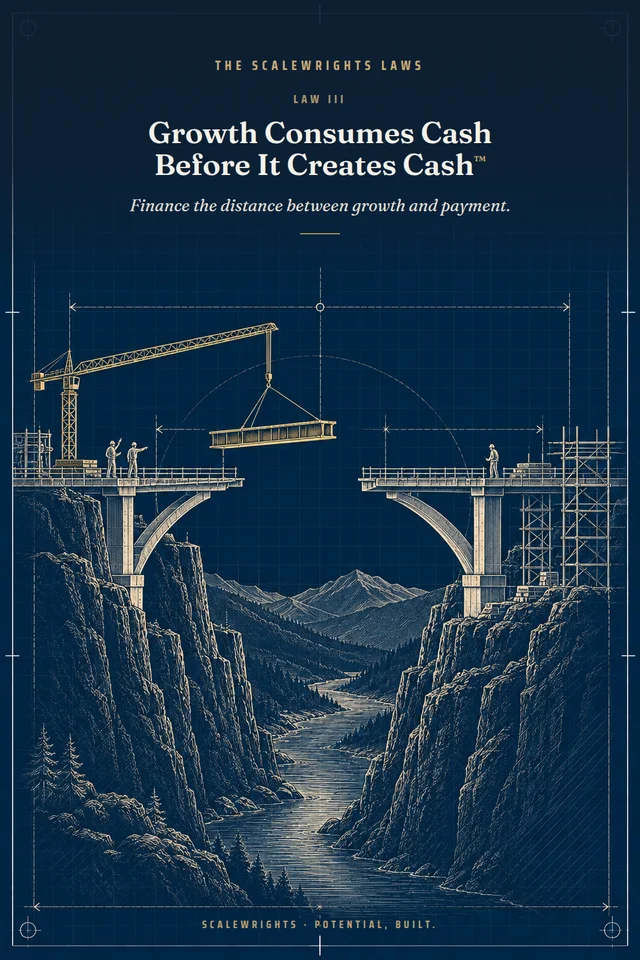
Cash leaves before cash returns. The distance between those two moments is the working-capital gap.
A growing company is usually funding the next production cycle before the previous one has converted back to cash. The faster it grows, the more cycles overlap, and the more cash is outside the building at once. Fast-growing companies can therefore need more cash than slower-growing ones.
V. Inventory is cash wearing a box
Inventory is essential, but it is also capital. Until it sells, it is illiquid, and unlike cash it can expire, get damaged, or go out of date on the label.
Too little inventory creates lost sales. Too much creates trapped capital. The objective is the right inventory at the right time against the right level of demand, and “right” is set by the evidence, not the unit price.
VI. MOQs can create false economics
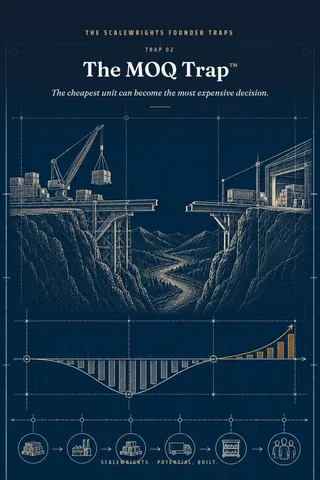
Larger runs lower the unit cost and raise the cash exposure. The co-packer’s tier pricing shows the first and not the second.
The cheapest unit can become the most expensive decision. Production quantity has to balance unit economics against demand evidence, shelf life, lead time, cash availability, forecast confidence, and reorder timing. A run that saves $0.20 a unit and ties up nine months of cash has saved nothing yet.
VII. Margin and cash flow are different problems
Healthy margins do not eliminate timing risk. If suppliers are paid in 15 days and customers pay in 60, the company must finance the 45 days in between, on every order, for as long as it grows.
A business can be profitable and underfunded. Margin decides whether the company should grow. Cash flow decides whether it can. The second question is due first.
VIII. The channel stack
Start with the shelf price. Subtract the retailer margin, the distributor margin, trade spend, broker and selling expense, freight and logistics, and landed product cost. What remains is the contribution available to the company.
Margin quality determines how much growth the balance sheet can support, because every dollar of growth rides on that contribution until the receivable clears. A stack that leaves 12 percent carries less than one that leaves 30.
IX. Payment terms are a financing decision
Net 30, Net 60, and Net 90 are financing arrangements, whoever wrote them. Payment timing changes the working-capital requirement as surely as the order quantity does.
On every deal, ask: Who gets paid first? Who gets paid last? Who is financing whom? A retailer on Net 90 with a co-packer on deposit has answered all three questions, and the answer is you.
X. Forecasting is a cash decision
A forecast tells operations what to produce. Production tells finance how much cash must be committed. The forecast is therefore the first cash decision the company makes, even when sales writes it.
Forecasts should distinguish committed, high-confidence, probable, and speculative demand, and those four categories should not receive equal inventory commitments. Building to the speculative line is optimism converted into inventory.
XI. The Working-Capital Waterline™
Every company should define a minimum liquidity threshold and defend it. That threshold is the Working-Capital Waterline.
Above the Waterline, decisions are made from strength. Below it, vendors become urgent, hiring pauses, marketing is cut, payments are delayed, financing becomes desperate, and negotiating leverage falls. Above the line, the company runs the business. Below it, the business runs the company.
XII. The 13-Week Cash Forecast
Use a rolling 13-Week Cash Forecast. Each week shows beginning cash, expected collections, and other inflows; then payroll, production, ingredients, packaging, freight, marketing, trade spend, debt service, taxes, operating expenses, and known commitments; then ending cash.
The purpose is not perfect prediction. It is early warning. A week that ends below the Waterline in week nine is a problem with nine weeks of solutions attached.
XIII. Cash Velocity™
Cash Velocity measures how quickly a dollar invested in working capital returns to the company ready to be deployed again.
Higher Cash Velocity means faster inventory turns, faster collections, shorter production cycles, better terms, and less trapped capital. Two companies with the same margin and growth rate can need very different amounts of cash, and Cash Velocity is the difference.
XIV. Growth rate is a financing decision
The faster the growth, the more working capital may be required.
A company cannot choose its growth rate independently of its financing model. Ask not only how fast we can sell, but how fast we can finance the cash cycle safely. The second answer sets the ceiling. Ignore it and you have chosen a growth rate the bank account did not agree to.
XV. The Working-Capital Stress Test™
Run the Working-Capital Stress Test on a base case, a downside case, a severe case, and an upside case. Examine ending cash, inventory, receivables, payables, production commitments, debt capacity, shelf life, covenants, runway, and required financing under each.
Demand 50 percent above plan can create an upside cash crisis if replenishment must be funded before earlier receivables are collected. That case is Law IV — Success Can Kill the Company™.
XVI. The Cash Gate™
Before the commitment, run the Cash Gate. How much cash leaves, and when? When does product become sellable? When does the customer pay? What deductions or delays should we expect? When is the next production commitment required? What is peak cash need? What happens at 75 percent, 50 percent, and 125 percent of forecast?
Then choose: GO · GO SMALL · NOT YET · NOT THIS.
XVII. Solve cash problems while they are still forecasts
A projected shortage 90 days out is a planning problem. A shortage this Friday is a crisis.
At 90 days you can negotiate, finance, slow production, change terms, raise capital, reallocate inventory, and adjust the plan. On Friday, you beg. Every instrument in this Law exists to move the discovery from Friday to 90 days out, where options still exist.
Every dollar of growth must be financed through the period between when the company spends the money and when it gets it back.
We believe revenue is not cash.
We believe profit is not cash.
We believe the timing of money matters as much as the margin on money.
We believe growth creates obligations before it creates liquidity.
We believe inventory is cash wearing a box.
We believe the cheapest unit can become the most expensive decision.
We believe payment terms are financing terms.
We believe every company needs a Working-Capital Waterline.
We believe cash problems should be visible weeks before they become emergencies.
We believe growth rate and financing strategy cannot be separated.
We believe downside and upside must both be stress-tested.
We believe the next production run matters as much as the first.
We believe the best growth opportunity is the one the company can finance without surrendering its future.
Map your cash conversion cycle this week: write down the five dates from cash out to cash in and count the days between them.
Set the Working-Capital Waterline as a dollar figure, and build a rolling 13-Week Cash Forecast that flags every week ending below it.
Before the next production commitment, run the Cash Gate at 75, 100, and 125 percent of forecast and record the peak cash need for each.
The First Batch™ Workbook, Template eight — the cash cycle and 12-month plan, builds the 12-month plan from the five dates: every cost line by the month it lands, the run, the first collection, the second run’s deposit, and the minimum-cash month — the Waterline test. It is at scalewrights.gumroad.com/l/first-batch. After the first year, the 13-Week Cash Forecast lives in The Build Line™ Workbook, Template seven — the Management Report Pack (scalewrights.gumroad.com/l/build-line).
Open the workbook →START · SCALE — this Law belongs to First Batch and The Build Line. Take the First Batch check at /first-batch.html or the Scale check at /build-line.html.
Take the First Batch Check →