Collins studied companies that made the leap from good to great and sustained it, and found the cause was never a market, a genius, or a lucky break. It was disciplined people, disciplined thought, and disciplined action — greatness as a choice, compounded, not a gift bestowed.
The first line of the book that shaped this entire firm is also its hardest: good is the enemy of great. Not failure. Not laziness. Good. The company that works well enough, sells enough, earns enough — that is the one most likely to stop climbing, because good is comfortable, and comfort is where potential goes to die quietly and on time.
Collins spent years proving that the leap from good to great is not a matter of circumstance. The great companies did not have better markets, luckier timing, or more charismatic founders. They had discipline — disciplined people, disciplined thought, disciplined action — applied relentlessly, long after the results would have satisfied anyone reasonable. Greatness, he found, is largely a choice, and a repeated one.
◆Discipline is the root, and the root can be measured
This is where Scalewrights picks up the thread. Collins was the researcher — he documented what great companies do from the outside, with a rigor almost no one brings to it. Our work lives on the other side of that glass: to take what he observed and build an instrument to measure it, so that a founder can see, driver by driver, where the company is disciplined and where it is merely good. That is what the Scalability Quotient is — greatness made gradable.
Because you cannot fix what you refuse to measure, and “we’re doing pretty well” is the most dangerous sentence in business. It is the anesthetic that lets a good company stay good for a decade while a disciplined competitor quietly builds the great one. The score exists to interrupt that comfort — to name the gap between good and great in numbers you cannot argue with.
◆First who, then the flywheel
Two of Collins’s findings run through everything we build. First who, then what — get the right people on the bus before you decide where to drive it, because a great strategy in the hands of the wrong team is just an expensive opinion. And the flywheel — greatness is not a single dramatic push but a heavy wheel turned consistently in one direction until momentum becomes unstoppable. There is no miracle moment. There is only the next disciplined turn, and the one after that.
Refuse, too, what Collins called the tyranny of the or — the false choice between profit and purpose, discipline and creativity, today and tomorrow. Great companies live in the genius of the and. They build value now and build to last. That refusal to choose is not indulgence; it is the discipline of holding two hard things at once, and it is exactly the standard we hold a company to before it goes to market.
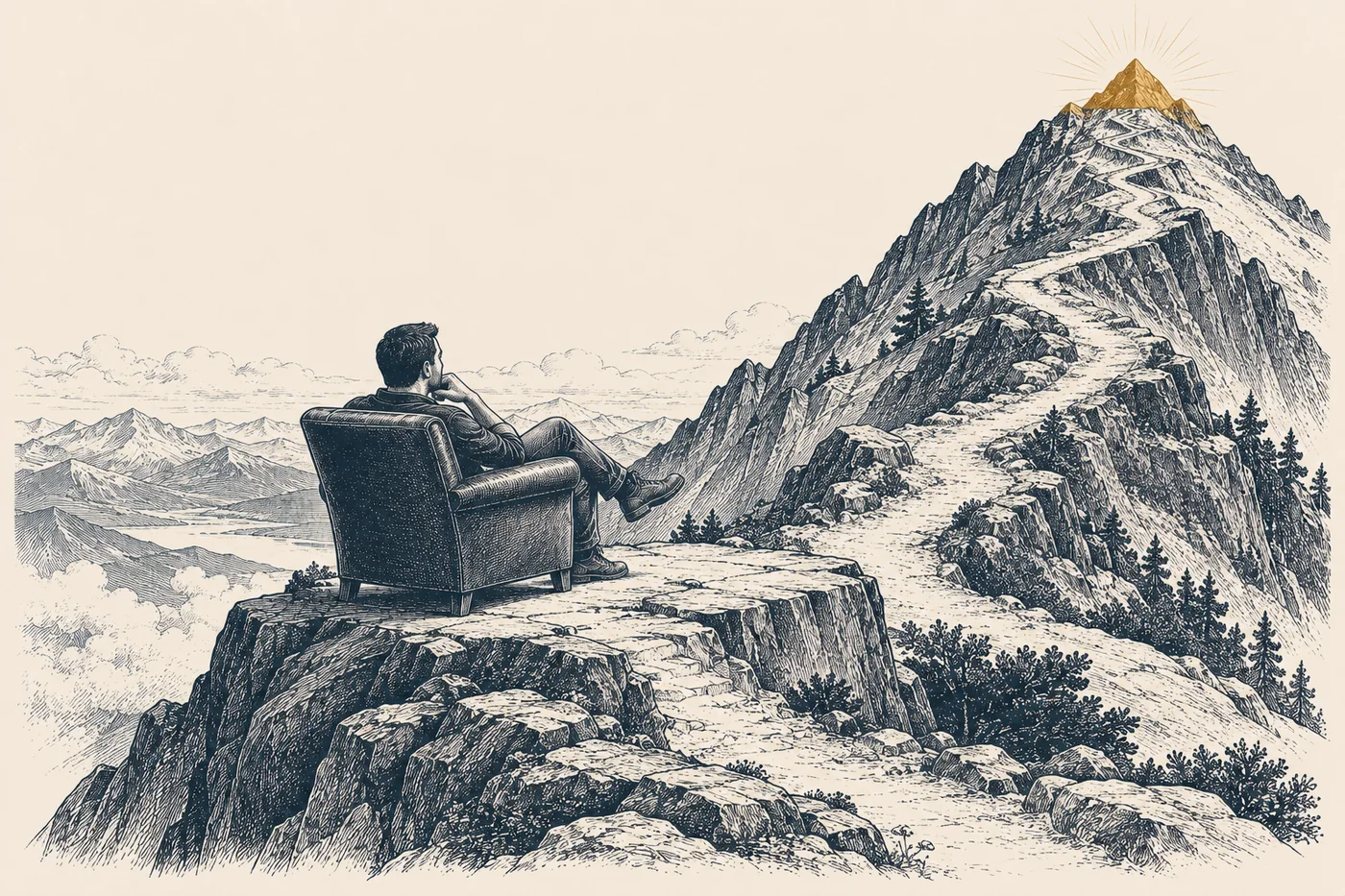
- Good is the enemy of great — and comfort is the ceiling we’re paid to break.
- Greatness is a choice, not a circumstance. Disciplined people, thought, and action, repeated.
- First who, then what. The right team on the bus before the map.
- Turn the flywheel. No miracle moment — just the next disciplined turn, compounding.