Lencioni maps team failure as a pyramid: an absence of trust breeds fear of conflict, which breeds a lack of commitment, which breeds avoidance of accountability, which breeds inattention to collective results. Every dysfunction above rests on the one below — and the whole structure stands or falls on the base: trust.
Lencioni tells his story as a fable, but the structure underneath it is ruthless engineering. Five dysfunctions, stacked like a pyramid, each one resting on the failure below it. And at the very bottom — the foundation that decides whether everything above it stands — is a single thing: trust. Not the warm kind. The kind where people are willing to be wrong in front of each other.
Here is the pyramid, bottom to top. Without trust, people guard themselves, so there is no honest conflict — just polite agreement that hides real disagreement. Without conflict, there is no true commitment, because people don’t buy into decisions they were never able to challenge. Without commitment, there is no accountability, because no one holds peers to a plan they don’t own. And without accountability, the team drifts to inattention to results — everyone protecting their status while the company quietly loses. Pull the bottom brick and the whole thing is a performance.
◆Why this is a valuation issue, not just a culture issue
Founders file “team dynamics” under soft stuff — the thing HR worries about. A buyer does not. A buyer knows that the leadership team is what they are actually acquiring, and they read it fast: in whether people will disagree in the room, in whether the second-in-command can finish a thought without checking the founder’s face, in whether accountability is real or theatrical. A team riddled with these dysfunctions is key-person risk wearing a suit, and it gets priced accordingly.
This is why we treat the health of the leadership team as a hard asset in the Re-Rate 180, not a footnote. A company where the team trusts enough to fight well, commit fully, and hold each other accountable is a company that can run without the founder — which is precisely the thing that commands a premium. The pyramid is not about feelings. It is about whether the machine works when you leave the room.
◆Trust is built on purpose, not by accident
The hopeful part of Lencioni’s model is that trust is not a personality trait you either have or don’t. It is built — through leaders who go first in showing weakness, through conflict that is structured rather than avoided, through commitments made explicit and accountability made routine. It is uncomfortable work, and it is exactly the kind of unglamorous foundation-laying that turns a group of talented individuals into a team a buyer would pay to keep.
So we start at the bottom brick. Fix the results without fixing the trust and you have rearranged the theater. Build the trust, and everything above it — the honest arguments, the real commitment, the peer accountability — finally becomes load-bearing.
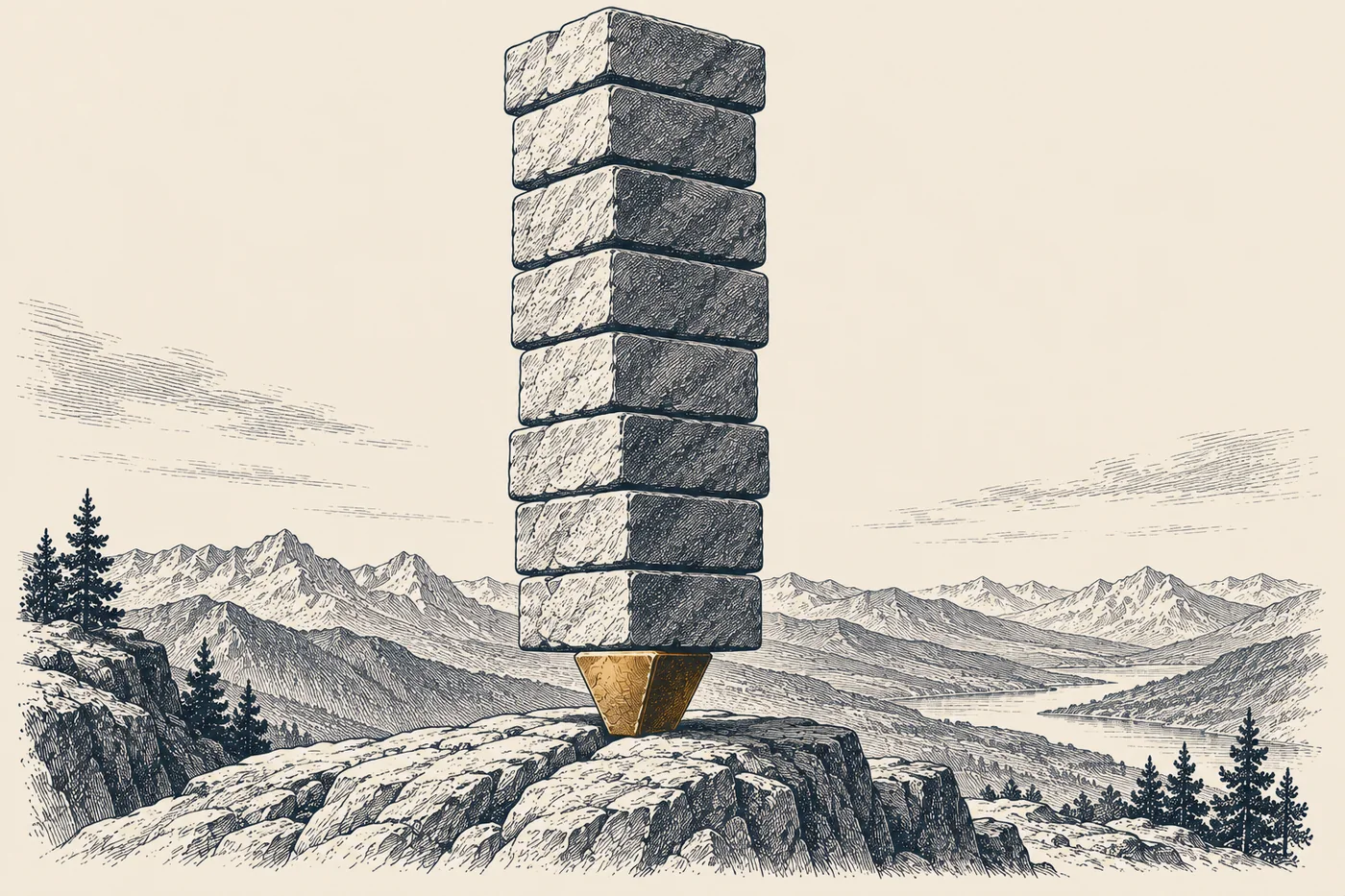
- Trust is the foundation. Every dysfunction above it is downstream of its absence.
- Healthy conflict is a feature, not a threat — polite agreement hides the real risks.
- A dysfunctional team is key-person risk in a suit, and buyers price it hard.
- Trust is built on purpose: leaders go first, conflict gets structured, accountability gets routine.