The Trap
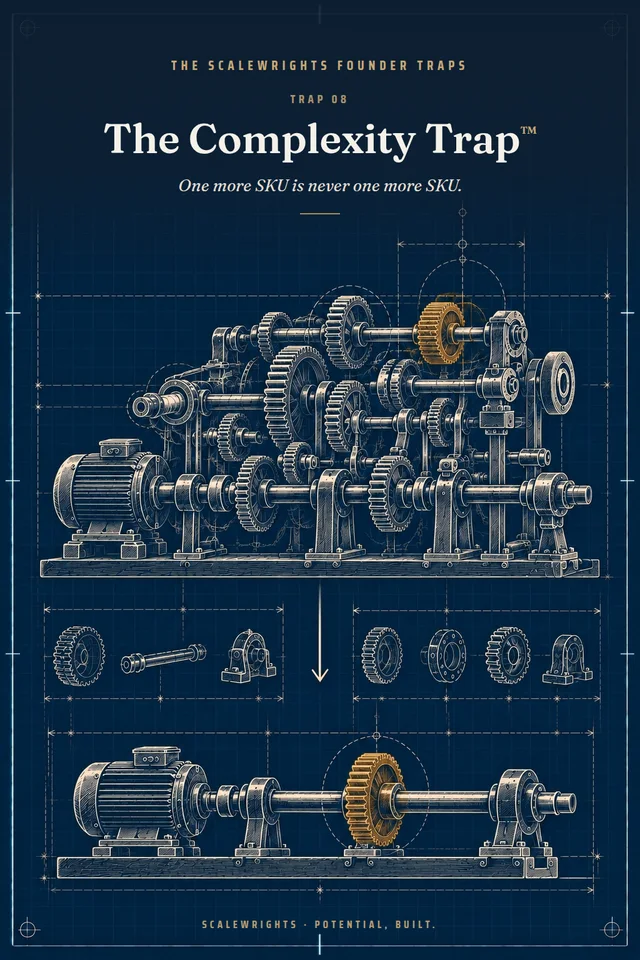
The buyer says the line needs more than one facing to hold the shelf. The distributor says a second flavor would help him open the accounts that passed on the first. Your own customers say they would love a berry. All three are telling the truth, and each flavor is one decision that makes sense on its own. The Complexity Trap™ is the company nobody designed, built one reasonable decision at a time.
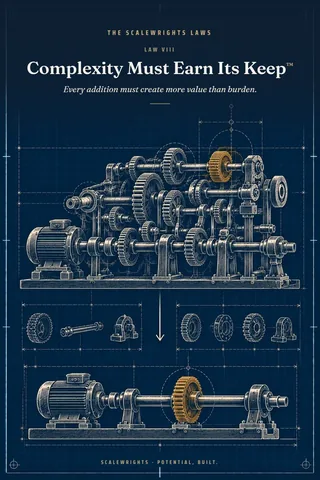
Law VIII — Complexity Must Earn Its Keep™ — says that one more SKU is never one more SKU. It is another formula, another label and UPC, another MOQ, another forecast, another inventory position, another production changeover, another shelf-life clock, another way to be out of stock, and another way to write something off. That is the Complexity Shadow™, and it does not appear on the line review where the flavor was approved.
The trap is that additions feel like growth and are counted as growth, while the burden lands in places nobody is counting: the planner’s week, the warehouse’s picking, the changeover cost, the cash in four inventory positions instead of one. The company gets 3 percent larger and feels 100 percent more complicated, and the feeling is the accurate one.
The tell
- You have four SKUs and one of them is 70 percent of the units.
- The newest flavor’s first run is still in the warehouse after its second reorder date has passed.
- Nobody can say the contribution per SKU after inventory carry and changeover.
- Every line review adds one and none has ever removed one.
- The forecast is four forecasts now, and each is worse than the one you had.
The arithmetic
An energy shot with one SKU, 1,000 doors, and a velocity of 6.0 units per door per week. The company adds three flavors. Demand does not quadruple. It splits.
| SKU | Velocity (units/door/week) | Units a year | Weeks one 25,000-unit run lasts | Cash in one run at $1.45 |
|---|---|---|---|---|
| Original | 4.4 | 228,800 | 5.7 | $36,250 |
| Berry | 0.9 | 46,800 | 27.8 | $36,250 |
| Citrus | 0.6 | 31,200 | 41.7 | $36,250 |
| Mint | 0.3 | 15,600 | 83.3 | $36,250 |
| Four SKUs | 6.2 | 322,400 | $145,000 |
Before: 312,000 units a year and one inventory position. After: 322,400 units — up 3.3 percent — and four positions. Original lost 1.6 units a week to its own siblings. Mint’s first run lasts 83 weeks against a 78-week shelf life, so 1,600 units expire before the run is gone, and that is the good case, because Mint will lose its facing before that. Citrus is 42 weeks of stock; the plant will want the same 25,000 again.
Add the Complexity Tax™: three more changeovers a cycle at about $2,500 each; three more labels to keep compliant; three more safety stocks; three more lines on every distributor’s price list and every retailer’s planogram; three more numbers to forecast, each with less data than the one before. And the shelf: four facings where there was one means the retailer is giving you the space, and the day Berry runs at 0.9 the buyer takes it back — sometimes with Original’s second facing attached.
Score each on the SKU Burden Score™: revenue, contribution, velocity, turns, working capital, forecast accuracy, shelf-life risk, complexity, strategic importance. Original is the Hero SKU™. Berry might earn its keep. Citrus and Mint are burden with a label on it. Hypo Energy launched Decaf in April 2025 and killed it in September. Five months is a good time to know.
The fix
Law VIII’s rule is that every addition must create more value than burden, and the burden has to be counted in all five capitals. Put every element on the Complexity Ledger™ — SKUs, customers, channels, exceptions, meetings — and ask three questions of each: What value does this create? What does it consume? Would we add it today, knowing what we know?
Run the Complexity Gate™ before the next flavor: What value? What complexity? What working capital? Can we get 80 percent of the value with 20 percent of the complexity — a second flavor, not three? What do we remove if we add it? That last question is the Addition/Subtraction Rule™, and it is the muscle most companies never build. Practice deletion once a quarter, on purpose.
The Gate answer this usually produces is NOT THIS for two of the three, and GO SMALL for one — a single second flavor, one run, in the doors where Original runs above 5.0, with a Stop Rule written down before the label is printed. Principle 01 — Potential, Built.™ — asks what each addition has been converted into. A flavor that has been converted into 83 weeks of stock has not been built. It has been ordered.
Build the Complexity Ledger this month: every SKU, customer, channel, and standing exception, with value, burden, and a yes or no on “would we add it today.”
Score every SKU on the nine lines of the Burden Score and kill or merge the bottom two by the next line review.
Adopt the rule for 12 months: no addition without a named subtraction on the same page.
The Build Line™ Workbook’s Template 13, 13_Margin_Stress_Test.xlsx, carries contribution by channel and break-even velocity under load — run it by SKU and the tail shows itself. Template 7, 07_Management_Report_Pack.xlsx, holds doors times velocity, where a fourth SKU’s 0.3 becomes visible every month. Before the second flavor is ordered at all, the First Batch™ Workbook’s Template 1, 01_First_Batch_Plan.xlsx, runs the MOQ, the run-out, and the cash tied up for the new SKU as if it were a first batch, because it is. Start with the check at /build-line.html.
SCALE — this trap belongs to The Build Line. Take the check at /build-line.html.
Take the Scale Readiness Check →