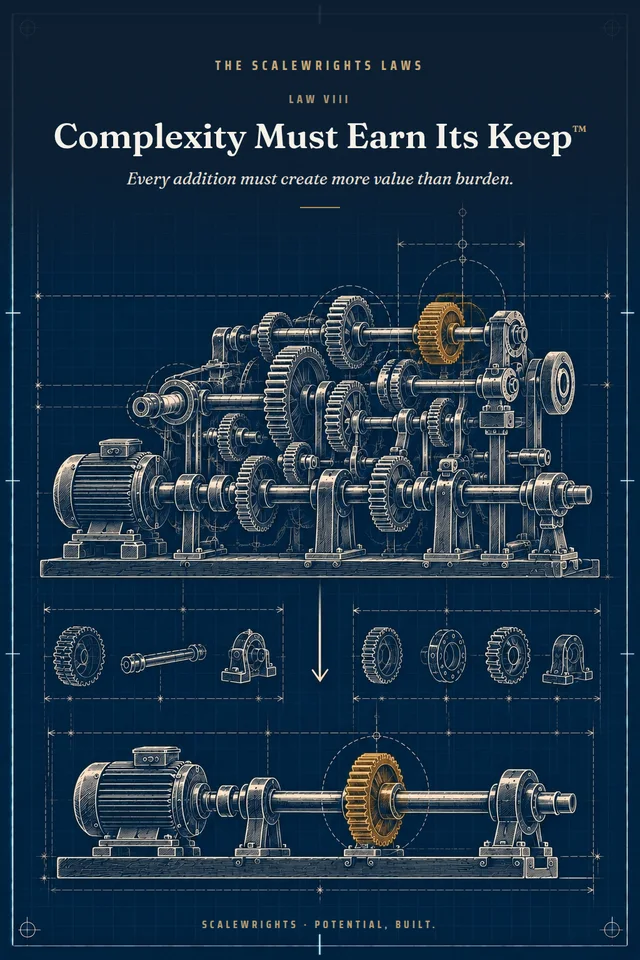
The Law
Companies rarely become complicated all at once. They become complicated one reasonable decision at a time: one more SKU, flavor, retailer, distributor, country, employee, meeting, report, or exception. Each makes sense by itself. Together they produce a company nobody designed.
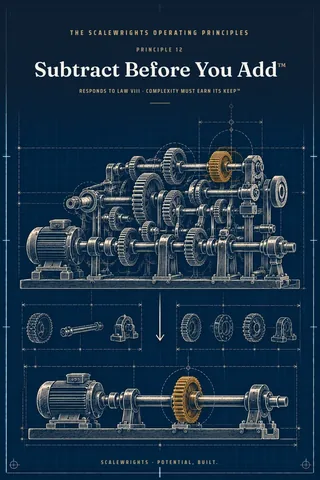
Complexity is not automatically bad, but it is never free. Every addition consumes some combination of Financial, Operating, Relational, Human, and Intellectual Capital. So the question is not “does this create revenue?” but “does the incremental value justify the incremental burden?” That is Law VIII — Complexity Must Earn Its Keep™.
I. Every addition creates a shadow
One new flavor looks like one addition. Its shadow is another formula, ingredient profile, label, UPC, forecast, MOQ, inventory position, production slot, quality specification, shelf-life clock, sales story, stockout risk, and write-off risk.
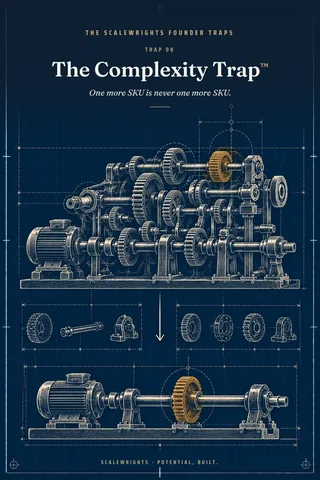
The difference between the addition you see and the burden it casts is the Complexity Shadow™. One more SKU is never one more SKU. Count the shadow first.
II. Complexity compounds
Complexity does not grow in a straight line, because the pieces interact. SKUs multiply against retailers, warehouses, suppliers, promotions, regions, forecasts, and production schedules. Add a flavor and a retailer and you have added every combination of them.
That is why a company can grow 30 percent while management feels complexity grew 100 percent. The feeling is not wrong. It is the arithmetic.
III. The Complexity Tax™
The Complexity Tax is the total burden of keeping one more element of the business alive and working.
It is paid in management attention, working capital, forecasting effort, inventory, training, technology, meetings, quality control, warehousing, changeovers, reporting, customer service, regulatory work, and decision time. None of it appears on the P&L under a line called “complexity.” All of it is paid.
IV. The Complexity Ledger™
List the major elements consuming organizational capacity: SKUs, customers, channels, markets, suppliers, systems, meetings, reports, projects, and policies.
For each, ask three questions. What value does this create? Which of the Five Capitals does it consume? Would we add it today, knowing what we know now? The Complexity Ledger is the list with the answers beside it. The third answer is usually the one that moves something.
V. SKU proliferation is a CPG trap
Line extensions look like growth. They fragment demand, divide inventory, raise working capital, raise forecasting error, raise obsolescence, and add production complexity — whether or not the new item sells.
A company can expand its portfolio while weakening its economic engine. The shelf looks fuller; the company is thinner. Trap 08 — The Complexity Trap™ is this section with a founder in it.
VI. The Hero SKU™ and the SKU Burden Score™
Every portfolio has Hero SKUs, the few products creating most of the value. Most also have a tail that lives on the heroes’ margin.
Score each SKU on revenue, contribution margin, velocity, inventory turns, working-capital requirement, forecast accuracy, shelf-life risk, operational complexity, and strategic importance; that is the SKU Burden Score. Revenue ranks the portfolio wrong. The score ranks it by what each item earns net of what it costs to carry.
VII. Customers, channels, and geographies create complexity too
Some customers create constant exceptions, slow payments, custom packaging, and low margins, and the revenue line never shows it. Each channel is a different operating system with its own terms and rhythm. Each geography adds regulation, language, currency, freight, contracts, pricing, and forecasting.
None of that is a reason not to expand. It is a reason to price the expansion in full. Every expansion must pay for the complexity it creates.
VIII. People can add complexity faster than capacity
Every employee adds capacity. Every employee also adds communication, management, coordination, training, and decision interfaces — with you and with everyone else.
Headcount is not capacity; Trap 06 — The Hiring Trap™ is built on that sentence. The test for each hire is whether the person removed more burden than they created. Good hires pass it within a quarter. Wrong hires make the company busier.
IX. Exceptions are expensive
Special pricing, special packaging, special payment terms, special shipping, a special production run, a special commission: each creates an alternate version of the operating system that someone has to remember, run, and reconcile.
Some exceptions are worth it. Most are the residue of a conversation nobody wanted to have. Every exception should create exceptional value or disappear. Count yours this week.
X. Complexity Debt™
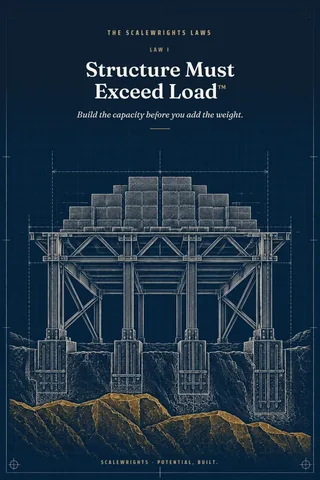
Complexity Debt is the burden of additions the company has never simplified, standardized, integrated, or removed. Like Structural Debt™ in Law I — Structure Must Exceed Load™, it carries interest.
The interest is paid in slower decisions, higher working capital, more mistakes, more meetings, more people, lower margins, more founder intervention, and more frustration. Nobody sends an invoice. The payments are made anyway.
XI. Standardize the repeatable
Whenever something happens repeatedly, ask whether it can be standardized, automated, templated, or eliminated. The order matters: eliminate first, then template, then automate, and only then accept that it stays.
Repeated problems are usually asking for a system. A founder solving the same problem for the fifth time has been given four chances to build one, and has declined each of them.
XII. Simplicity creates speed, cash, quality, and clarity
Fewer SKUs, fewer priorities, cleaner decision rights, fewer systems, and less variation all pay out in the same places: faster decisions, easier training, higher inventory turns, more cash, better quality, and a strategy people can repeat.
Complexity is easy to create; anyone can add. Clarity is hard, because it requires someone to say no, and then to keep saying it.
XIII. The Addition/Subtraction Rule™
Every meaningful addition should trigger the same question: what can now be removed?
New system? Retire an old one. New meeting? Cancel another. New SKU? Review the tail. New initiative? Stop something else. The rule does not forbid growth. It keeps the count honest, so that the company that adds 10 things a year is also one that removed a few.
XIV. The Deletion Muscle™
Every quarter, ask what should stop, be discontinued, automated, standardized, consolidated, or no longer require approval. Put the answers on a list with owners and dates, like any other plan.
Organizations become good at what they practice. Most practice addition. Few practice deletion. The Deletion Muscle is built the same way as any other: by using it on a schedule.
XV. Zero-Based Complexity™
Ask one question of everything you own: if we were building this company today from zero, would we recreate this?
Apply it to products, people, processes, systems, customers, meetings, reports, and policies. Zero-Based Complexity has no respect for how something got here. Legacy is not justification. “We have always done it this way” describes the debt; it does not defend it.
XVI. Productive complexity
The goal is not minimal complexity. Some complexity creates resilience — a second source, a second channel. Some creates capability, defensibility, options, and enterprise value. A company with one SKU and one customer is simple and fragile.
The goal is productive complexity: complexity that earns its place. The test is not “is this complicated?” It is “does it pay its way?”
XVII. The Complexity Gate™
Before the addition, ask: What value does this create? What complexity? Which of the Five Capitals does it consume? What is the working-capital impact? What coordination does it require? What happens if we do not add it? Can we get 80 percent of the value with 20 percent of the complexity? What can we remove if we add it?
Then choose: GO · GO SMALL · NOT YET · NOT THIS. It is the Gate, pointed at the tail.
Every addition to the company must create enough incremental value to justify the financial, operating, relational, human, and intellectual burden it creates.
We believe complexity is not free.
We believe companies become complicated one reasonable decision at a time.
We believe every addition creates a Complexity Shadow and pays a Complexity Tax.
We believe revenue can hide burden.
We believe SKUs, customers, channels, and geographies should earn their complexity.
We believe employees should add more capacity than coordination.
We believe exceptions should create exceptional value.
We believe Complexity Debt compounds.
We believe simplicity creates speed, cash, and quality.
We believe every addition should invite subtraction.
We believe legacy is not justification.
We believe the goal is the simplest company capable of delivering the strategy.
Score every SKU on the SKU Burden Score this month and name the tail: the bottom 20 percent net of burden.
Retire, merge, or automate three things — a SKU, a meeting, an exception — before next quarter.
Run the Complexity Gate on the next addition before approval; write down what goes if it stays.
The Build Line™ Workbook carries this Law in Template six — Process Register, the processes that carry the company, written by the person who runs them and tested by a stranger, with the pass rate beside it — where the repeatable gets standardized — and in Template nine — Concentration Map: revenue and contribution by payer and channel, share against a threshold, contract terms, and the cut plan by quarter. Template 13 — Margin Stress Test supplies the contribution by channel a SKU Burden Score starts from. All at scalewrights.gumroad.com/l/build-line; Scale check at /build-line.html.
Open the workbook →SCALE — this Law belongs to The Build Line. Take the Scale check at /build-line.html.
Take the Scale Readiness Check →