The Law
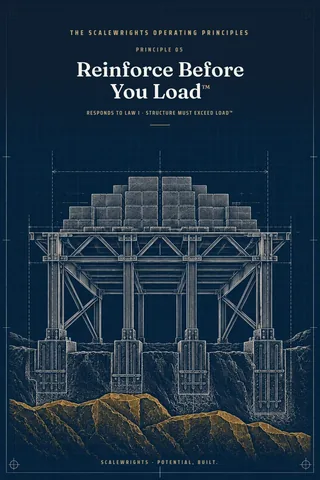
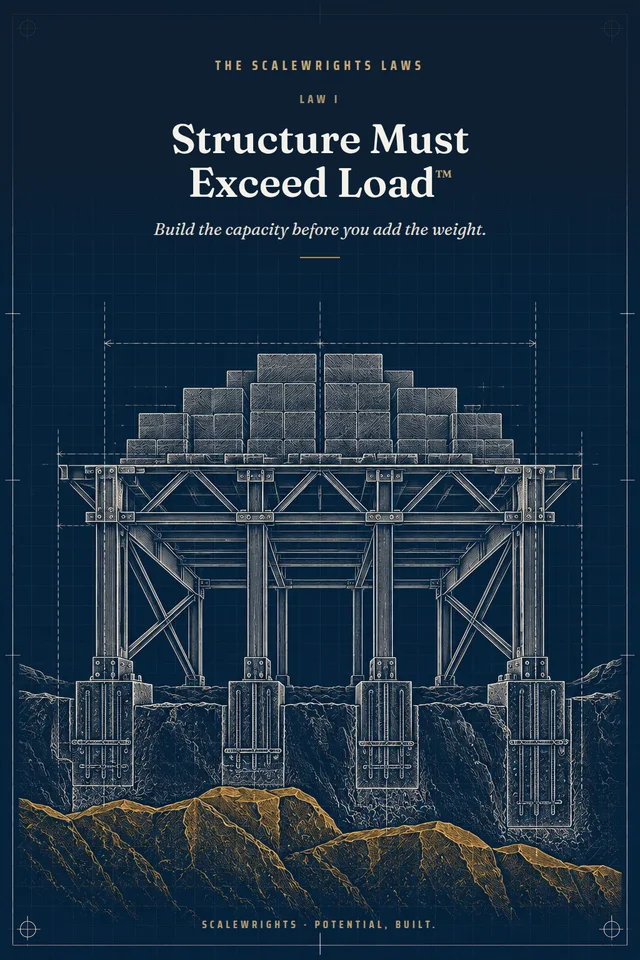
Every structure has a limit. A bridge, a building, a shelf, a supply chain, a leadership team, a balance sheet, a company.
You can place weight on a structure for a long time without knowing where its limit is. A little more. Nothing happens. A little more. Still nothing. Then one more load arrives, and something breaks.
The final load gets blamed. But the structure was already carrying more than it could safely support.
Companies behave the same way. A founder adds another retailer, another SKU, another production run, another $5,000,000 of revenue. For a while the company carries it: people work harder, the founder gets involved, problems are solved by hand. Underneath, load is accumulating faster than structure. Eventually something gives, and the sudden failure was years in the making.
I. Growth adds weight
Growth is usually described in positive terms: more revenue, more customers, more distribution, more employees, more products, more markets. Operationally, every one of those adds weight.
A new retailer does not merely add revenue. It adds forecasting, inventory, production, receivables, deductions, reporting, promotions, freight, customer service, and working capital. A new SKU adds ingredients, packaging, scheduling, quality requirements, warehouse locations, sales materials, data, and obsolescence risk.
The question is not how much growth the company can create. It is how much growth the current structure can safely carry.
II. Growth and scale are not the same thing
Growth means becoming larger. Scale means becoming larger without becoming proportionately more fragile.
A company can grow without scaling. Revenue moves from $2,000,000 to $5,000,000 to $12,000,000 while headcount triples, inventory balloons, margins decline, the founder works more, cash gets tighter, and decisions slow down.
That is growth, not scale. True scale creates operating leverage: more economic activity without an equivalent increase in complexity, capital, people, and founder intervention.
III. The load is often invisible
Physical structures make load obvious. A truck weighs something. A steel beam has a rating. Business load is harder to see.
A founder adds a national retailer. The purchase order shows $1,000,000. The hidden load appears elsewhere: incremental inventory, another production slot, packaging commitments, larger freight bills, longer receivable cycles, EDI requirements, retailer-specific reporting, promotional allowances, deductions, broker support, and management attention.
The founder sees $1,000,000 of revenue. The organization experiences $1,000,000 of revenue plus a bundle of obligations. Law III — Growth Eats Cash First™ follows that bundle to the bank account.
IV. Heroics mask weak structure
Early companies rarely have great systems. They have great people. Someone notices the inventory count is wrong and fixes it. Someone calls the co-manufacturer personally. Someone rebuilds the spreadsheet at midnight.
Heroics are remarkably effective at small scale. That is why they are dangerous. They create the illusion that the system works. It does not; the people are compensating for it.
If the company requires extraordinary effort to produce ordinary outcomes, it does not have a strong operating system. It has committed people carrying structural debt.
V. Structural Debt™
Technology companies talk about technical debt. Every company accumulates Structural Debt: the work it knows it should have done but postponed because the workaround still functions. That work is inventory discipline, documented process, clean financial reporting, stronger supplier structure, clear decision rights, management cadence, and leadership depth.
Every new layer of growth gets built on that unresolved weakness. Structural Debt compounds, and the interest shows up as mistakes, rework, expedited freight, lost margin, employee frustration, poor forecasting, founder dependency, and lower enterprise value. None of it is itemized on an invoice, which is why it is easy to keep borrowing.
VI. The Five Capitals are the structure
Scalewrights evaluates readiness through the Five Capitals: Financial, Operating, Relational, Human, and Intellectual (FORHI).
Financial Capital is cash, working capital, debt capacity, margin, runway, and access to financing. Operating Capital is manufacturing, supply chain, quality, process, technology, data, forecasting, and logistics. Relational Capital is suppliers, manufacturers, distributors, retailers, customers, advisors, and investors. Human Capital is leadership, capability, accountability, decision rights, succession, and management depth. Intellectual Capital is consumer, formulation, channel, and regulatory knowledge, operating data, and intellectual property.
They are not separate from the company’s structure. They are the structure, and the weakest critical capital sets the company’s true limit.
VII. The Load Test
Before adding meaningful load, run the Load Test. What load are we actually adding? Where will it land? Which capital is most likely to become the constraint? What happens if the load is greater than expected? What happens if the economic return is lower than expected?
The five questions are asked before the commitment, not after the problem. A leadership team can answer them in an afternoon, and a team that cannot has already learned something.
VIII. Success is a Load Test
Founders naturally fear failure. They should also prepare for success.
Every growth plan needs a downside test and an upside test. The downside asks whether the company can survive if demand disappoints. The upside asks whether it can perform if demand exceeds expectations: the second run, the second retailer, the reorder that arrives before the first invoice is paid.
A company that can survive only its forecast has not built sufficient structure. Law IV — Success Can Kill the Company™ is this section at full length.
IX. Structural Reserve™
Structural Reserve is the difference between what the organization can safely carry and what it is carrying now.
If safe capacity is 100 and current load is 60, reserve is 40. If load rises to 95, reserve falls to 5. The company still functions, but one late shipment is enough to break it.
Read critical systems in Green, Yellow, and Red zones. Green means meaningful reserve. Yellow means capacity is tightening. Red means add no meaningful load until the constraint is addressed. The Red Zone is not a judgment on the team. It is a reading on the structure.
X. The Gate
The Gate exists to protect the company from momentum. Before a major growth step, ask whether the evidence is sufficient, the Five Capitals are ready, the structure can carry the load, and the downside and upside strain have been tested. Law II — Capital Follows Evidence™ owns the first question; this Law owns the rest.
The decision is one of 4: GO · GO SMALL · NOT YET · NOT THIS. Go Small is a legitimate scaling strategy, not a loss of nerve. Not Yet is a date. Not This saves the most money when given early.
XI. The Structure–Load Loop™
Identify the next load. Map the obligations. Test the Five Capitals. Identify the constraint. Build the required structure. Pass the Gate. Add load. Measure. Build Structural Reserve. Repeat.
Structure → load → evidence → stronger structure → more load.
Structure should lead load, but not by a mile. Capacity built years ahead of demand is an empty building; capacity built after demand arrives is a collapse. The Structure–Load Loop keeps structure one step ahead.
XII. The Monday morning structure test
Gather the leadership team. Write down the five largest loads expected in the next 12 months. For each, ask: What new obligations does this create? Which of the Five Capitals carries them? What is our current safe capacity? Where are we already in Yellow or Red? What must be strengthened before the load arrives? Who owns that work, and by what date? What evidence will demonstrate readiness? When will we run the Gate?
It takes a morning, and the answers are the agenda for the next quarter.
A company earns the right to carry more only after it has built the capacity to carry more.
We believe growth adds weight.
We believe revenue hides obligations.
We believe growth and scale are not the same thing.
We believe a company should become stronger as it becomes larger.
We believe heroics can conceal weak systems.
We believe Structural Debt compounds.
We believe the absence of failure does not prove the presence of capacity.
We believe the Five Capitals form the structure of the enterprise.
We believe every major growth opportunity deserves a Load Test.
We believe upside strain deserves as much preparation as downside risk.
We believe headcount is not the same thing as capacity.
We believe Go Small is a legitimate scaling strategy.
We believe structure should lead load — but not by a mile.
We believe the Gate exists to protect the company from its own momentum.
We believe the founder’s job is not simply to create growth. It is to build something capable of carrying growth.
Write down the five largest loads arriving in the next 12 months and, for each, the capital that carries it and the person who owns it.
Rate every critical system Green, Yellow, or Red this week, and add no load to anything in Red until the fix has an owner and a date.
Run the Gate on the next growth decision before the commitment, and record the answer: GO, GO SMALL, NOT YET, or NOT THIS.
The Build Line™ Workbook, Template one — the SQ Scorecard, measures the Five Capitals as condition and capacity across 80 items and reports the three lowest factors: your Structural Reserve, by capital, on one page. Template 17 — Capital Readiness (the Law I test) puts structure against load before an offer of capital is accepted. Both are in The Build Line Workbook at scalewrights.gumroad.com/l/build-line.
Open the workbook →SCALE — this Law belongs to The Build Line. Take the Scale check at /build-line.html.
Take the Scale Readiness Check →