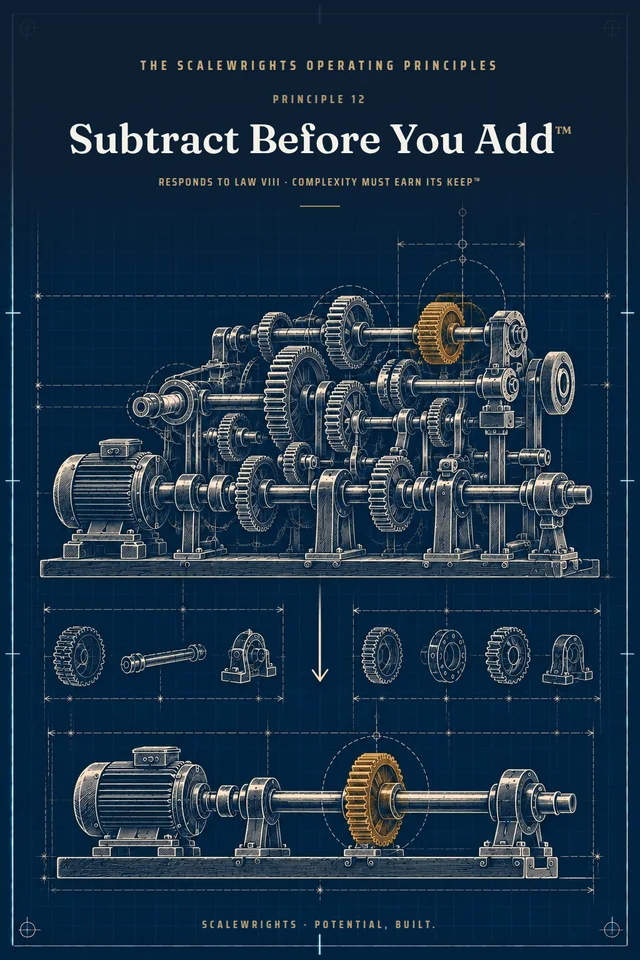
The Principle
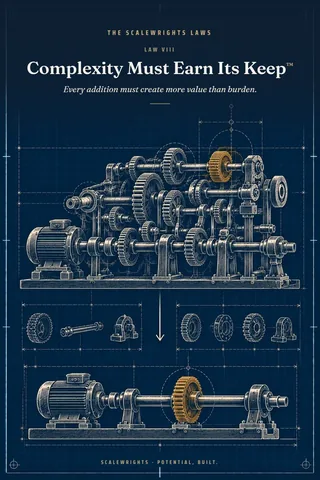
This is how I want you to operate under Law VIII — Complexity Must Earn Its Keep™: before you add the next thing, ask what it will cost to carry, and ask what leaves to make room for it.
No founder sets out to build a complicated company. It happens one reasonable decision at a time. A retailer asks for a second size. A distributor wants a display pack. A good salesperson lands a customer who needs custom labeling. A new market needs a new certification, a new freight lane, a new price list. Each decision is defensible on its own. Together they produce a company that is bigger on the shelf and thinner underneath, with more meetings, more inventory, more forecasting error, and less cash than the revenue line suggests.
I want the company to grow. I want the growth to be lighter than it looks, not heavier.
Price the shadow before you say yes
Every addition casts a Complexity Shadow™: the attention, working capital, forecasting effort, inventory, training, changeovers, reporting, quality control, and decision time it takes to keep one more element of the business alive. None of it appears on the P&L under a line called “complexity.” All of it is paid, in every one of the Five Capitals.
So price it before the decision, not after. A new SKU is not one more SKU. It is a second forecast, a second safety stock, a second changeover, a second set of labels and claims to keep compliant, a second thing for the co-packer to get wrong, and a share of everyone’s Tuesday. Write that list down beside the projected revenue. Most additions survive the comparison. Some do not, and those are the ones that would otherwise have been approved.
Keep the Complexity Ledger™
List the major elements consuming the company’s capacity: SKUs, customers, channels, markets, suppliers, systems, meetings, reports, projects, and policies. For each, answer three questions. What value does it create? Which of the Five Capitals does it consume? Would we add it today, knowing what we know now?
The third answer is the one that moves something. A surprising share of what a company carries is there because it was once a good idea, and nobody has been asked since. The Ledger is where they get asked.
Score the portfolio by what it earns net of what it costs to carry
Revenue ranks a portfolio wrong. It puts the SKU that sells $400,000 with nine months of shelf life, three changeovers, and a 30 percent forecast error above the one that sells $250,000 with none of that.
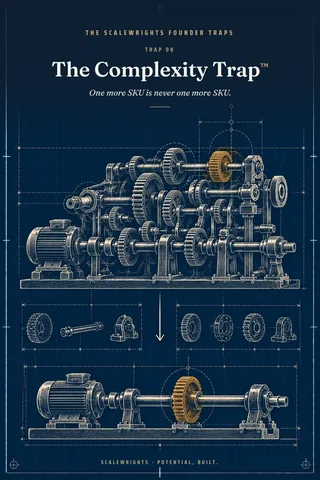
Score every SKU instead on the SKU Burden Score™: revenue, contribution, velocity, inventory turns, working capital required, forecast accuracy, shelf-life risk, operational complexity, and strategic importance. Then look at the bottom 20 percent. That is the tail, and it lives on the margin of the Hero SKUs™ above it. Trap 08 — The Complexity Trap™ is what happens when nobody looks. Customers, channels, and geographies get the same score; the customer with constant exceptions and 75-day terms is a tail item wearing a revenue number.
Take something out when something comes in
The Addition/Subtraction Rule™ is simple to state and hard to keep: every meaningful addition triggers the question of what can now be removed. New SKU, review the tail. New system, retire an old one. New meeting, cancel another. New initiative, stop something.
The rule does not forbid growth. It keeps the count honest. A company that adds ten things a year and removes none is not growing; it is accumulating, and the accumulation compounds into Complexity Debt™ that someone pays later at a worse rate.
Practice deletion on a schedule
Organizations become good at what they practice. Most practice addition. Almost none practice deletion, which is why the Deletion Muscle™ has to be built deliberately: once a quarter, ask what should stop, be discontinued, automated, standardized, consolidated, or no longer need an approval. Put the answers on a list with owners and dates, like any other plan, and report on it like any other plan.
The first quarter is uncomfortable. By the third, the company has retired a dozen things nobody misses, and the people who run the place have found the time that the additions had been taking.
Ask the zero-based question of everything
If we were building this company today, from zero, would we recreate this? Ask it of products, people, processes, systems, customers, meetings, reports, and policies. Zero-Based Complexity™ has no respect for how something got here. Legacy is not justification. “We have always done it this way” describes the debt. It does not defend it.
Standardize the repeatable so exceptions stay exceptional
Complexity hides in exceptions: the one customer with a different invoice format, the one retailer with its own pallet spec, the one SKU that ships from the other warehouse. Every exception is a small process nobody wrote down, running on the memory of one person.
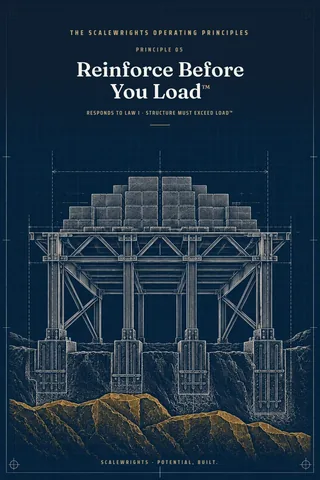
Standardize whatever repeats. Then hold exceptions to a higher bar: an exception should create exceptional value, or it should become the standard, or it should go. Operating Principle 05 — Reinforce Before You Load™ says build the structure before the weight arrives. This Principle is its companion: do not add weight the structure was never built to carry.
Run the Complexity Gate™
Before the addition, ask: What value does this create? What complexity? Which of the Five Capitals does it consume? What is the working-capital impact? What coordination does it require? What happens if we do not add it? Can we get 80 percent of the value with 20 percent of the complexity? What can we remove if we add it?
Then GO, GO SMALL, NOT YET, or NOT THIS. GO SMALL is the common answer: the second size in one channel, the display pack for one account, the new market through one distributor. The addition earns its place in a small version before it is allowed to become a large one.
The Scalewrights view
The goal is not the simplest possible company. A company with one SKU and one customer is simple and fragile. Some complexity buys resilience, a second source, a second channel, a defensible position. The goal is the simplest company capable of delivering the strategy, and every element of it able to answer the question: does this pay its way?
Subtract before you add. The company that can retire what stopped earning is the company that can afford what comes next.
Score every SKU on the SKU Burden Score this month and name the tail: the bottom 20 percent net of burden, with what each one costs the heroes.
Retire, merge, or automate three things before next quarter: a SKU, a meeting, an exception. Give each an owner and a date.
Run the Complexity Gate on the next addition before approval, and write down what leaves if it stays.
The Build Line™ Workbook carries this Principle in Template 6, 06_Process_Register.xlsx, where the repeatable gets standardized and tested by a stranger, and Template 9, 09_Concentration_Map.xlsx, revenue and contribution by payer and channel with the cut plan by quarter. Template 13, 13_Margin_Stress_Test.xlsx, supplies the contribution by channel a SKU Burden Score starts from (scalewrights.gumroad.com/l/build-line). If you are earlier, the First Batch™ Workbook’s Template 3, 03_Co-Packer_Comparison_and_Run.xlsx, is where a second SKU’s changeover and minimum run first show their shadow (scalewrights.gumroad.com/l/first-batch).
SCALE — this Principle belongs to The Build Line. Take the Scale Readiness Check at /build-line.html.
Take the Scale Readiness Check →