My whole life I have been keenly aware of the power of a person’s energy — the thing people reach for the word vibration to describe, for want of a better one. I want to be around people who see opportunity where others see obstacle. I want to be around people who make me want to be a better man than I am. So I have built my circle deliberately, and kept it tight: friends and colleagues who bring energy into a room rather than take it out.
That is not sentiment, and it is not a preference about personalities. After a career of building companies, advising executives and sitting at boardroom tables, I have come to think of it as a measurement.
The question underneath is not soft. What happens to a room when this person walks into it? Do people get more candid, or more careful? Does this person create momentum, or consume it? Do people leave with more clarity than they came in with, or more doubt?
That is not a mood. It is a property of the company, and it carries a price.
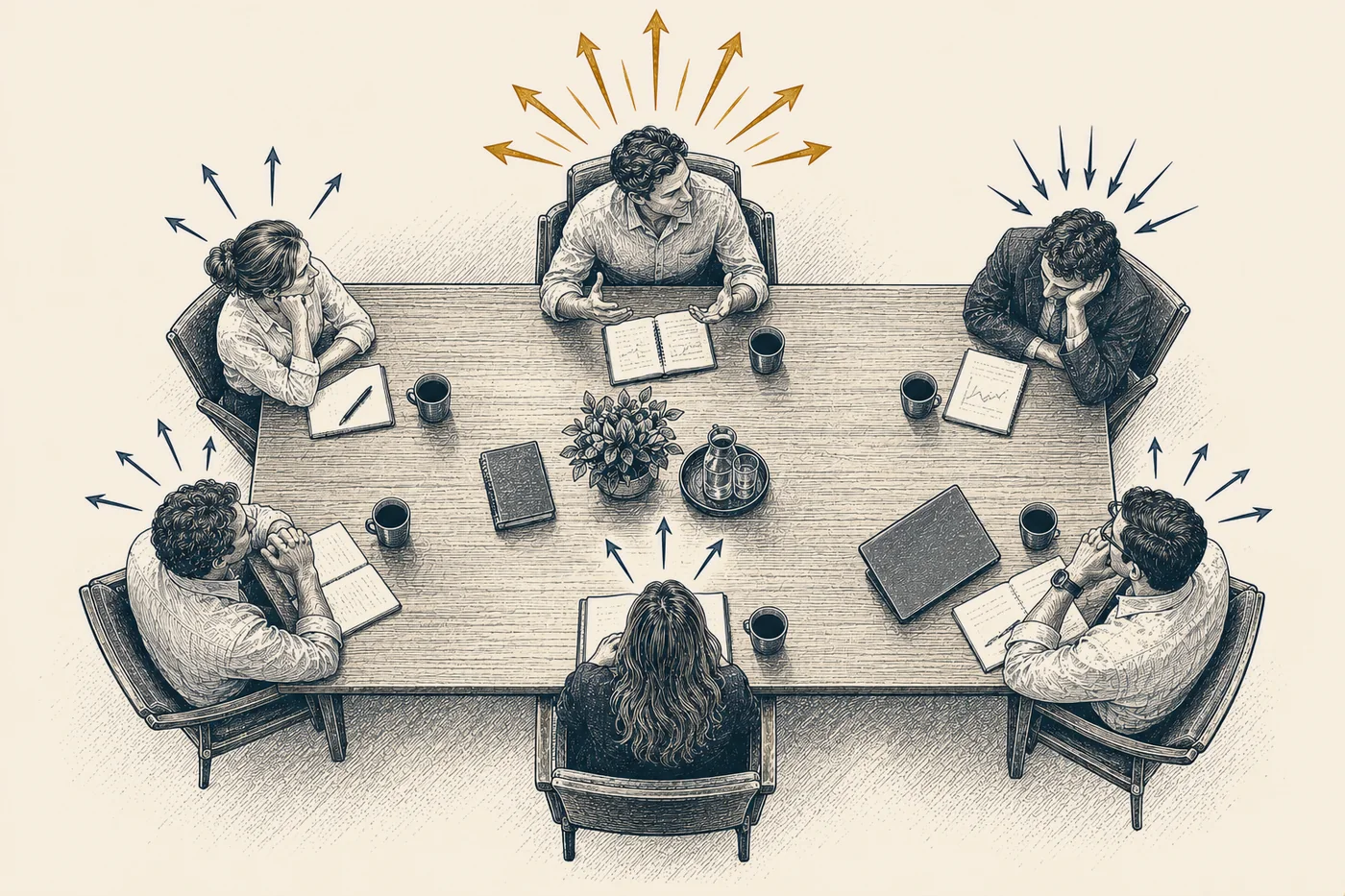
◆A leader transmits a state
We feel leadership before we analyze it. People read one another unnervingly well — interest and indifference, confidence and insecurity — usually before a word has been said.
So a leader transmits far more than a strategy. A leader transmits a state. Walk in anxious and defensive and the organization has that information within the hour. Walk in prepared, curious and steady, and it has that instead.
This has been run as an experiment. Thomas Sy, Stéphane Côté and Richard Saavedra put leaders into a positive or a negative mood — using nothing more than an eight-minute film clip before the session — then handed their groups a task. The leader’s mood moved into the group. Positive-mood leaders produced a more positive affective tone and measurably better coordination. And here is the finding that keeps me honest: the groups with negative-mood leaders worked harder. They read the negativity as a signal that more effort was required. So this is not a case for relentless positivity. A leader transmits, and the group acts on what it receives — which is a heavier responsibility than being upbeat.
None of which argues for manufactured optimism, the easiest thing in any room to detect. Good energy is the ability to confront reality without draining possibility from it. The strongest leaders I have worked beside can deliver genuinely bad news and leave people more determined than before. They do not minimize the problem. They leave intact the belief that it can be solved.
◆The tax nobody invoices
Energy does not stay where it is spent. One person’s posture reaches five people; those five carry a residue into their next conversations. A founder’s Tuesday morning is through the building by Wednesday.
Stephen Covey called this the Emotional Bank Account. In The 7 Habits of Highly Effective People he put it plainly: make deposits through “courtesy, kindness, honesty, and keeping my commitments to you” and you build a reserve; make enough withdrawals and the account is overdrawn. Every interaction is one or the other, and they compound.
I would add a line to his. Do not be the person who bounces checks with people because there is nothing left to draw from. The reserve is built long before the day you need it — and that day is the only one on which anyone finds out whether it is there.
Which is why the most expensive people in a company are rarely the incompetent ones. They are the talented net withdrawals — capable, productive, sometimes indispensable on paper, and followed everywhere by friction. People rehearse before speaking to them. Information stops moving freely. Meetings turn political — and the political meeting is the one where the real problem never gets raised.
That is the energy tax, and it never appears as a line item. It is paid in the question nobody asked, the problem that surfaced a month later than it should have, and the good person who left quietly, giving a different reason. By the time it shows up in a number, it has been charged for years.
Rob Cross and Karen Dillon gave the small version of this a name in The Microstress Effect: the tiny, individually trivial transmissions between people that never rise to the level of a problem worth raising, and quietly accumulate into one. That is the exact shape of the tax. No single interaction is worth an invoice. The total is enormous.
◆Why this sounds like The Secret, and why it is not
I should deal with this directly, because the moment you say energy in a business setting, half the room hears The Secret — thoughts emitting a frequency that attracts matching circumstances into your life. I do not believe that, and the harder thing a psychologist is obliged to say out loud is that the logic implies the sick attracted their illness. That is not merely unscientific. It is cruel to the people who most need it not to be true.
But tens of millions of people did not buy that book for no reason. They bought it because it named something they had felt their whole lives and had never had a word for: some people change a room, and some people close one. It got the mechanism wrong and the observation exactly right.
The mechanism is not metaphysical. It has been measured. In Sigal Barsade’s study at Wharton, a trained drama student was placed inside managerial work groups carrying one of four moods — varied by pleasantness and by energy level — and conveying it through nothing but nonverbal behavior: smiling, eye contact, rate of speech, posture. The mood spread. Cooperation rose, conflict fell, and the group’s rated performance on the task improved. The participants had no idea a mood had been introduced at all — one suspected a confederate, and his data was thrown out. She called it the ripple effect.
Nobody in those rooms attracted anything. One person brought a state, and the state traveled.
And it does not stop at mood. Brad Owens, Wayne Baker, Dana Sumpter and Kim Cameron built and validated a measure of what they call relational energy — the vitality a person actually experiences in their interactions with one specific other human being. Then they tested it where it counts. The relational energy employees experienced with their leader predicted their engagement a month later, and their job performance later still. It held while controlling for perceived social support, and for the quality of the leader relationship itself. Energy was not standing in for those things. It was its own variable, and it moved the output.
So when I say a person is a net withdrawal, I am not describing a feeling I have about them. I am describing a measurable input to how everyone around them performs.
◆Energy is not charisma
The word invites the wrong picture. Good energy is not volume, extroversion, humor, or relentless enthusiasm. Some of the steadiest energy I have encountered belongs to notably quiet people.
It comes from somewhere else. They are totally comfortable in their own skin, not trying to be something they are not. They listen. They are not spending the meeting demonstrating their own importance, which leaves room for everyone else to think and disagree. That room is the asset. The freedom to say the awkward thing is how a company finds out what is actually wrong while it is still cheap to fix.
◆Select for character. Train for skill.
I have carried one idea for twenty‑five years, since I first read First, Break All the Rules. Buckingham and Coffman’s opening key is select for talent — on the logic that skills and knowledge can be taught and the deeper recurring patterns cannot. I have always said it with one word changed, and the word matters: select for character, train on skill and knowledge. That formulation is mine, not theirs. I will defend it anyway. Skill is a curriculum. Knowledge is a syllabus. Character arrived before you did.
And energy is part of character. Not adjacent to it — part of it. Energy is character made observable, which is why it is the first thing you meet in a person and the last thing you will ever change.
So here is the hard stance: a person cannot fake their energy. They can certainly try. Some perform positivity, which reads as loud. Some perform humility, which is harder to catch and worse when you miss it. But a performance costs something to hold, and every performance has a seam. You only have to know where to press.
The research on this is unusually clean. Alicia Grandey separated two things people do with emotion at work: surface acting, which changes the face, and deep acting, which changes the actual feeling. Then she had their coworkers rate them. Surface acting was rated worse by the people around them — the performance did not merely fail to land, it registered as a deficit — and it was the only one of the two associated with stress in the person doing it. Deep acting rated better and cost nothing. Faking is both detectable by others and expensive to the faker. That is the seam.
Three conversations do it. None is a trick question, and none of them is about energy.
“Tell me about someone who got better while they worked with you. Not someone you hired well — someone who grew.”
Listen for a name and for detail: what they were bad at, the moment it turned, where they are now. Someone who actually raises people remembers all of it, and their energy rises while describing a person who is not in the room. Performed humility deflects into a philosophy of coaching, or credits “the team” without producing a single human being. The talented net withdrawal tells a story that bends back to their own judgment in spotting the talent. You cannot invent specific detail about another person’s growth unless you were paying attention to it — and the attention is the deposit. The detail is only the receipt.
“Walk me through the hardest six months of your career. Not how it resolved — the middle of it.”
The second sentence is the entire test. Manufactured positivity cannot stay in the middle; it sprints for the lesson learned, because the lesson is the safe part. Ask again and hold them there. You are not assessing whether they suffered gracefully. You are watching whether they can hold a bad reality in front of you without draining the room — and whether, at the end of it, you feel more willing or less willing to look at your own hard thing.
“Tell me about someone you genuinely could not work with. What was it actually like?”
“I get along with everybody” is not an answer, it is an evasion — everyone has one. What matters is where the energy goes once they do answer. Some people are pleasant for an hour and then arrive fully — lit up, precise, finally themselves — the moment they get to be aggrieved. That is the tell, and it is the most useful thing you will learn all day, because grievance is the one subject on which people forget to perform. The person you want describes the friction without recruiting you into it, and names their own part in it without being asked.
None of which is evidence. It is where to look.
◆Why I do not trust my own read
Here is the honest problem with everything above. Good energy is also how bias gets in. The people whose presence feels easy to us are usually the people who resemble us, and culture fit has been the polite name for a great deal of poor hiring. A criterion you assess by how you feel will quietly reproduce you.
I am trained as an industrial-organizational psychologist — the discipline that studies how executives are actually selected — so I know what my own instinct is worth. It is worth a great deal as a signal about where to look. It is worth nothing as evidence.
That gap is why I built Executive Diligence. When a board is making the most expensive hire it will make this decade, the last thing that should decide it is how the finalist made the room feel across two hours. Charisma interviews beautifully, and so does a candidate who happens to resemble the panel.
So the work is structured instead: a behavioral interview, a written read on real strengths and the risks a résumé hides, and a clear hire, hold, or pass call the board can stand behind. Evidence rather than a vibe check — including mine.
The test I trust is not do I enjoy this person. That is about me. The test is whether other people get better around them — observable, in people who are not you. Does the quiet one speak? Does the difficult thing get said while it is still early?
◆Composition is a capital decision
Who sits at a table is not a social question. Who partners. Who takes equity. Who joins the board. A company can hold the right strategy, the right money and the right market and still destroy value because of who is in the room — and the reverse happens too.
Energy substitutes for nothing — not diligence, not competence, not evidence. It is data: the kind that arrives before the evidence, and tells you where to look.
- Energy is an asset, not a mood. It shows up in the quality of what people are willing to say to you.
- Confront reality without draining possibility. The problem stays hard; the belief that it is solvable stays intact.
- Watch other people, not yourself. Do they get better around this person? That is observable. Enjoyment is not evidence.
- Then verify it properly. A signal tells you where to look. A structured assessment tells you what is there.
Everything in this piece that is not my own opinion is sourced here.
Barsade, S. G. (2002). The ripple effect: Emotional contagion and its influence on group behavior. Administrative Science Quarterly, 47(4), 644–675.
Grandey, A. A. (2003). When “the show must go on”: Surface acting and deep acting as determinants of emotional exhaustion and peer-rated service delivery. Academy of Management Journal, 46(1), 86–96.
Owens, B. P., Baker, W. E., Sumpter, D. M., & Cameron, K. S. (2016). Relational energy at work: Implications for job engagement and job performance. Journal of Applied Psychology, 101(1), 35–49.
Sy, T., Côté, S., & Saavedra, R. (2005). The contagious leader: Impact of the leader’s mood on the mood of group members, group affective tone, and group processes. Journal of Applied Psychology, 90(2), 295–305.
Buckingham, M., & Coffman, C. (1999). First, Break All the Rules: What the World’s Greatest Managers Do Differently. Simon & Schuster.
Byrne, R. (2006). The Secret. Atria Books / Beyond Words.
Covey, S. R. (1989). The 7 Habits of Highly Effective People. Free Press.
Cross, R., & Dillon, K. (2023). The Microstress Effect: How Little Things Pile Up and Create Big Problems — and What to Do about It. Harvard Business Review Press.